

684
Y. Rasyid
collaboration to design, and implement NGO interventions to improve the livelihood
conditions of the Bajau Ubian community.
4 Research Methodology
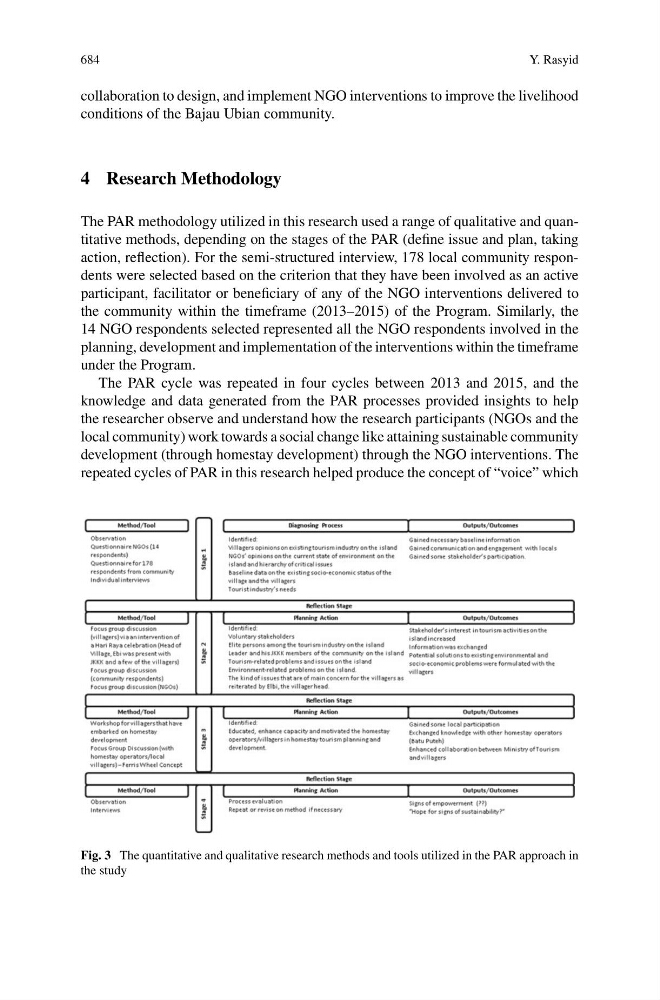
The PAR methodology utilized in this research used a range of qualitative and quantitative methods, depending on the stages of the PAR (define issue and plan, taking
action, reflection). For the semi-structured interview, 178 local community respondents were selected based on the criterion that they have been involved as an active
participant, facilitator or beneficiary of any of the NGO interventions delivered to
the community within the timeframe (2013–2015) of the Program. Similarly, the
14 NGO respondents selected represented all the NGO respondents involved in the
planning, development and implementation of the interventions within the timeframe
under the Program.
The PAR cycle was repeated in four cycles between 2013 and 2015, and the
knowledge and data generated from the PAR processes provided insights to help
the researcher observe and understand how the research participants (NGOs and the
local community) work towards a social change like attaining sustainable community
development (through homestay development) through the NGO interventions. The
repeated cycles of PAR in this research helped produce the concept of “voice” which
Fig. 3 The quantitative and qualitative research methods and tools utilized in the PAR approach in
the study