

Education for Sustainable Development: The STEM …
581
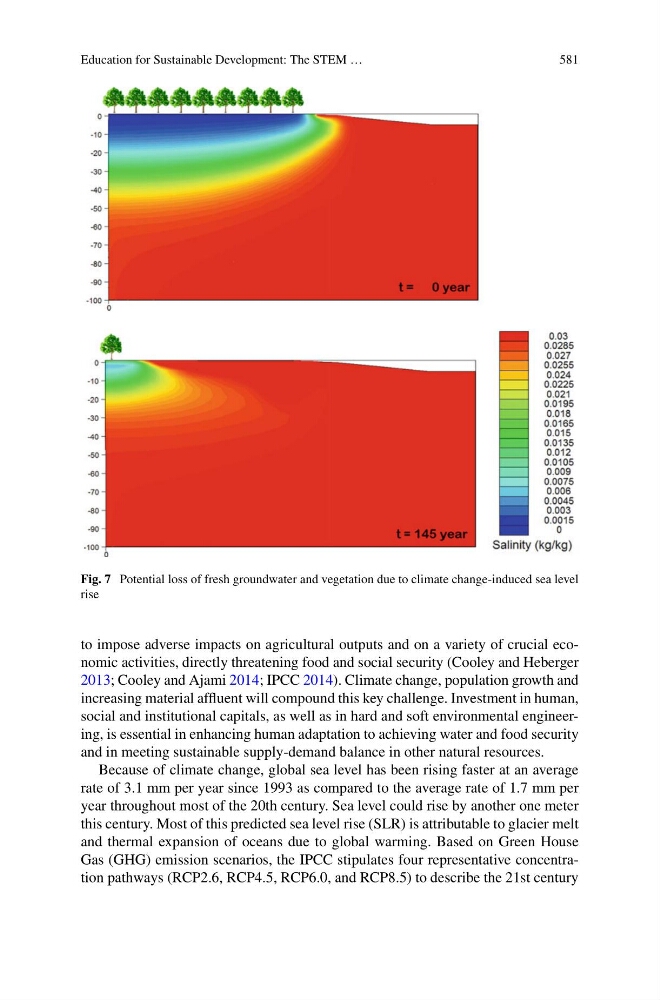
Fig. 7 Potential loss of fresh groundwater and vegetation due to climate change-induced sea level
rise
to impose adverse impacts on agricultural outputs and on a variety of crucial economic activities, directly threatening food and social security (Cooley and Heberger
2013; Cooley and Ajami 2014; IPCC 2014). Climate change, population growth and
increasing material affluent will compound this key challenge. Investment in human,
social and institutional capitals, as well as in hard and soft environmental engineering, is essential in enhancing human adaptation to achieving water and food security
and in meeting sustainable supply-demand balance in other natural resources.
Because of climate change, global sea level has been rising faster at an average
rate of 3.1 mm per year since 1993 as compared to the average rate of 1.7 mm per
year throughout most of the 20th century. Sea level could rise by another one meter
this century. Most of this predicted sea level rise (SLR) is attributable to glacier melt
and thermal expansion of oceans due to global warming. Based on Green House
Gas (GHG) emission scenarios, the IPCC stipulates four representative concentration pathways (RCP2.6, RCP4.5, RCP6.0, and RCP8.5) to describe the 21st century
581
Fig. 7 Potential loss of fresh groundwater and vegetation due to climate change-induced sea level
rise
to impose adverse impacts on agricultural outputs and on a variety of crucial economic activities, directly threatening food and social security (Cooley and Heberger
2013; Cooley and Ajami 2014; IPCC 2014). Climate change, population growth and
increasing material affluent will compound this key challenge. Investment in human,
social and institutional capitals, as well as in hard and soft environmental engineering, is essential in enhancing human adaptation to achieving water and food security
and in meeting sustainable supply-demand balance in other natural resources.
Because of climate change, global sea level has been rising faster at an average
rate of 3.1 mm per year since 1993 as compared to the average rate of 1.7 mm per
year throughout most of the 20th century. Sea level could rise by another one meter
this century. Most of this predicted sea level rise (SLR) is attributable to glacier melt
and thermal expansion of oceans due to global warming. Based on Green House
Gas (GHG) emission scenarios, the IPCC stipulates four representative concentration pathways (RCP2.6, RCP4.5, RCP6.0, and RCP8.5) to describe the 21st century