

Education for Sustainable Development: The STEM …
571
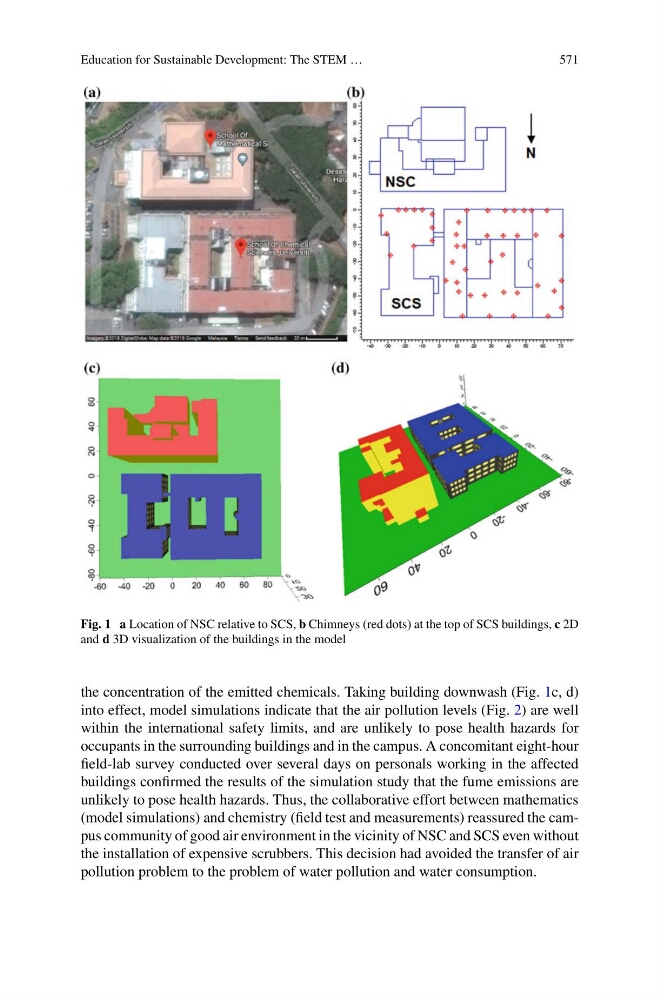
Fig. 1 a Location of NSC relative to SCS, b Chimneys (red dots) at the top of SCS buildings, c 2D
and d 3D visualization of the buildings in the model
the concentration of the emitted chemicals. Taking building downwash (Fig. 1c, d)
into effect, model simulations indicate that the air pollution levels (Fig. 2) are well
within the international safety limits, and are unlikely to pose health hazards for
occupants in the surrounding buildings and in the campus. A concomitant eight-hour
field-lab survey conducted over several days on personals working in the affected
buildings confirmed the results of the simulation study that the fume emissions are
unlikely to pose health hazards. Thus, the collaborative effort between mathematics
(model simulations) and chemistry (field test and measurements) reassured the campus community of good air environment in the vicinity of NSC and SCS even without
the installation of expensive scrubbers. This decision had avoided the transfer of air
pollution problem to the problem of water pollution and water consumption.
571
Fig. 1 a Location of NSC relative to SCS, b Chimneys (red dots) at the top of SCS buildings, c 2D
and d 3D visualization of the buildings in the model
the concentration of the emitted chemicals. Taking building downwash (Fig. 1c, d)
into effect, model simulations indicate that the air pollution levels (Fig. 2) are well
within the international safety limits, and are unlikely to pose health hazards for
occupants in the surrounding buildings and in the campus. A concomitant eight-hour
field-lab survey conducted over several days on personals working in the affected
buildings confirmed the results of the simulation study that the fume emissions are
unlikely to pose health hazards. Thus, the collaborative effort between mathematics
(model simulations) and chemistry (field test and measurements) reassured the campus community of good air environment in the vicinity of NSC and SCS even without
the installation of expensive scrubbers. This decision had avoided the transfer of air
pollution problem to the problem of water pollution and water consumption.