

554
J. Jodoin and J. Singer
3 Results
The “Subtopics commonly found in ESD” were coded as outlined in Table 1. There
were several sample texts that used two topics, such as a unit entitled “The Footprint
of Fun,” which was coded with both PO (pollution) and UoR (Use of Resources), as
the unit dealt with the idea of humans creating pollution such as plastic waste and
then talked about ways of recycling and composting. The results of this analysis are
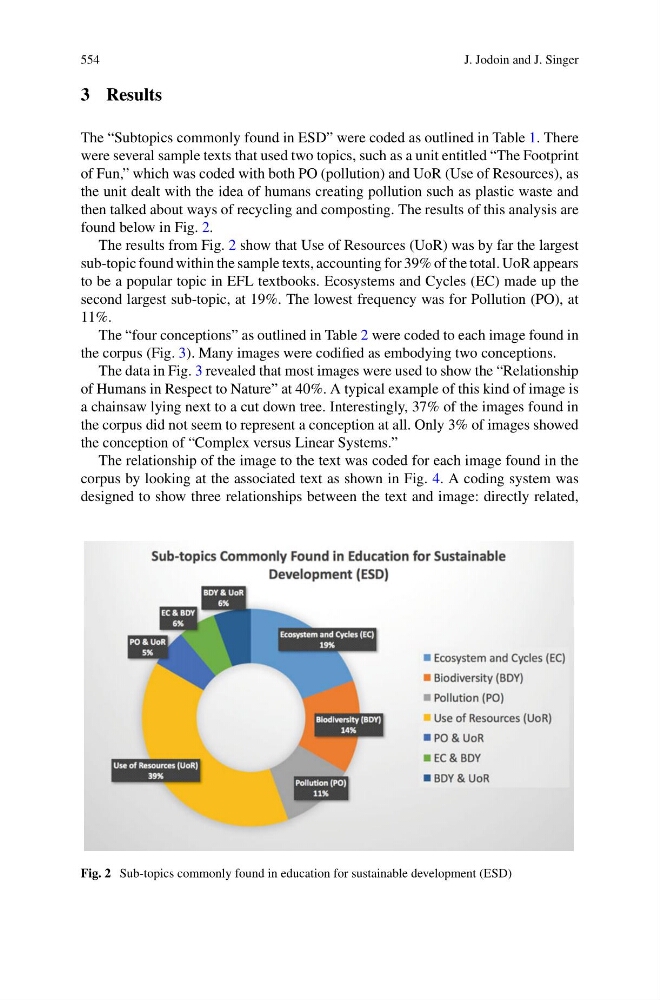
found below in Fig. 2.
The results from Fig. 2 show that Use of Resources (UoR) was by far the largest
sub-topic found within the sample texts, accounting for 39% of the total. UoR appears
to be a popular topic in EFL textbooks. Ecosystems and Cycles (EC) made up the
second largest sub-topic, at 19%. The lowest frequency was for Pollution (PO), at
11%.
The “four conceptions” as outlined in Table 2 were coded to each image found in
the corpus (Fig. 3). Many images were codified as embodying two conceptions.
The data in Fig. 3 revealed that most images were used to show the “Relationship
of Humans in Respect to Nature” at 40%. A typical example of this kind of image is
a chainsaw lying next to a cut down tree. Interestingly, 37% of the images found in
the corpus did not seem to represent a conception at all. Only 3% of images showed
the conception of “Complex versus Linear Systems.”
The relationship of the image to the text was coded for each image found in the
corpus by looking at the associated text as shown in Fig. 4. A coding system was
designed to show three relationships between the text and image: directly related,
Fig. 2 Sub-topics commonly found in education for sustainable development (ESD)
J. Jodoin and J. Singer
3 Results
The “Subtopics commonly found in ESD” were coded as outlined in Table 1. There
were several sample texts that used two topics, such as a unit entitled “The Footprint
of Fun,” which was coded with both PO (pollution) and UoR (Use of Resources), as
the unit dealt with the idea of humans creating pollution such as plastic waste and
then talked about ways of recycling and composting. The results of this analysis are
found below in Fig. 2.
The results from Fig. 2 show that Use of Resources (UoR) was by far the largest
sub-topic found within the sample texts, accounting for 39% of the total. UoR appears
to be a popular topic in EFL textbooks. Ecosystems and Cycles (EC) made up the
second largest sub-topic, at 19%. The lowest frequency was for Pollution (PO), at
11%.
The “four conceptions” as outlined in Table 2 were coded to each image found in
the corpus (Fig. 3). Many images were codified as embodying two conceptions.
The data in Fig. 3 revealed that most images were used to show the “Relationship
of Humans in Respect to Nature” at 40%. A typical example of this kind of image is
a chainsaw lying next to a cut down tree. Interestingly, 37% of the images found in
the corpus did not seem to represent a conception at all. Only 3% of images showed
the conception of “Complex versus Linear Systems.”
The relationship of the image to the text was coded for each image found in the
corpus by looking at the associated text as shown in Fig. 4. A coding system was
designed to show three relationships between the text and image: directly related,
Fig. 2 Sub-topics commonly found in education for sustainable development (ESD)