

Knowledge and Opinions Amongst Youths in Secondary …
523
information that represents the Malaysian youths about sustainable development
issues in Malaysia.
Meanwhile, Helferty and Clarke (2009) in their study on student-led campus
climate change activities mentioned that HEI students are central in awareness-raising
campaign on campuses and they also have a unique perspective to contribute to
campus climate solutions. Clark further said that HEI students are likely to create their
own strategies to guide friends on behavioural change or implement mechanisms to
lessen climate change issues. Furthermore, engaging key groups in decision-making
and co-develop solutions to address development challenges can help the country
towards achieving the global 2030 Sustainable Development Goals Agenda (UN
Women 2016). In addition, to ensure that the new development agenda is in fact
changes our nation and provides a more sustainable world, participatory youths
are needed. Hence, results from this study may help the key actors in sustainable
development especially the government and youth organizations to develop effective
initiatives and strategies especially in formal education.
4.2 Knowledge
The first two knowledge items were a multiple-choice type of question concerning
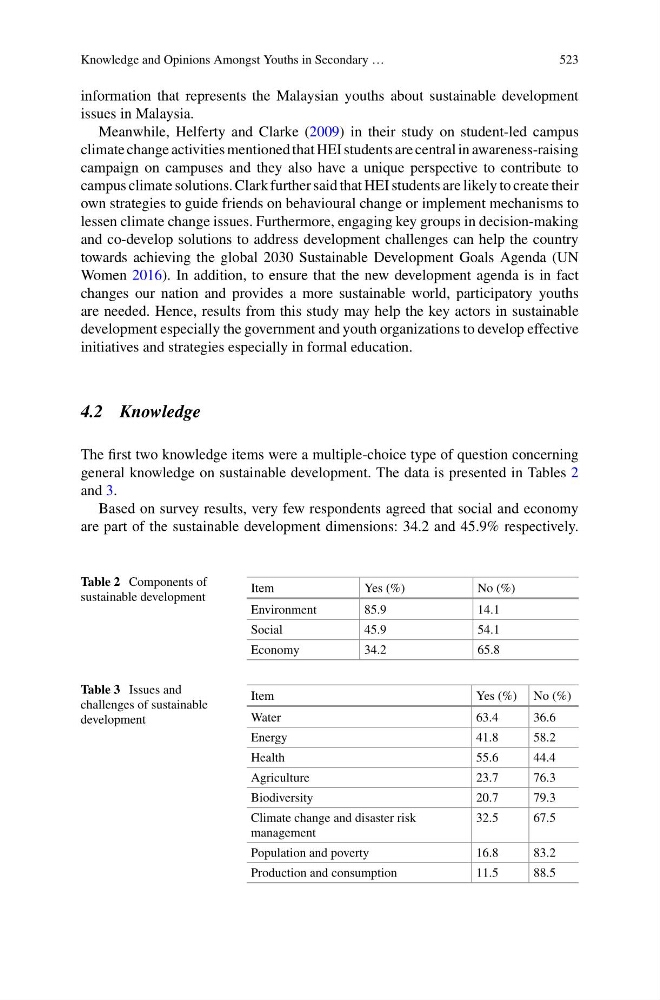
general knowledge on sustainable development. The data is presented in Tables 2
and 3.
Based on survey results, very few respondents agreed that social and economy
are part of the sustainable development dimensions: 34.2 and 45.9% respectively.
Table 2 Components of
sustainable development
Item
Yes (%)
No (%)
Environment
85.9
14.1
Social
45.9
54.1
Economy
34.2
65.8
Table 3 Issues and
challenges of sustainable
development
Item
Yes (%) No (%)
Water
63.4
36.6
Energy
41.8
58.2
Health
55.6
44.4
Agriculture
23.7
76.3
Biodiversity
20.7
79.3
Climate change and disaster risk
management
32.5
67.5
Population and poverty
16.8
83.2
Production and consumption
11.5
88.5
523
information that represents the Malaysian youths about sustainable development
issues in Malaysia.
Meanwhile, Helferty and Clarke (2009) in their study on student-led campus
climate change activities mentioned that HEI students are central in awareness-raising
campaign on campuses and they also have a unique perspective to contribute to
campus climate solutions. Clark further said that HEI students are likely to create their
own strategies to guide friends on behavioural change or implement mechanisms to
lessen climate change issues. Furthermore, engaging key groups in decision-making
and co-develop solutions to address development challenges can help the country
towards achieving the global 2030 Sustainable Development Goals Agenda (UN
Women 2016). In addition, to ensure that the new development agenda is in fact
changes our nation and provides a more sustainable world, participatory youths
are needed. Hence, results from this study may help the key actors in sustainable
development especially the government and youth organizations to develop effective
initiatives and strategies especially in formal education.
4.2 Knowledge
The first two knowledge items were a multiple-choice type of question concerning
general knowledge on sustainable development. The data is presented in Tables 2
and 3.
Based on survey results, very few respondents agreed that social and economy
are part of the sustainable development dimensions: 34.2 and 45.9% respectively.
Table 2 Components of
sustainable development
Item
Yes (%)
No (%)
Environment
85.9
14.1
Social
45.9
54.1
Economy
34.2
65.8
Table 3 Issues and
challenges of sustainable
development
Item
Yes (%) No (%)
Water
63.4
36.6
Energy
41.8
58.2
Health
55.6
44.4
Agriculture
23.7
76.3
Biodiversity
20.7
79.3
Climate change and disaster risk
management
32.5
67.5
Population and poverty
16.8
83.2
Production and consumption
11.5
88.5