

522
F. N. Ariffin et al.
4 Results and Discussion of the Study
4.1 Demographics
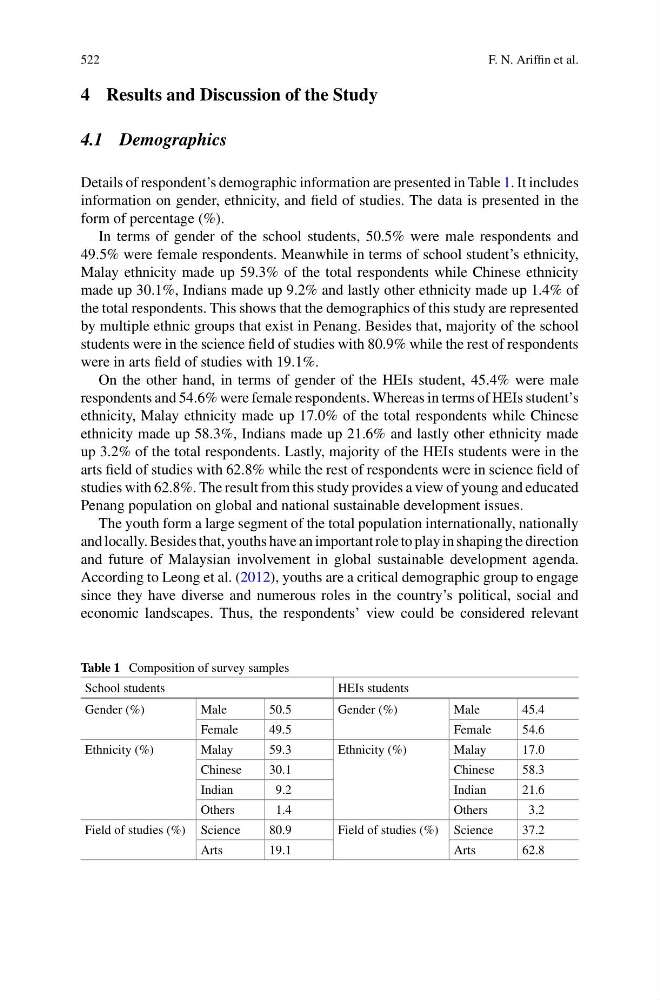
Details of respondent’s demographic information are presented in Table 1. It includes
information on gender, ethnicity, and field of studies. The data is presented in the
form of percentage (%).
In terms of gender of the school students, 50.5% were male respondents and
49.5% were female respondents. Meanwhile in terms of school student’s ethnicity,
Malay ethnicity made up 59.3% of the total respondents while Chinese ethnicity
made up 30.1%, Indians made up 9.2% and lastly other ethnicity made up 1.4% of
the total respondents. This shows that the demographics of this study are represented
by multiple ethnic groups that exist in Penang. Besides that, majority of the school
students were in the science field of studies with 80.9% while the rest of respondents
were in arts field of studies with 19.1%.
On the other hand, in terms of gender of the HEIs student, 45.4% were male
respondents and 54.6% were female respondents. Whereas in terms of HEIs student’s
ethnicity, Malay ethnicity made up 17.0% of the total respondents while Chinese
ethnicity made up 58.3%, Indians made up 21.6% and lastly other ethnicity made
up 3.2% of the total respondents. Lastly, majority of the HEIs students were in the
arts field of studies with 62.8% while the rest of respondents were in science field of
studies with 62.8%. The result from this study provides a view of young and educated
Penang population on global and national sustainable development issues.
The youth form a large segment of the total population internationally, nationally
and locally. Besides that, youths have an important role to play in shaping the direction
and future of Malaysian involvement in global sustainable development agenda.
According to Leong et al. (2012), youths are a critical demographic group to engage
since they have diverse and numerous roles in the country’s political, social and
economic landscapes. Thus, the respondents’ view could be considered relevant
Table 1 Composition of survey samples
School students
HEIs students
Gender (%)
Male
50.5
Gender (%)
Male
45.4
Female
49.5
Female
54.6
Ethnicity (%)
Malay
59.3
Ethnicity (%)
Malay
17.0
Chinese
30.1
Chinese
58.3
Indian
9.2
Indian
21.6
Others
1.4
Others
3.2
Field of studies (%) Science
80.9
Field of studies (%) Science
37.2
Arts
19.1
Arts
62.8
F. N. Ariffin et al.
4 Results and Discussion of the Study
4.1 Demographics
Details of respondent’s demographic information are presented in Table 1. It includes
information on gender, ethnicity, and field of studies. The data is presented in the
form of percentage (%).
In terms of gender of the school students, 50.5% were male respondents and
49.5% were female respondents. Meanwhile in terms of school student’s ethnicity,
Malay ethnicity made up 59.3% of the total respondents while Chinese ethnicity
made up 30.1%, Indians made up 9.2% and lastly other ethnicity made up 1.4% of
the total respondents. This shows that the demographics of this study are represented
by multiple ethnic groups that exist in Penang. Besides that, majority of the school
students were in the science field of studies with 80.9% while the rest of respondents
were in arts field of studies with 19.1%.
On the other hand, in terms of gender of the HEIs student, 45.4% were male
respondents and 54.6% were female respondents. Whereas in terms of HEIs student’s
ethnicity, Malay ethnicity made up 17.0% of the total respondents while Chinese
ethnicity made up 58.3%, Indians made up 21.6% and lastly other ethnicity made
up 3.2% of the total respondents. Lastly, majority of the HEIs students were in the
arts field of studies with 62.8% while the rest of respondents were in science field of
studies with 62.8%. The result from this study provides a view of young and educated
Penang population on global and national sustainable development issues.
The youth form a large segment of the total population internationally, nationally
and locally. Besides that, youths have an important role to play in shaping the direction
and future of Malaysian involvement in global sustainable development agenda.
According to Leong et al. (2012), youths are a critical demographic group to engage
since they have diverse and numerous roles in the country’s political, social and
economic landscapes. Thus, the respondents’ view could be considered relevant
Table 1 Composition of survey samples
School students
HEIs students
Gender (%)
Male
50.5
Gender (%)
Male
45.4
Female
49.5
Female
54.6
Ethnicity (%)
Malay
59.3
Ethnicity (%)
Malay
17.0
Chinese
30.1
Chinese
58.3
Indian
9.2
Indian
21.6
Others
1.4
Others
3.2
Field of studies (%) Science
80.9
Field of studies (%) Science
37.2
Arts
19.1
Arts
62.8