

Interdisciplinary Cooperation and Collaboration …
407
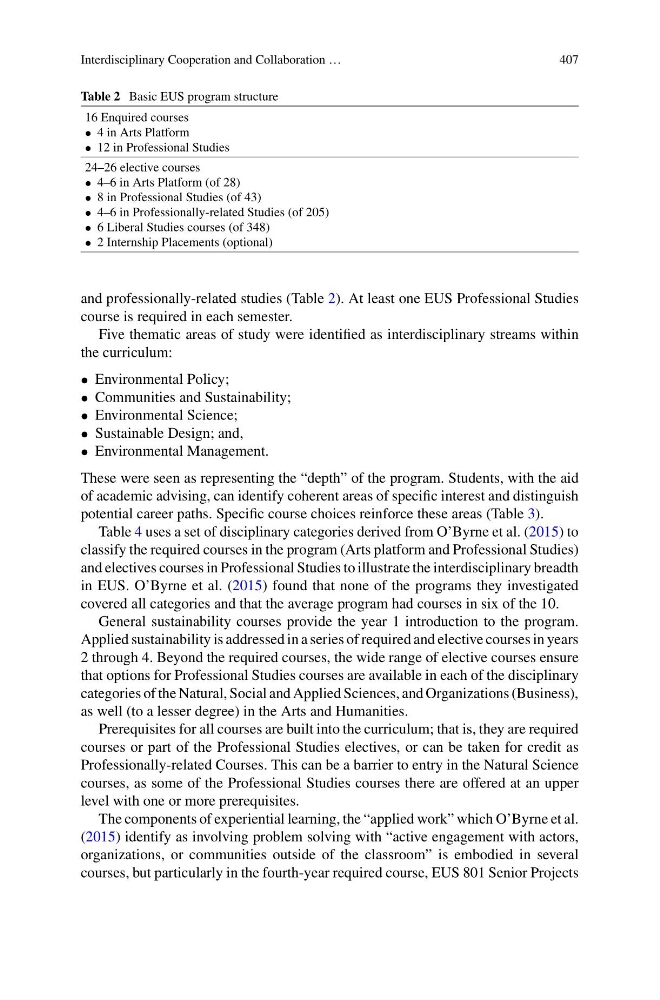
Table 2 Basic EUS program structure
16 Enquired courses
• 4 in Arts Platform
• 12 in Professional Studies
24–26 elective courses
• 4–6 in Arts Platform (of 28)
• 8 in Professional Studies (of 43)
• 4–6 in Professionally-related Studies (of 205)
• 6 Liberal Studies courses (of 348)
• 2 Internship Placements (optional)
and professionally-related studies (Table 2). At least one EUS Professional Studies
course is required in each semester.
Five thematic areas of study were identified as interdisciplinary streams within
the curriculum:
• Environmental Policy;
• Communities and Sustainability;
• Environmental Science;
• Sustainable Design; and,
• Environmental Management.
These were seen as representing the “depth” of the program. Students, with the aid
of academic advising, can identify coherent areas of specific interest and distinguish
potential career paths. Specific course choices reinforce these areas (Table 3).
Table 4 uses a set of disciplinary categories derived from O’Byrne et al. (2015) to
classify the required courses in the program (Arts platform and Professional Studies)
and electives courses in Professional Studies to illustrate the interdisciplinary breadth
in EUS. O’Byrne et al. (2015) found that none of the programs they investigated
covered all categories and that the average program had courses in six of the 10.
General sustainability courses provide the year 1 introduction to the program.
Applied sustainability is addressed in a series of required and elective courses in years
2 through 4. Beyond the required courses, the wide range of elective courses ensure
that options for Professional Studies courses are available in each of the disciplinary
categories of the Natural, Social and Applied Sciences, and Organizations (Business),
as well (to a lesser degree) in the Arts and Humanities.
Prerequisites for all courses are built into the curriculum; that is, they are required
courses or part of the Professional Studies electives, or can be taken for credit as
Professionally-related Courses. This can be a barrier to entry in the Natural Science
courses, as some of the Professional Studies courses there are offered at an upper
level with one or more prerequisites.
The components of experiential learning, the “applied work” which O’Byrne et al.
(2015) identify as involving problem solving with “active engagement with actors,
organizations, or communities outside of the classroom” is embodied in several
courses, but particularly in the fourth-year required course, EUS 801 Senior Projects
407
Table 2 Basic EUS program structure
16 Enquired courses
• 4 in Arts Platform
• 12 in Professional Studies
24–26 elective courses
• 4–6 in Arts Platform (of 28)
• 8 in Professional Studies (of 43)
• 4–6 in Professionally-related Studies (of 205)
• 6 Liberal Studies courses (of 348)
• 2 Internship Placements (optional)
and professionally-related studies (Table 2). At least one EUS Professional Studies
course is required in each semester.
Five thematic areas of study were identified as interdisciplinary streams within
the curriculum:
• Environmental Policy;
• Communities and Sustainability;
• Environmental Science;
• Sustainable Design; and,
• Environmental Management.
These were seen as representing the “depth” of the program. Students, with the aid
of academic advising, can identify coherent areas of specific interest and distinguish
potential career paths. Specific course choices reinforce these areas (Table 3).
Table 4 uses a set of disciplinary categories derived from O’Byrne et al. (2015) to
classify the required courses in the program (Arts platform and Professional Studies)
and electives courses in Professional Studies to illustrate the interdisciplinary breadth
in EUS. O’Byrne et al. (2015) found that none of the programs they investigated
covered all categories and that the average program had courses in six of the 10.
General sustainability courses provide the year 1 introduction to the program.
Applied sustainability is addressed in a series of required and elective courses in years
2 through 4. Beyond the required courses, the wide range of elective courses ensure
that options for Professional Studies courses are available in each of the disciplinary
categories of the Natural, Social and Applied Sciences, and Organizations (Business),
as well (to a lesser degree) in the Arts and Humanities.
Prerequisites for all courses are built into the curriculum; that is, they are required
courses or part of the Professional Studies electives, or can be taken for credit as
Professionally-related Courses. This can be a barrier to entry in the Natural Science
courses, as some of the Professional Studies courses there are offered at an upper
level with one or more prerequisites.
The components of experiential learning, the “applied work” which O’Byrne et al.
(2015) identify as involving problem solving with “active engagement with actors,
organizations, or communities outside of the classroom” is embodied in several
courses, but particularly in the fourth-year required course, EUS 801 Senior Projects