

406
M. Bardecki et al.
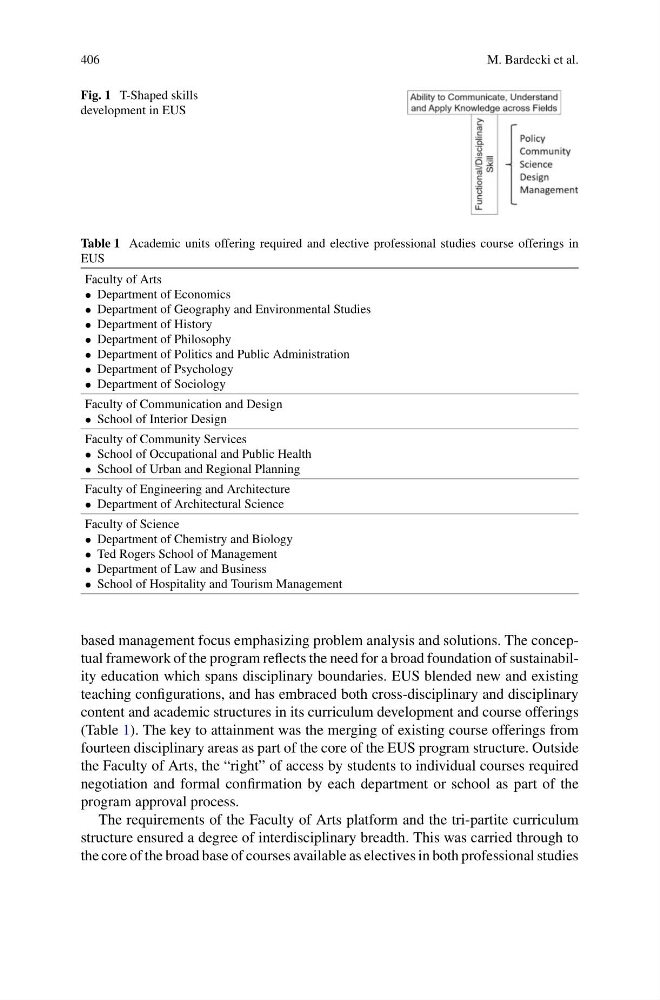
Fig. 1 T-Shaped skills
development in EUS
Table 1 Academic units offering required and elective professional studies course offerings in
EUS
Faculty of Arts
• Department of Economics
• Department of Geography and Environmental Studies
• Department of History
• Department of Philosophy
• Department of Politics and Public Administration
• Department of Psychology
• Department of Sociology
Faculty of Communication and Design
• School of Interior Design
Faculty of Community Services
• School of Occupational and Public Health
• School of Urban and Regional Planning
Faculty of Engineering and Architecture
• Department of Architectural Science
Faculty of Science
• Department of Chemistry and Biology
• Ted Rogers School of Management
• Department of Law and Business
• School of Hospitality and Tourism Management
based management focus emphasizing problem analysis and solutions. The conceptual framework of the program reflects the need for a broad foundation of sustainability education which spans disciplinary boundaries. EUS blended new and existing
teaching configurations, and has embraced both cross-disciplinary and disciplinary
content and academic structures in its curriculum development and course offerings
(Table 1). The key to attainment was the merging of existing course offerings from
fourteen disciplinary areas as part of the core of the EUS program structure. Outside
the Faculty of Arts, the “right” of access by students to individual courses required
negotiation and formal confirmation by each department or school as part of the
program approval process.
The requirements of the Faculty of Arts platform and the tri-partite curriculum
structure ensured a degree of interdisciplinary breadth. This was carried through to
the core of the broad base of courses available as electives in both professional studies
M. Bardecki et al.
Fig. 1 T-Shaped skills
development in EUS
Table 1 Academic units offering required and elective professional studies course offerings in
EUS
Faculty of Arts
• Department of Economics
• Department of Geography and Environmental Studies
• Department of History
• Department of Philosophy
• Department of Politics and Public Administration
• Department of Psychology
• Department of Sociology
Faculty of Communication and Design
• School of Interior Design
Faculty of Community Services
• School of Occupational and Public Health
• School of Urban and Regional Planning
Faculty of Engineering and Architecture
• Department of Architectural Science
Faculty of Science
• Department of Chemistry and Biology
• Ted Rogers School of Management
• Department of Law and Business
• School of Hospitality and Tourism Management
based management focus emphasizing problem analysis and solutions. The conceptual framework of the program reflects the need for a broad foundation of sustainability education which spans disciplinary boundaries. EUS blended new and existing
teaching configurations, and has embraced both cross-disciplinary and disciplinary
content and academic structures in its curriculum development and course offerings
(Table 1). The key to attainment was the merging of existing course offerings from
fourteen disciplinary areas as part of the core of the EUS program structure. Outside
the Faculty of Arts, the “right” of access by students to individual courses required
negotiation and formal confirmation by each department or school as part of the
program approval process.
The requirements of the Faculty of Arts platform and the tri-partite curriculum
structure ensured a degree of interdisciplinary breadth. This was carried through to
the core of the broad base of courses available as electives in both professional studies