

Upcycling for Teaching and Learning in Higher Education …
377
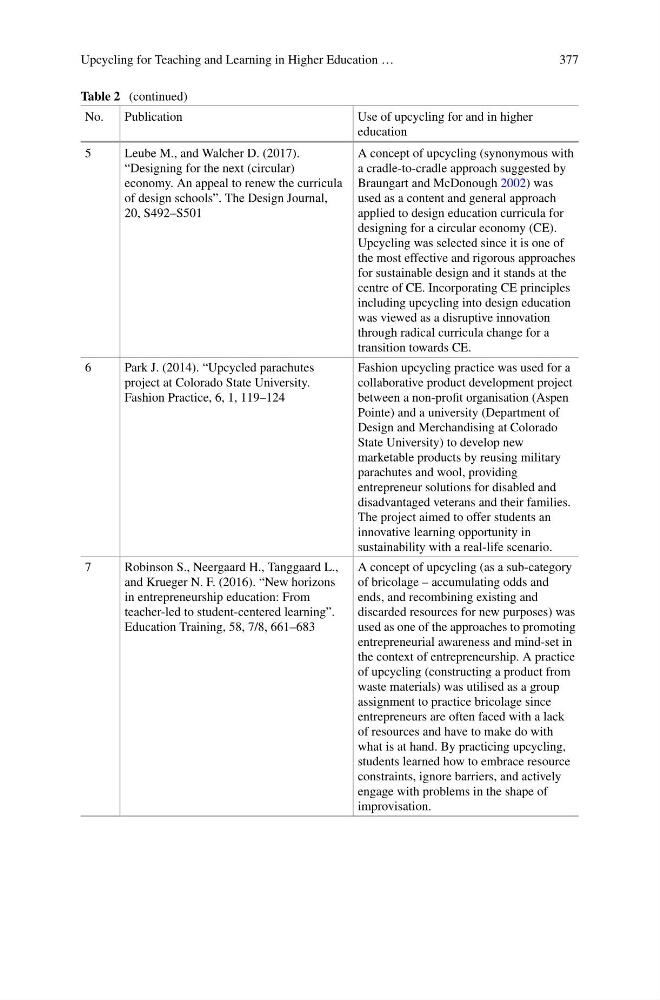
Table 2 (continued)
No.
Publication
Use of upcycling for and in higher
education
5
Leube M., and Walcher D. (2017).
“Designing for the next (circular)
economy. An appeal to renew the curricula
of design schools”. The Design Journal,
20, S492–S501
A concept of upcycling (synonymous with
a cradle-to-cradle approach suggested by
Braungart and McDonough 2002) was
used as a content and general approach
applied to design education curricula for
designing for a circular economy (CE).
Upcycling was selected since it is one of
the most effective and rigorous approaches
for sustainable design and it stands at the
centre of CE. Incorporating CE principles
including upcycling into design education
was viewed as a disruptive innovation
through radical curricula change for a
transition towards CE.
6
Park J. (2014). “Upcycled parachutes
project at Colorado State University.
Fashion Practice, 6, 1, 119–124
Fashion upcycling practice was used for a
collaborative product development project
between a non-profit organisation (Aspen
Pointe) and a university (Department of
Design and Merchandising at Colorado
State University) to develop new
marketable products by reusing military
parachutes and wool, providing
entrepreneur solutions for disabled and
disadvantaged veterans and their families.
The project aimed to offer students an
innovative learning opportunity in
sustainability with a real-life scenario.
7
Robinson S., Neergaard H., Tanggaard L.,
and Krueger N. F. (2016). “New horizons
in entrepreneurship education: From
teacher-led to student-centered learning”.
Education Training, 58, 7/8, 661–683
A concept of upcycling (as a sub-category
of bricolage – accumulating odds and
ends, and recombining existing and
discarded resources for new purposes) was
used as one of the approaches to promoting
entrepreneurial awareness and mind-set in
the context of entrepreneurship. A practice
of upcycling (constructing a product from
waste materials) was utilised as a group
assignment to practice bricolage since
entrepreneurs are often faced with a lack
of resources and have to make do with
what is at hand. By practicing upcycling,
students learned how to embrace resource
constraints, ignore barriers, and actively
engage with problems in the shape of
improvisation.
377
Table 2 (continued)
No.
Publication
Use of upcycling for and in higher
education
5
Leube M., and Walcher D. (2017).
“Designing for the next (circular)
economy. An appeal to renew the curricula
of design schools”. The Design Journal,
20, S492–S501
A concept of upcycling (synonymous with
a cradle-to-cradle approach suggested by
Braungart and McDonough 2002) was
used as a content and general approach
applied to design education curricula for
designing for a circular economy (CE).
Upcycling was selected since it is one of
the most effective and rigorous approaches
for sustainable design and it stands at the
centre of CE. Incorporating CE principles
including upcycling into design education
was viewed as a disruptive innovation
through radical curricula change for a
transition towards CE.
6
Park J. (2014). “Upcycled parachutes
project at Colorado State University.
Fashion Practice, 6, 1, 119–124
Fashion upcycling practice was used for a
collaborative product development project
between a non-profit organisation (Aspen
Pointe) and a university (Department of
Design and Merchandising at Colorado
State University) to develop new
marketable products by reusing military
parachutes and wool, providing
entrepreneur solutions for disabled and
disadvantaged veterans and their families.
The project aimed to offer students an
innovative learning opportunity in
sustainability with a real-life scenario.
7
Robinson S., Neergaard H., Tanggaard L.,
and Krueger N. F. (2016). “New horizons
in entrepreneurship education: From
teacher-led to student-centered learning”.
Education Training, 58, 7/8, 661–683
A concept of upcycling (as a sub-category
of bricolage – accumulating odds and
ends, and recombining existing and
discarded resources for new purposes) was
used as one of the approaches to promoting
entrepreneurial awareness and mind-set in
the context of entrepreneurship. A practice
of upcycling (constructing a product from
waste materials) was utilised as a group
assignment to practice bricolage since
entrepreneurs are often faced with a lack
of resources and have to make do with
what is at hand. By practicing upcycling,
students learned how to embrace resource
constraints, ignore barriers, and actively
engage with problems in the shape of
improvisation.