

376
K. Sung
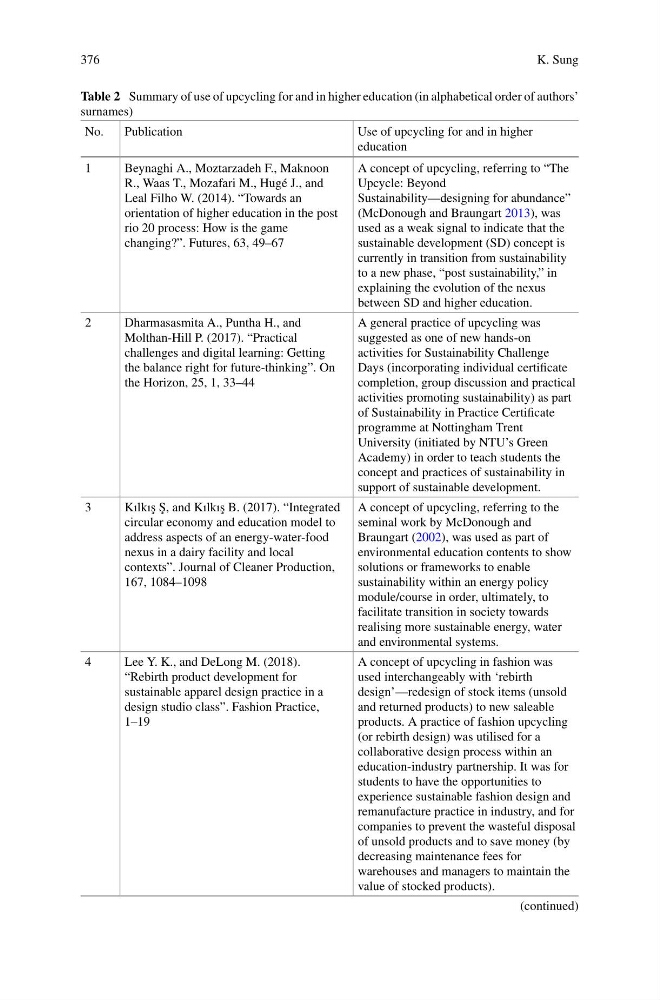
Table 2 Summary of use of upcycling for and in higher education (in alphabetical order of authors’
surnames)
No.
Publication
Use of upcycling for and in higher
education
1
Beynaghi A., Moztarzadeh F., Maknoon
R., Waas T., Mozafari M., Hugé J., and
Leal Filho W. (2014). “Towards an
orientation of higher education in the post
rio 20 process: How is the game
changing?”. Futures, 63, 49–67
A concept of upcycling, referring to “The
Upcycle: Beyond
Sustainability—designing for abundance”
(McDonough and Braungart 2013), was
used as a weak signal to indicate that the
sustainable development (SD) concept is
currently in transition from sustainability
to a new phase, “post sustainability,” in
explaining the evolution of the nexus
between SD and higher education.
2
Dharmasasmita A., Puntha H., and
Molthan-Hill P. (2017). “Practical
challenges and digital learning: Getting
the balance right for future-thinking”. On
the Horizon, 25, 1, 33–44
A general practice of upcycling was
suggested as one of new hands-on
activities for Sustainability Challenge
Days (incorporating individual certificate
completion, group discussion and practical
activities promoting sustainability) as part
of Sustainability in Practice Certificate
programme at Nottingham Trent
University (initiated by NTU’s Green
Academy) in order to teach students the
concept and practices of sustainability in
support of sustainable development.
3
Kılkı¸ s ¸
S, and Kılkı¸ s B. (2017). “Integrated
circular economy and education model to
address aspects of an energy-water-food
nexus in a dairy facility and local
contexts”. Journal of Cleaner Production,
167, 1084–1098
A concept of upcycling, referring to the
seminal work by McDonough and
Braungart (2002), was used as part of
environmental education contents to show
solutions or frameworks to enable
sustainability within an energy policy
module/course in order, ultimately, to
facilitate transition in society towards
realising more sustainable energy, water
and environmental systems.
4
Lee Y. K., and DeLong M. (2018).
“Rebirth product development for
sustainable apparel design practice in a
design studio class”. Fashion Practice,
1–19
A concept of upcycling in fashion was
used interchangeably with ‘rebirth
design’—redesign of stock items (unsold
and returned products) to new saleable
products. A practice of fashion upcycling
(or rebirth design) was utilised for a
collaborative design process within an
education-industry partnership. It was for
students to have the opportunities to
experience sustainable fashion design and
remanufacture practice in industry, and for
companies to prevent the wasteful disposal
of unsold products and to save money (by
decreasing maintenance fees for
warehouses and managers to maintain the
value of stocked products).
(continued)
K. Sung
Table 2 Summary of use of upcycling for and in higher education (in alphabetical order of authors’
surnames)
No.
Publication
Use of upcycling for and in higher
education
1
Beynaghi A., Moztarzadeh F., Maknoon
R., Waas T., Mozafari M., Hugé J., and
Leal Filho W. (2014). “Towards an
orientation of higher education in the post
rio 20 process: How is the game
changing?”. Futures, 63, 49–67
A concept of upcycling, referring to “The
Upcycle: Beyond
Sustainability—designing for abundance”
(McDonough and Braungart 2013), was
used as a weak signal to indicate that the
sustainable development (SD) concept is
currently in transition from sustainability
to a new phase, “post sustainability,” in
explaining the evolution of the nexus
between SD and higher education.
2
Dharmasasmita A., Puntha H., and
Molthan-Hill P. (2017). “Practical
challenges and digital learning: Getting
the balance right for future-thinking”. On
the Horizon, 25, 1, 33–44
A general practice of upcycling was
suggested as one of new hands-on
activities for Sustainability Challenge
Days (incorporating individual certificate
completion, group discussion and practical
activities promoting sustainability) as part
of Sustainability in Practice Certificate
programme at Nottingham Trent
University (initiated by NTU’s Green
Academy) in order to teach students the
concept and practices of sustainability in
support of sustainable development.
3
Kılkı¸ s ¸
S, and Kılkı¸ s B. (2017). “Integrated
circular economy and education model to
address aspects of an energy-water-food
nexus in a dairy facility and local
contexts”. Journal of Cleaner Production,
167, 1084–1098
A concept of upcycling, referring to the
seminal work by McDonough and
Braungart (2002), was used as part of
environmental education contents to show
solutions or frameworks to enable
sustainability within an energy policy
module/course in order, ultimately, to
facilitate transition in society towards
realising more sustainable energy, water
and environmental systems.
4
Lee Y. K., and DeLong M. (2018).
“Rebirth product development for
sustainable apparel design practice in a
design studio class”. Fashion Practice,
1–19
A concept of upcycling in fashion was
used interchangeably with ‘rebirth
design’—redesign of stock items (unsold
and returned products) to new saleable
products. A practice of fashion upcycling
(or rebirth design) was utilised for a
collaborative design process within an
education-industry partnership. It was for
students to have the opportunities to
experience sustainable fashion design and
remanufacture practice in industry, and for
companies to prevent the wasteful disposal
of unsold products and to save money (by
decreasing maintenance fees for
warehouses and managers to maintain the
value of stocked products).
(continued)