

334
L. Liu and L. Gao
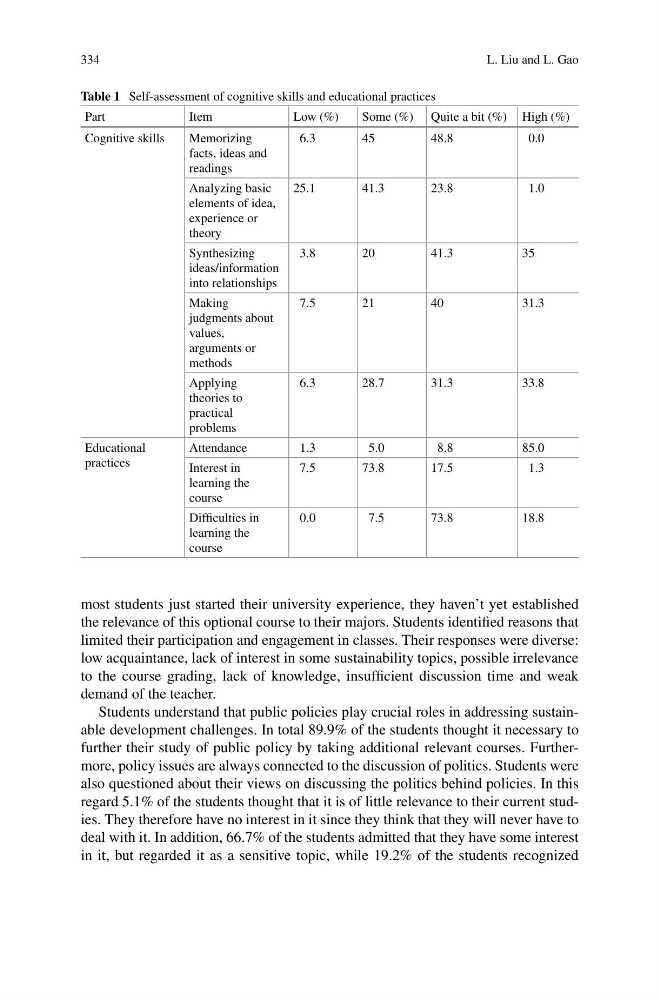
Table 1 Self-assessment of cognitive skills and educational practices
Part
Item
Low (%)
Some (%) Quite a bit (%) High (%)
Cognitive skills
Memorizing
facts, ideas and
readings
6.3
45
48.8
0.0
Analyzing basic
elements of idea,
experience or
theory
25.1
41.3
23.8
1.0
Synthesizing
ideas/information
into relationships
3.8
20
41.3
35
Making
judgments about
values,
arguments or
methods
7.5
21
40
31.3
Applying
theories to
practical
problems
6.3
28.7
31.3
33.8
Educational
practices
Attendance
1.3
5.0
8.8
85.0
Interest in
learning the
course
7.5
73.8
17.5
1.3
Difficulties in
learning the
course
0.0
7.5
73.8
18.8
most students just started their university experience, they haven’t yet established
the relevance of this optional course to their majors. Students identified reasons that
limited their participation and engagement in classes. Their responses were diverse:
low acquaintance, lack of interest in some sustainability topics, possible irrelevance
to the course grading, lack of knowledge, insufficient discussion time and weak
demand of the teacher.
Students understand that public policies play crucial roles in addressing sustainable development challenges. In total 89.9% of the students thought it necessary to
further their study of public policy by taking additional relevant courses. Furthermore, policy issues are always connected to the discussion of politics. Students were
also questioned about their views on discussing the politics behind policies. In this
regard 5.1% of the students thought that it is of little relevance to their current studies. They therefore have no interest in it since they think that they will never have to
deal with it. In addition, 66.7% of the students admitted that they have some interest
in it, but regarded it as a sensitive topic, while 19.2% of the students recognized
L. Liu and L. Gao
Table 1 Self-assessment of cognitive skills and educational practices
Part
Item
Low (%)
Some (%) Quite a bit (%) High (%)
Cognitive skills
Memorizing
facts, ideas and
readings
6.3
45
48.8
0.0
Analyzing basic
elements of idea,
experience or
theory
25.1
41.3
23.8
1.0
Synthesizing
ideas/information
into relationships
3.8
20
41.3
35
Making
judgments about
values,
arguments or
methods
7.5
21
40
31.3
Applying
theories to
practical
problems
6.3
28.7
31.3
33.8
Educational
practices
Attendance
1.3
5.0
8.8
85.0
Interest in
learning the
course
7.5
73.8
17.5
1.3
Difficulties in
learning the
course
0.0
7.5
73.8
18.8
most students just started their university experience, they haven’t yet established
the relevance of this optional course to their majors. Students identified reasons that
limited their participation and engagement in classes. Their responses were diverse:
low acquaintance, lack of interest in some sustainability topics, possible irrelevance
to the course grading, lack of knowledge, insufficient discussion time and weak
demand of the teacher.
Students understand that public policies play crucial roles in addressing sustainable development challenges. In total 89.9% of the students thought it necessary to
further their study of public policy by taking additional relevant courses. Furthermore, policy issues are always connected to the discussion of politics. Students were
also questioned about their views on discussing the politics behind policies. In this
regard 5.1% of the students thought that it is of little relevance to their current studies. They therefore have no interest in it since they think that they will never have to
deal with it. In addition, 66.7% of the students admitted that they have some interest
in it, but regarded it as a sensitive topic, while 19.2% of the students recognized