

Enhancing Student Engagement in a Sustainability …
333
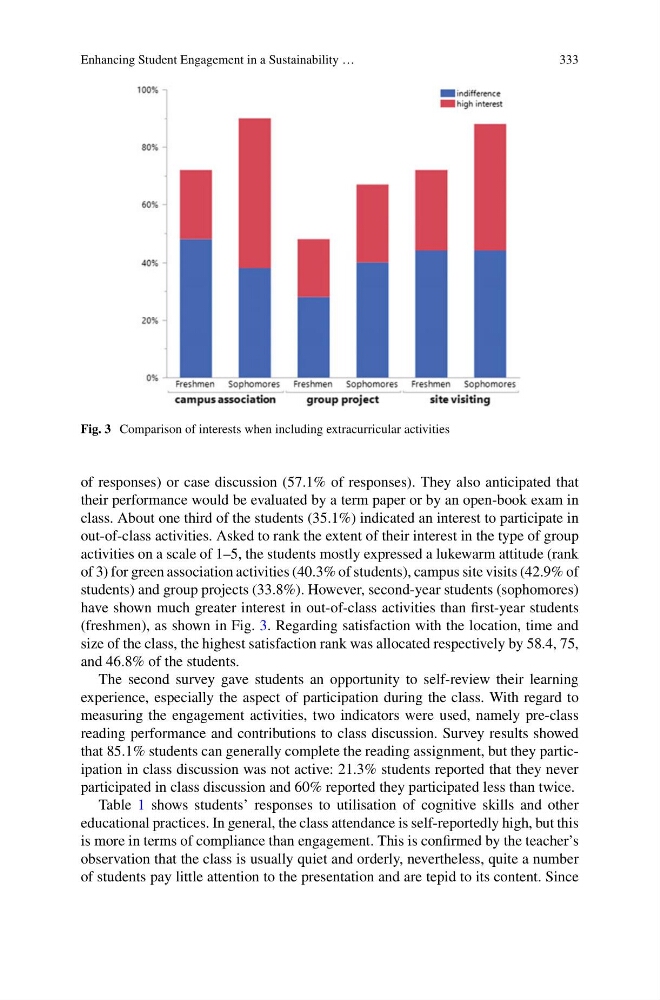
Fig. 3 Comparison of interests when including extracurricular activities
of responses) or case discussion (57.1% of responses). They also anticipated that
their performance would be evaluated by a term paper or by an open-book exam in
class. About one third of the students (35.1%) indicated an interest to participate in
out-of-class activities. Asked to rank the extent of their interest in the type of group
activities on a scale of 1–5, the students mostly expressed a lukewarm attitude (rank
of 3) for green association activities (40.3% of students), campus site visits (42.9% of
students) and group projects (33.8%). However, second-year students (sophomores)
have shown much greater interest in out-of-class activities than first-year students
(freshmen), as shown in Fig. 3. Regarding satisfaction with the location, time and
size of the class, the highest satisfaction rank was allocated respectively by 58.4, 75,
and 46.8% of the students.
The second survey gave students an opportunity to self-review their learning
experience, especially the aspect of participation during the class. With regard to
measuring the engagement activities, two indicators were used, namely pre-class
reading performance and contributions to class discussion. Survey results showed
that 85.1% students can generally complete the reading assignment, but they participation in class discussion was not active: 21.3% students reported that they never
participated in class discussion and 60% reported they participated less than twice.
Table 1 shows students’ responses to utilisation of cognitive skills and other
educational practices. In general, the class attendance is self-reportedly high, but this
is more in terms of compliance than engagement. This is confirmed by the teacher’s
observation that the class is usually quiet and orderly, nevertheless, quite a number
of students pay little attention to the presentation and are tepid to its content. Since
333
Fig. 3 Comparison of interests when including extracurricular activities
of responses) or case discussion (57.1% of responses). They also anticipated that
their performance would be evaluated by a term paper or by an open-book exam in
class. About one third of the students (35.1%) indicated an interest to participate in
out-of-class activities. Asked to rank the extent of their interest in the type of group
activities on a scale of 1–5, the students mostly expressed a lukewarm attitude (rank
of 3) for green association activities (40.3% of students), campus site visits (42.9% of
students) and group projects (33.8%). However, second-year students (sophomores)
have shown much greater interest in out-of-class activities than first-year students
(freshmen), as shown in Fig. 3. Regarding satisfaction with the location, time and
size of the class, the highest satisfaction rank was allocated respectively by 58.4, 75,
and 46.8% of the students.
The second survey gave students an opportunity to self-review their learning
experience, especially the aspect of participation during the class. With regard to
measuring the engagement activities, two indicators were used, namely pre-class
reading performance and contributions to class discussion. Survey results showed
that 85.1% students can generally complete the reading assignment, but they participation in class discussion was not active: 21.3% students reported that they never
participated in class discussion and 60% reported they participated less than twice.
Table 1 shows students’ responses to utilisation of cognitive skills and other
educational practices. In general, the class attendance is self-reportedly high, but this
is more in terms of compliance than engagement. This is confirmed by the teacher’s
observation that the class is usually quiet and orderly, nevertheless, quite a number
of students pay little attention to the presentation and are tepid to its content. Since