

ITC’s Community-Based Solid Waste Management Strategy: A Case…
219
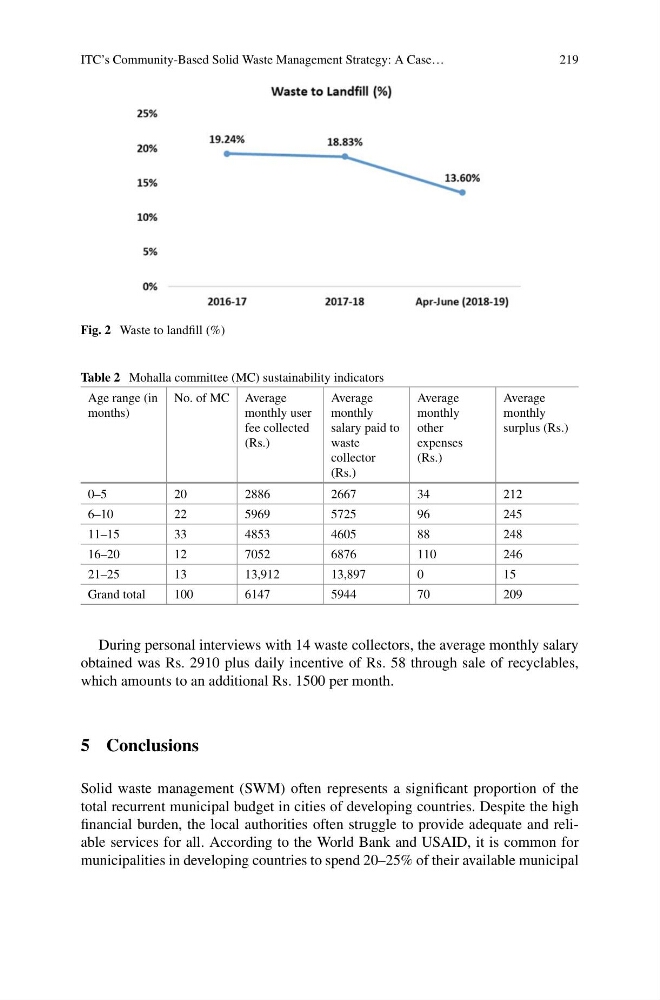
Fig. 2 Waste to landfill (%)
Table 2 Mohalla committee (MC) sustainability indicators
Age range (in
months)
No. of MC Average
monthly user
fee collected
(Rs.)
Average
monthly
salary paid to
waste
collector
(Rs.)
Average
monthly
other
expenses
(Rs.)
Average
monthly
surplus (Rs.)
0–5
20
2886
2667
34
212
6–10
22
5969
5725
96
245
11–15
33
4853
4605
88
248
16–20
12
7052
6876
110
246
21–25
13
13,912
13,897
0
15
Grand total
100
6147
5944
70
209
During personal interviews with 14 waste collectors, the average monthly salary
obtained was Rs. 2910 plus daily incentive of Rs. 58 through sale of recyclables,
which amounts to an additional Rs. 1500 per month.
5 Conclusions
Solid waste management (SWM) often represents a significant proportion of the
total recurrent municipal budget in cities of developing countries. Despite the high
financial burden, the local authorities often struggle to provide adequate and reliable services for all. According to the World Bank and USAID, it is common for
municipalities in developing countries to spend 20–25% of their available municipal
219
Fig. 2 Waste to landfill (%)
Table 2 Mohalla committee (MC) sustainability indicators
Age range (in
months)
No. of MC Average
monthly user
fee collected
(Rs.)
Average
monthly
salary paid to
waste
collector
(Rs.)
Average
monthly
other
expenses
(Rs.)
Average
monthly
surplus (Rs.)
0–5
20
2886
2667
34
212
6–10
22
5969
5725
96
245
11–15
33
4853
4605
88
248
16–20
12
7052
6876
110
246
21–25
13
13,912
13,897
0
15
Grand total
100
6147
5944
70
209
During personal interviews with 14 waste collectors, the average monthly salary
obtained was Rs. 2910 plus daily incentive of Rs. 58 through sale of recyclables,
which amounts to an additional Rs. 1500 per month.
5 Conclusions
Solid waste management (SWM) often represents a significant proportion of the
total recurrent municipal budget in cities of developing countries. Despite the high
financial burden, the local authorities often struggle to provide adequate and reliable services for all. According to the World Bank and USAID, it is common for
municipalities in developing countries to spend 20–25% of their available municipal