

210
C. Boonchit
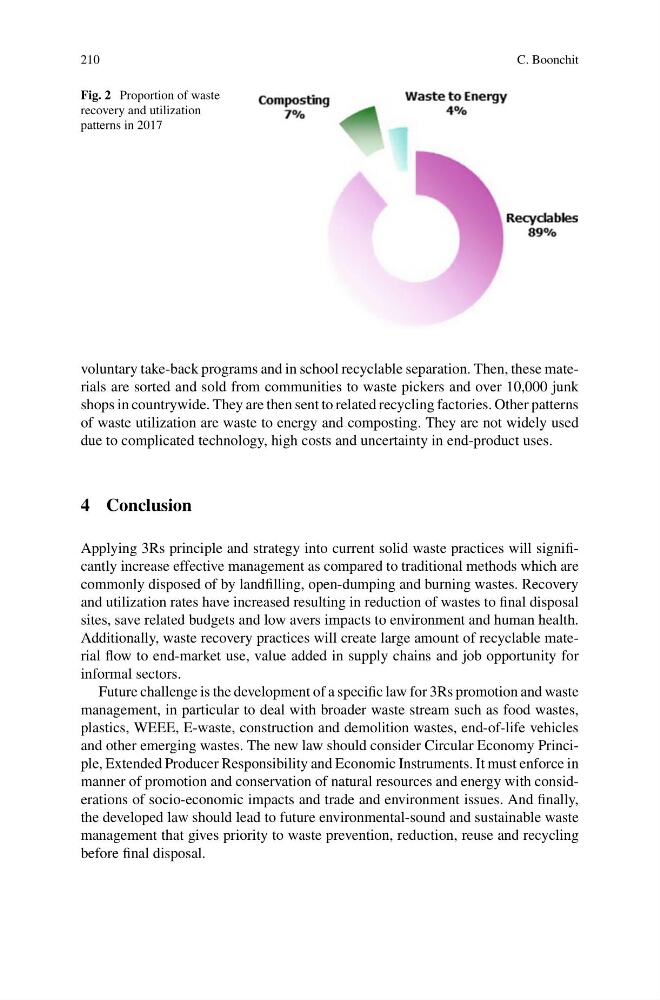
Fig. 2 Proportion of waste
recovery and utilization
patterns in 2017
voluntary take-back programs and in school recyclable separation. Then, these materials are sorted and sold from communities to waste pickers and over 10,000 junk
shops in countrywide. They are then sent to related recycling factories. Other patterns
of waste utilization are waste to energy and composting. They are not widely used
due to complicated technology, high costs and uncertainty in end-product uses.
4 Conclusion
Applying 3Rs principle and strategy into current solid waste practices will significantly increase effective management as compared to traditional methods which are
commonly disposed of by landfilling, open-dumping and burning wastes. Recovery
and utilization rates have increased resulting in reduction of wastes to final disposal
sites, save related budgets and low avers impacts to environment and human health.
Additionally, waste recovery practices will create large amount of recyclable material flow to end-market use, value added in supply chains and job opportunity for
informal sectors.
Future challenge is the development of a specific law for 3Rs promotion and waste
management, in particular to deal with broader waste stream such as food wastes,
plastics, WEEE, E-waste, construction and demolition wastes, end-of-life vehicles
and other emerging wastes. The new law should consider Circular Economy Principle, Extended Producer Responsibility and Economic Instruments. It must enforce in
manner of promotion and conservation of natural resources and energy with considerations of socio-economic impacts and trade and environment issues. And finally,
the developed law should lead to future environmental-sound and sustainable waste
management that gives priority to waste prevention, reduction, reuse and recycling
before final disposal.
C. Boonchit
Fig. 2 Proportion of waste
recovery and utilization
patterns in 2017
voluntary take-back programs and in school recyclable separation. Then, these materials are sorted and sold from communities to waste pickers and over 10,000 junk
shops in countrywide. They are then sent to related recycling factories. Other patterns
of waste utilization are waste to energy and composting. They are not widely used
due to complicated technology, high costs and uncertainty in end-product uses.
4 Conclusion
Applying 3Rs principle and strategy into current solid waste practices will significantly increase effective management as compared to traditional methods which are
commonly disposed of by landfilling, open-dumping and burning wastes. Recovery
and utilization rates have increased resulting in reduction of wastes to final disposal
sites, save related budgets and low avers impacts to environment and human health.
Additionally, waste recovery practices will create large amount of recyclable material flow to end-market use, value added in supply chains and job opportunity for
informal sectors.
Future challenge is the development of a specific law for 3Rs promotion and waste
management, in particular to deal with broader waste stream such as food wastes,
plastics, WEEE, E-waste, construction and demolition wastes, end-of-life vehicles
and other emerging wastes. The new law should consider Circular Economy Principle, Extended Producer Responsibility and Economic Instruments. It must enforce in
manner of promotion and conservation of natural resources and energy with considerations of socio-economic impacts and trade and environment issues. And finally,
the developed law should lead to future environmental-sound and sustainable waste
management that gives priority to waste prevention, reduction, reuse and recycling
before final disposal.