

3Rs Policy and Strategy for Municipal Waste Management …
209
Thailand also proceeds pollution control measures in compliance with international
agreement or commitment such as the Basel Convention.
2.5 Economic Instruments
Economic instruments (EIs) are applied for changing consumption behaviours as well
as promoting waste reduction and recovery. Example of EIs includes deposit-refund
system for lead and acid battery, marketing promotions for green products, pilot
project for purchasing environmental friendly products and services in governmental
organization and investment incentive for waste recovery and recycling activities.
2.6 Regulatory System
The strategy focuses mainly on existing law amendment, strike enforcement and
developing a new regulatory or code of practice to promote 3Rs activities such
as guideline and standard-specific waste separation containers, requirement for the
products made from recycled materials, the ministerial announcement on import of
certain recyclable materials and development of 3Rs promotion law.
3 Result and Discussion
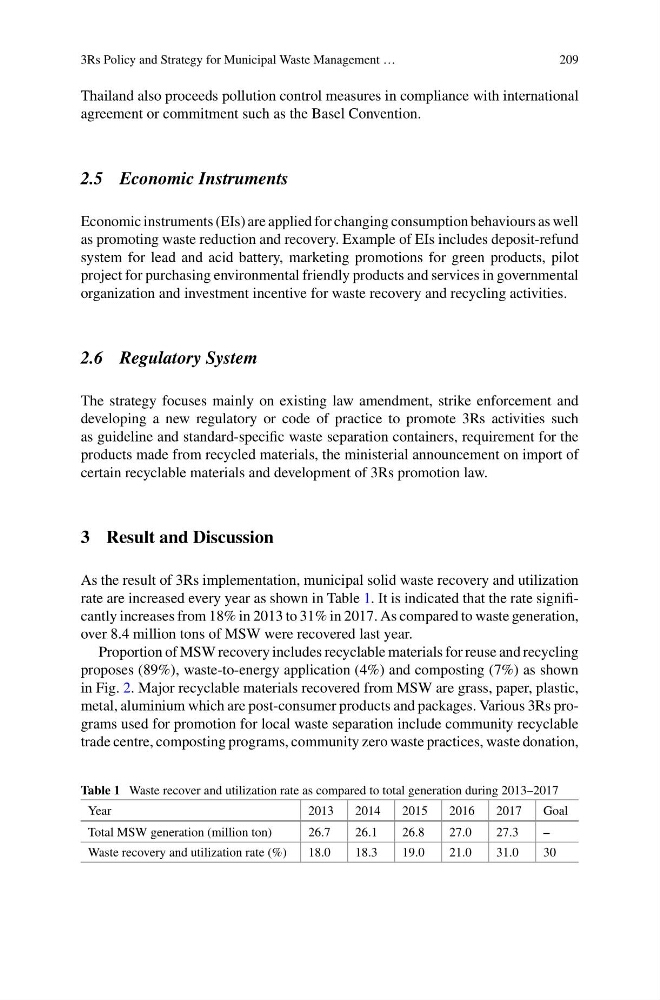
As the result of 3Rs implementation, municipal solid waste recovery and utilization
rate are increased every year as shown in Table 1. It is indicated that the rate significantly increases from 18% in 2013 to 31% in 2017. As compared to waste generation,
over 8.4 million tons of MSW were recovered last year.
Proportion of MSW recovery includes recyclable materials for reuse and recycling
proposes (89%), waste-to-energy application (4%) and composting (7%) as shown
in Fig. 2. Major recyclable materials recovered from MSW are grass, paper, plastic,
metal, aluminium which are post-consumer products and packages. Various 3Rs programs used for promotion for local waste separation include community recyclable
trade centre, composting programs, community zero waste practices, waste donation,
Table 1 Waste recover and utilization rate as compared to total generation during 2013–2017
Year
2013
2014
2015
2016
2017
Goal
Total MSW generation (million ton)
26.7
26.1
26.8
27.0
27.3
–
Waste recovery and utilization rate (%)
18.0
18.3
19.0
21.0
31.0
30
209
Thailand also proceeds pollution control measures in compliance with international
agreement or commitment such as the Basel Convention.
2.5 Economic Instruments
Economic instruments (EIs) are applied for changing consumption behaviours as well
as promoting waste reduction and recovery. Example of EIs includes deposit-refund
system for lead and acid battery, marketing promotions for green products, pilot
project for purchasing environmental friendly products and services in governmental
organization and investment incentive for waste recovery and recycling activities.
2.6 Regulatory System
The strategy focuses mainly on existing law amendment, strike enforcement and
developing a new regulatory or code of practice to promote 3Rs activities such
as guideline and standard-specific waste separation containers, requirement for the
products made from recycled materials, the ministerial announcement on import of
certain recyclable materials and development of 3Rs promotion law.
3 Result and Discussion
As the result of 3Rs implementation, municipal solid waste recovery and utilization
rate are increased every year as shown in Table 1. It is indicated that the rate significantly increases from 18% in 2013 to 31% in 2017. As compared to waste generation,
over 8.4 million tons of MSW were recovered last year.
Proportion of MSW recovery includes recyclable materials for reuse and recycling
proposes (89%), waste-to-energy application (4%) and composting (7%) as shown
in Fig. 2. Major recyclable materials recovered from MSW are grass, paper, plastic,
metal, aluminium which are post-consumer products and packages. Various 3Rs programs used for promotion for local waste separation include community recyclable
trade centre, composting programs, community zero waste practices, waste donation,
Table 1 Waste recover and utilization rate as compared to total generation during 2013–2017
Year
2013
2014
2015
2016
2017
Goal
Total MSW generation (million ton)
26.7
26.1
26.8
27.0
27.3
–
Waste recovery and utilization rate (%)
18.0
18.3
19.0
21.0
31.0
30