

8
J. Chauhan et al.
Keywords Cleanliness · Sanitation · Waste management · Municipal ·
Information, Education, Communication (IEC) · 3 R
1 Introduction
Waste management is the most important aspect in urban as well as rural areas, to
lead a neat and healthy life. Solid waste management (SWM) is far from a new phenomenon in India. The Ministry of Food and Agriculture offered loans to urban level
bodies (ULBs) for SWM initiatives as far back as in the 1960s; however, no major
changes were made, but in the last decade, especially with the Prime Minister’s philosophy of ‘Swachh Bharat Abhiyan,’ the waste issue moved faster on the country’s
development agenda and received substantial interest and could notice, especially in
younger generation, a big change on October 2, 2017, after the launch of a mission
three years back.
To attain the requisite results, first, ‘the plan states’ those have gone for ‘comprehensive project preparations’ should undertake for all towns and cities for both
solid and liquid waste treatments and its recycling. To achieve this, land needs to
be identified and acquired. It also stresses on waste segregation at source into nonbiodegradable and biodegradable waste (Laurence 1977). Another priority area is to
promote organic farming and the utilization of organic compost. The plan encourages
the conversion of municipal solid waste into vermi compost. The organic manure can
thereafter supplement the use of chemical fertilizer in crop production. Vermi compost improves the physical condition of the soil and increases the level of micronutrients. The plan further stresses the growing demand for organically produced food,
while positioning India as a potentially competitive organic food supplier in the world
market. Hence, the waste management is a process to recycle, reduce, and reuse of
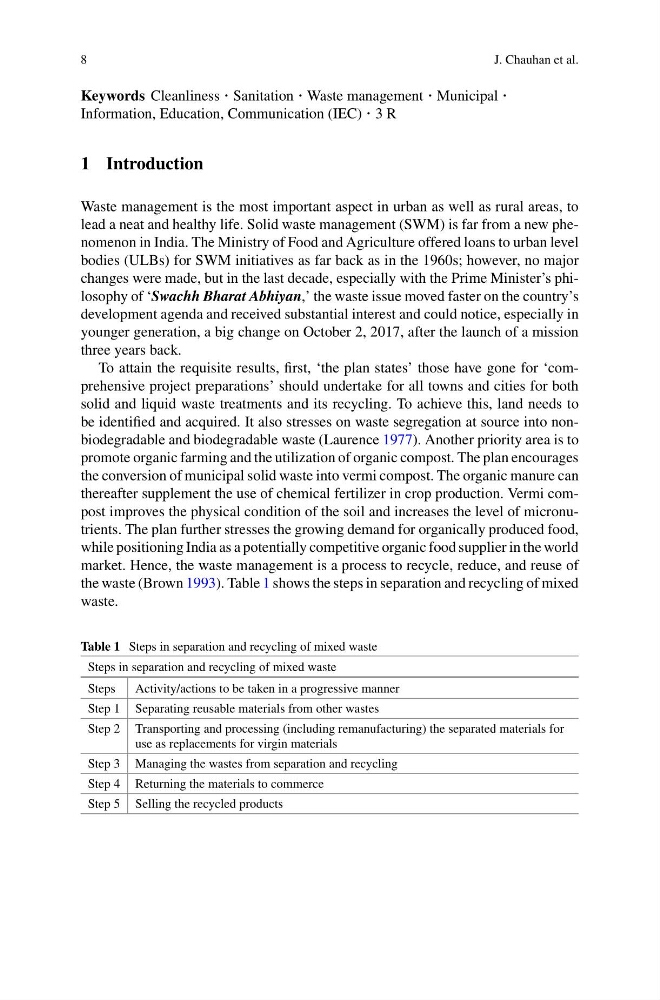
the waste (Brown 1993). Table 1 shows the steps in separation and recycling of mixed
waste.
Table 1 Steps in separation and recycling of mixed waste
Steps in separation and recycling of mixed waste
Steps
Activity/actions to be taken in a progressive manner
Step 1 Separating reusable materials from other wastes
Step 2 Transporting and processing (including remanufacturing) the separated materials for
use as replacements for virgin materials
Step 3 Managing the wastes from separation and recycling
Step 4 Returning the materials to commerce
Step 5 Selling the recycled products
J. Chauhan et al.
Keywords Cleanliness · Sanitation · Waste management · Municipal ·
Information, Education, Communication (IEC) · 3 R
1 Introduction
Waste management is the most important aspect in urban as well as rural areas, to
lead a neat and healthy life. Solid waste management (SWM) is far from a new phenomenon in India. The Ministry of Food and Agriculture offered loans to urban level
bodies (ULBs) for SWM initiatives as far back as in the 1960s; however, no major
changes were made, but in the last decade, especially with the Prime Minister’s philosophy of ‘Swachh Bharat Abhiyan,’ the waste issue moved faster on the country’s
development agenda and received substantial interest and could notice, especially in
younger generation, a big change on October 2, 2017, after the launch of a mission
three years back.
To attain the requisite results, first, ‘the plan states’ those have gone for ‘comprehensive project preparations’ should undertake for all towns and cities for both
solid and liquid waste treatments and its recycling. To achieve this, land needs to
be identified and acquired. It also stresses on waste segregation at source into nonbiodegradable and biodegradable waste (Laurence 1977). Another priority area is to
promote organic farming and the utilization of organic compost. The plan encourages
the conversion of municipal solid waste into vermi compost. The organic manure can
thereafter supplement the use of chemical fertilizer in crop production. Vermi compost improves the physical condition of the soil and increases the level of micronutrients. The plan further stresses the growing demand for organically produced food,
while positioning India as a potentially competitive organic food supplier in the world
market. Hence, the waste management is a process to recycle, reduce, and reuse of
the waste (Brown 1993). Table 1 shows the steps in separation and recycling of mixed
waste.
Table 1 Steps in separation and recycling of mixed waste
Steps in separation and recycling of mixed waste
Steps
Activity/actions to be taken in a progressive manner
Step 1 Separating reusable materials from other wastes
Step 2 Transporting and processing (including remanufacturing) the separated materials for
use as replacements for virgin materials
Step 3 Managing the wastes from separation and recycling
Step 4 Returning the materials to commerce
Step 5 Selling the recycled products