

Waste Management—A Case Study in Nepal
187
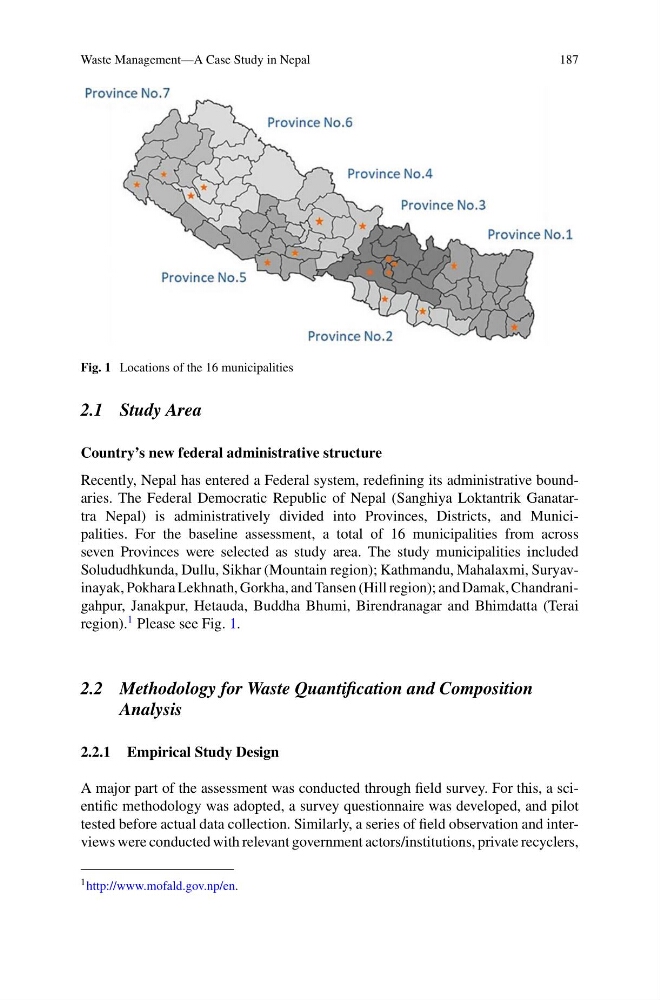
Fig. 1 Locations of the 16 municipalities
2.1 Study Area
Country’s new federal administrative structure
Recently, Nepal has entered a Federal system, redefining its administrative boundaries. The Federal Democratic Republic of Nepal (Sanghiya Loktantrik Ganatartra Nepal) is administratively divided into Provinces, Districts, and Municipalities. For the baseline assessment, a total of 16 municipalities from across
seven Provinces were selected as study area. The study municipalities included
Solududhkunda, Dullu, Sikhar (Mountain region); Kathmandu, Mahalaxmi, Suryavinayak, Pokhara Lekhnath, Gorkha, and Tansen (Hill region); and Damak, Chandranigahpur, Janakpur, Hetauda, Buddha Bhumi, Birendranagar and Bhimdatta (Terai
region).
1 Please see Fig. 1.
2.2 Methodology for Waste Quantification and Composition
Analysis
2.2.1 Empirical Study Design
A major part of the assessment was conducted through field survey. For this, a scientific methodology was adopted, a survey questionnaire was developed, and pilot
tested before actual data collection. Similarly, a series of field observation and interviews were conducted with relevant government actors/institutions, private recyclers,
1 http://www.mofald.gov.np/en.
187
Fig. 1 Locations of the 16 municipalities
2.1 Study Area
Country’s new federal administrative structure
Recently, Nepal has entered a Federal system, redefining its administrative boundaries. The Federal Democratic Republic of Nepal (Sanghiya Loktantrik Ganatartra Nepal) is administratively divided into Provinces, Districts, and Municipalities. For the baseline assessment, a total of 16 municipalities from across
seven Provinces were selected as study area. The study municipalities included
Solududhkunda, Dullu, Sikhar (Mountain region); Kathmandu, Mahalaxmi, Suryavinayak, Pokhara Lekhnath, Gorkha, and Tansen (Hill region); and Damak, Chandranigahpur, Janakpur, Hetauda, Buddha Bhumi, Birendranagar and Bhimdatta (Terai
region).
1 Please see Fig. 1.
2.2 Methodology for Waste Quantification and Composition
Analysis
2.2.1 Empirical Study Design
A major part of the assessment was conducted through field survey. For this, a scientific methodology was adopted, a survey questionnaire was developed, and pilot
tested before actual data collection. Similarly, a series of field observation and interviews were conducted with relevant government actors/institutions, private recyclers,
1 http://www.mofald.gov.np/en.