

168
P. Kowlesser
a sanitary landfill is often a challenge (Agamuthu and Herat 2014). Illegal practices
such as backyard burning or illegal dumping of wastes are also prevalent in some
SIDS due to the lack of knowledge on the negative impacts that these practices have
on human health. With waste collection, a key functional element of an integrated
solid waste management system, the irregularity of waste collection in some SIDS
presents a gap in the waste management chain that heavily impacts on subsequent
processes, including an efficient waste management system.
6 Strategies to Overcome Barriers
Some of the strategies to overcome the barriers that are hindering the development
of an efficient, effective and integrated solid waste management in SIDS include:
a. Training and capacity building in the field of solid waste management.
b. Awareness-raising and sensitization campaigns on the negative health impacts
of illegal dumping and backyard burning of wastes.
c. Setting-up of suitable infrastructures for waste collection.
d. Seeking the financial assistance from international funding agencies or organizations for the development of a sustainable waste management system in
SIDS.
7 Waste Generation and Composition in Mauritius
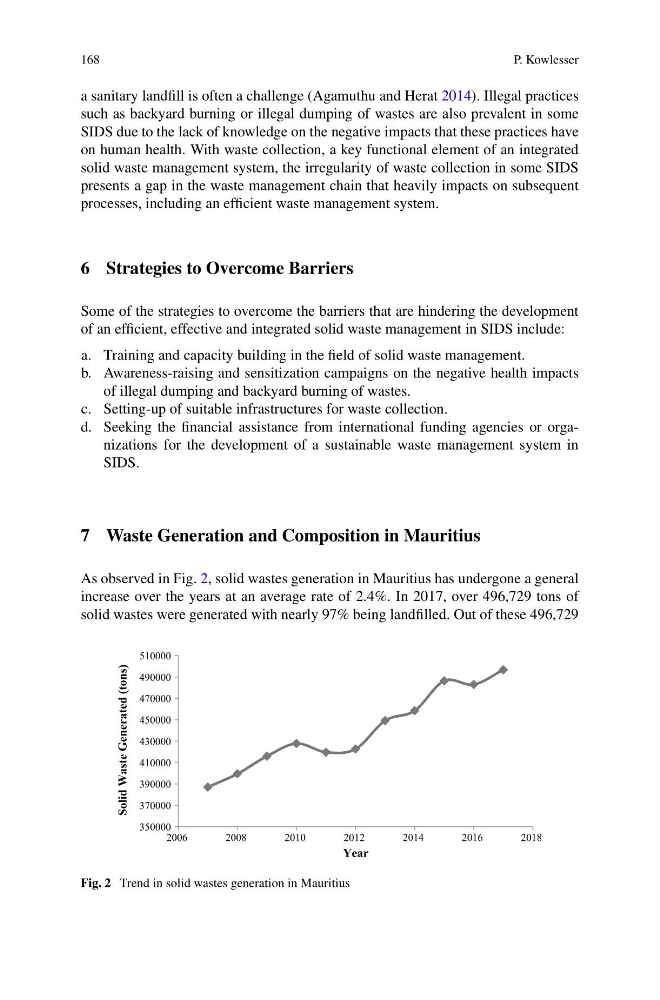
As observed in Fig. 2, solid wastes generation in Mauritius has undergone a general
increase over the years at an average rate of 2.4%. In 2017, over 496,729 tons of
solid wastes were generated with nearly 97% being landfilled. Out of these 496,729
350000
370000
390000
410000
430000
450000
470000
490000
510000
2006
2008
2010
2012
2014
2016
2018
Solid Waste Generated (tons)
Year
Fig. 2 Trend in solid wastes generation in Mauritius
P. Kowlesser
a sanitary landfill is often a challenge (Agamuthu and Herat 2014). Illegal practices
such as backyard burning or illegal dumping of wastes are also prevalent in some
SIDS due to the lack of knowledge on the negative impacts that these practices have
on human health. With waste collection, a key functional element of an integrated
solid waste management system, the irregularity of waste collection in some SIDS
presents a gap in the waste management chain that heavily impacts on subsequent
processes, including an efficient waste management system.
6 Strategies to Overcome Barriers
Some of the strategies to overcome the barriers that are hindering the development
of an efficient, effective and integrated solid waste management in SIDS include:
a. Training and capacity building in the field of solid waste management.
b. Awareness-raising and sensitization campaigns on the negative health impacts
of illegal dumping and backyard burning of wastes.
c. Setting-up of suitable infrastructures for waste collection.
d. Seeking the financial assistance from international funding agencies or organizations for the development of a sustainable waste management system in
SIDS.
7 Waste Generation and Composition in Mauritius
As observed in Fig. 2, solid wastes generation in Mauritius has undergone a general
increase over the years at an average rate of 2.4%. In 2017, over 496,729 tons of
solid wastes were generated with nearly 97% being landfilled. Out of these 496,729
350000
370000
390000
410000
430000
450000
470000
490000
510000
2006
2008
2010
2012
2014
2016
2018
Solid Waste Generated (tons)
Year
Fig. 2 Trend in solid wastes generation in Mauritius