

Ecoparks as a Model of Sustainable Solid Waste Management
145
2 Quantity and Characteristics of Municipal Solid Waste
Essential prerequisite for efficient and effective management of Municipal Solid
Waste is assessment of quantity and characteristics of solid waste. In the present
study, the quantity of Municipal Solid Waste was obtained by first finding the rate
of per capita generation of solid waste employing the house-to-house method of
collection of solid wastes as 0.487 kg/day and then multiplying this quantity by the
total no. of contributing population (residential 400,000 and pilgrim population in
terms of equivalent residential population 50,000) as 219.15 t/day.
3 Characteristics
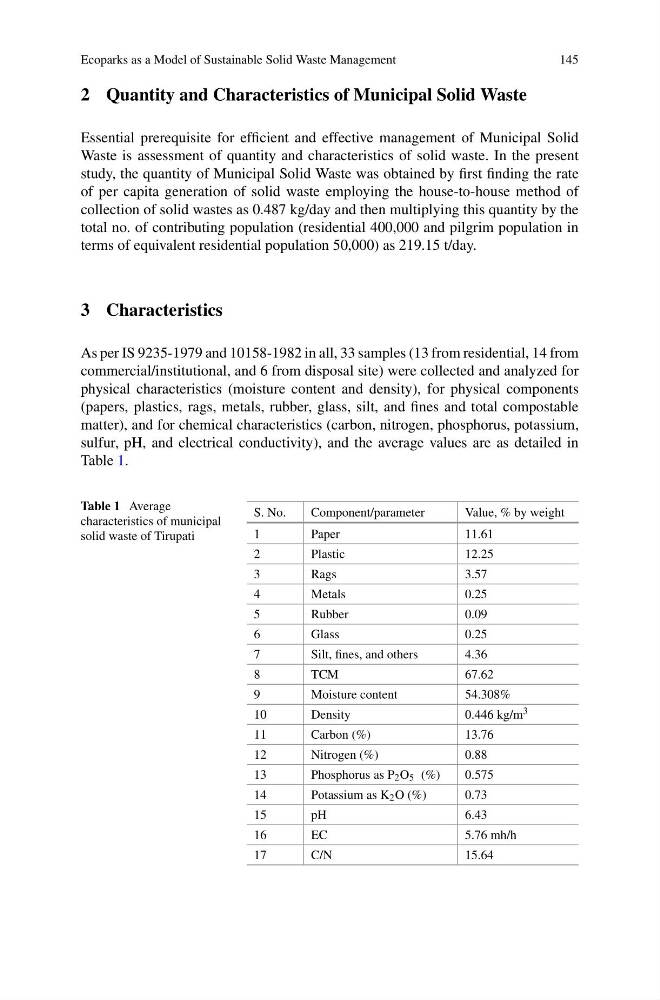
As per IS 9235-1979 and 10158-1982 in all, 33 samples (13 from residential, 14 from
commercial/institutional, and 6 from disposal site) were collected and analyzed for
physical characteristics (moisture content and density), for physical components
(papers, plastics, rags, metals, rubber, glass, silt, and fines and total compostable
matter), and for chemical characteristics (carbon, nitrogen, phosphorus, potassium,
sulfur, pH, and electrical conductivity), and the average values are as detailed in
Table 1.
Table 1 Average
characteristics of municipal
solid waste of Tirupati
S. No.
Component/parameter
Value, % by weight
1
Paper
11.61
2
Plastic
12.25
3
Rags
3.57
4
Metals
0.25
5
Rubber
0.09
6
Glass
0.25
7
Silt, fines, and others
4.36
8
TCM
67.62
9
Moisture content
54.308%
10
Density
0.446 kg/m 3
11
Carbon (%)
13.76
12
Nitrogen (%)
0.88
13
Phosphorus as P 2 O 5 (%)
0.575
14
Potassium as K 2 O (%)
0.73
15
pH
6.43
16
EC
5.76 mh/h
17
C/N
15.64
145
2 Quantity and Characteristics of Municipal Solid Waste
Essential prerequisite for efficient and effective management of Municipal Solid
Waste is assessment of quantity and characteristics of solid waste. In the present
study, the quantity of Municipal Solid Waste was obtained by first finding the rate
of per capita generation of solid waste employing the house-to-house method of
collection of solid wastes as 0.487 kg/day and then multiplying this quantity by the
total no. of contributing population (residential 400,000 and pilgrim population in
terms of equivalent residential population 50,000) as 219.15 t/day.
3 Characteristics
As per IS 9235-1979 and 10158-1982 in all, 33 samples (13 from residential, 14 from
commercial/institutional, and 6 from disposal site) were collected and analyzed for
physical characteristics (moisture content and density), for physical components
(papers, plastics, rags, metals, rubber, glass, silt, and fines and total compostable
matter), and for chemical characteristics (carbon, nitrogen, phosphorus, potassium,
sulfur, pH, and electrical conductivity), and the average values are as detailed in
Table 1.
Table 1 Average
characteristics of municipal
solid waste of Tirupati
S. No.
Component/parameter
Value, % by weight
1
Paper
11.61
2
Plastic
12.25
3
Rags
3.57
4
Metals
0.25
5
Rubber
0.09
6
Glass
0.25
7
Silt, fines, and others
4.36
8
TCM
67.62
9
Moisture content
54.308%
10
Density
0.446 kg/m 3
11
Carbon (%)
13.76
12
Nitrogen (%)
0.88
13
Phosphorus as P 2 O 5 (%)
0.575
14
Potassium as K 2 O (%)
0.73
15
pH
6.43
16
EC
5.76 mh/h
17
C/N
15.64