

62
J. Maruani
from the analysis of X-ray inelastic scattering has direct experimental evidence. The
Compton radius r C defines the amplitude of the Zitterbewegung responsible for the
electron spin angular momentum and intrinsic magnetic moment. Equation (3.4)
also relates Planck’s energy E P , length 2r P , and time τ P of the Big-Bang singularity [38].
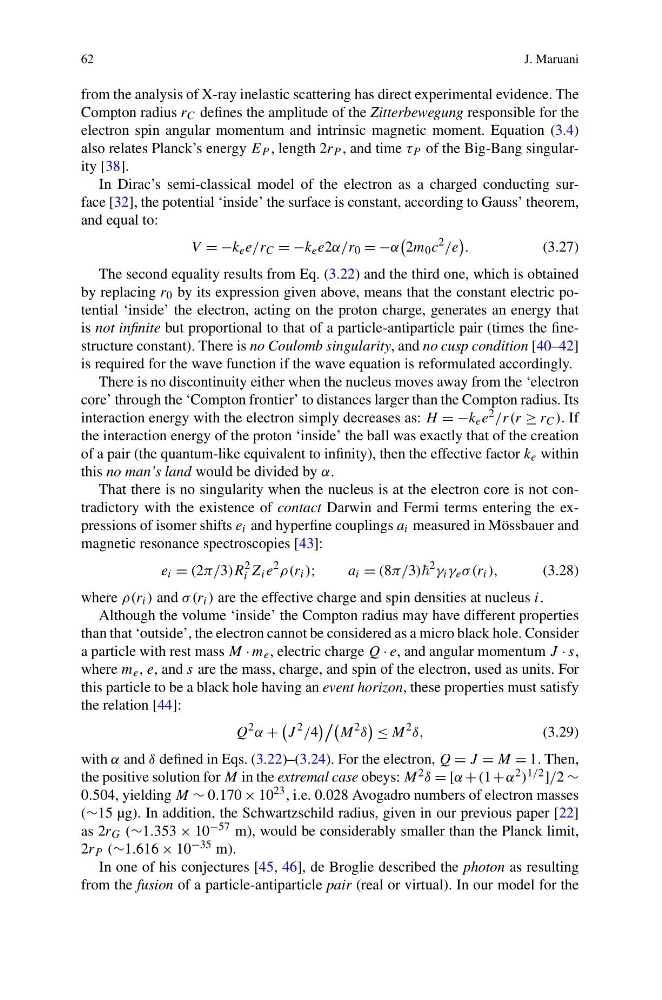
In Dirac’s semi-classical model of the electron as a charged conducting surface [32], the potential ‘inside’ the surface is constant, according to Gauss’ theorem,
and equal to:
V = −k e e/r C = −k e e2α/r 0 = −α
2m 0 c
2 /e
.
(3.27)
The second equality results from Eq. (3.22) and the third one, which is obtained
by replacing r 0 by its expression given above, means that the constant electric potential ‘inside’ the electron, acting on the proton charge, generates an energy that
is not infinite but proportional to that of a particle-antiparticle pair (times the finestructure constant). There is no Coulomb singularity, and no cusp condition [40–42]
is required for the wave function if the wave equation is reformulated accordingly.
There is no discontinuity either when the nucleus moves away from the ‘electron
core’ through the ‘Compton frontier’ to distances larger than the Compton radius. Its
interaction energy with the electron simply decreases as: H = −k e e 2 /r(r ≥ r C ). If
the interaction energy of the proton ‘inside’ the ball was exactly that of the creation
of a pair (the quantum-like equivalent to infinity), then the effective factor k e within
this no man’s land would be divided by α.
That there is no singularity when the nucleus is at the electron core is not contradictory with the existence of contact Darwin and Fermi terms entering the expressions of isomer shifts e i and hyperfine couplings a i measured in Mössbauer and
magnetic resonance spectroscopies [43]:
e i = (2π/3)R
2
i Z i e
2 ρ(r i );
a i = (8π/3)
2 γ i γ e σ (r i ),
(3.28)
where ρ(r i ) and σ (r i ) are the effective charge and spin densities at nucleus i.
Although the volume ‘inside’ the Compton radius may have different properties
than that ‘outside’, the electron cannot be considered as a micro black hole. Consider
a particle with rest mass M · m e , electric charge Q · e, and angular momentum J · s,
where m e , e, and s are the mass, charge, and spin of the electron, used as units. For
this particle to be a black hole having an event horizon, these properties must satisfy
the relation [44]:
Q
2 α +
J
2 /4
M
2 δ
≤ M
2 δ,
(3.29)
with α and δ defined in Eqs. (3.22)–(3.24). For the electron, Q = J = M = 1. Then,
the positive solution for M in the extremal case obeys: M 2 δ = [α +(1+α 2 ) 1/2 ]/2 ∼
0.504, yielding M ∼ 0.170 × 10 23 , i.e. 0.028 Avogadro numbers of electron masses
(∼15 µg). In addition, the Schwartzschild radius, given in our previous paper [22]
as 2r G (∼1.353 × 10 −57 m), would be considerably smaller than the Planck limit,
2r P (∼1.616 × 10 −35 m).
In one of his conjectures [45, 46], de Broglie described the photon as resulting
from the fusion of a particle-antiparticle pair (real or virtual). In our model for the
J. Maruani
from the analysis of X-ray inelastic scattering has direct experimental evidence. The
Compton radius r C defines the amplitude of the Zitterbewegung responsible for the
electron spin angular momentum and intrinsic magnetic moment. Equation (3.4)
also relates Planck’s energy E P , length 2r P , and time τ P of the Big-Bang singularity [38].
In Dirac’s semi-classical model of the electron as a charged conducting surface [32], the potential ‘inside’ the surface is constant, according to Gauss’ theorem,
and equal to:
V = −k e e/r C = −k e e2α/r 0 = −α
2m 0 c
2 /e
.
(3.27)
The second equality results from Eq. (3.22) and the third one, which is obtained
by replacing r 0 by its expression given above, means that the constant electric potential ‘inside’ the electron, acting on the proton charge, generates an energy that
is not infinite but proportional to that of a particle-antiparticle pair (times the finestructure constant). There is no Coulomb singularity, and no cusp condition [40–42]
is required for the wave function if the wave equation is reformulated accordingly.
There is no discontinuity either when the nucleus moves away from the ‘electron
core’ through the ‘Compton frontier’ to distances larger than the Compton radius. Its
interaction energy with the electron simply decreases as: H = −k e e 2 /r(r ≥ r C ). If
the interaction energy of the proton ‘inside’ the ball was exactly that of the creation
of a pair (the quantum-like equivalent to infinity), then the effective factor k e within
this no man’s land would be divided by α.
That there is no singularity when the nucleus is at the electron core is not contradictory with the existence of contact Darwin and Fermi terms entering the expressions of isomer shifts e i and hyperfine couplings a i measured in Mössbauer and
magnetic resonance spectroscopies [43]:
e i = (2π/3)R
2
i Z i e
2 ρ(r i );
a i = (8π/3)
2 γ i γ e σ (r i ),
(3.28)
where ρ(r i ) and σ (r i ) are the effective charge and spin densities at nucleus i.
Although the volume ‘inside’ the Compton radius may have different properties
than that ‘outside’, the electron cannot be considered as a micro black hole. Consider
a particle with rest mass M · m e , electric charge Q · e, and angular momentum J · s,
where m e , e, and s are the mass, charge, and spin of the electron, used as units. For
this particle to be a black hole having an event horizon, these properties must satisfy
the relation [44]:
Q
2 α +
J
2 /4
M
2 δ
≤ M
2 δ,
(3.29)
with α and δ defined in Eqs. (3.22)–(3.24). For the electron, Q = J = M = 1. Then,
the positive solution for M in the extremal case obeys: M 2 δ = [α +(1+α 2 ) 1/2 ]/2 ∼
0.504, yielding M ∼ 0.170 × 10 23 , i.e. 0.028 Avogadro numbers of electron masses
(∼15 µg). In addition, the Schwartzschild radius, given in our previous paper [22]
as 2r G (∼1.353 × 10 −57 m), would be considerably smaller than the Planck limit,
2r P (∼1.616 × 10 −35 m).
In one of his conjectures [45, 46], de Broglie described the photon as resulting
from the fusion of a particle-antiparticle pair (real or virtual). In our model for the