

3 The Dirac Electron and Basic Physical Concepts
61
electron, m 0 . It is involved, for instance, in estimating the minimum size and age of
the Universe [34] and in building universe models.
In one of these models [35, 36], the whole Universe undergoes a kind of Zitterbewegung. Let M U ∼ N H · m H × 10/3 be, according to Eddington [34], the
total mass of the Universe, N H and m H being the number and the mass of hydrogen atom equivalents: N H ∼ 0.53 × 10 80 → M U ∼ 0.88 × 10 53 kg. The Universe resulting radius is given by the relativistic formula: R U = 2G × M U /c 2 ∼
13.0 × 10 25 m ∼ 13.8 × 10 9 light-years. A ‘cosmic flickering’ frequency is then
defined as: ν U = 2M U c 2 /h ∼ 0.24 × 10 104 s −1 , which is a kind of ‘wave beat’
between matter and antimatter, reminding of Zitterbewegung [6].
According to Sanchez et al. [35, 36], this frequency is coordinated with the
electron and other fermion frequencies—which occur in widely different ranges—
through an extended ‘holographic principle’ [37]. In the hydrogen atom, for instance, there is a ‘holographic relation’ between the Bohr radius and the electron and
proton radii. If ordinary matter results from an oscillation between positive and negative energy states [6], what we call antimatter then amounts to a totally dephased
oscillation [35, 36]. But this does not explain the dissymmetry of the occurrences of
the two species.
Expressing the distance r between two identical particles (e, m 0 ) as a multiple
N of the Compton diameter: 2r C = /m 0 c (Eq. (3.4)), and scaling both the electrostatic force: F e = k e · e 2 /r 2 , and the gravitational force: F g = G · m 2
0 /r 2 , to Planck
units: F P = c 4 /G, E P = (c 5 /G) 1/2 [38], Macken [39] managed to express the
two widely different forces as two different powers of the rest mass energy of the
particles (E 0 = m 0 c 2 ):
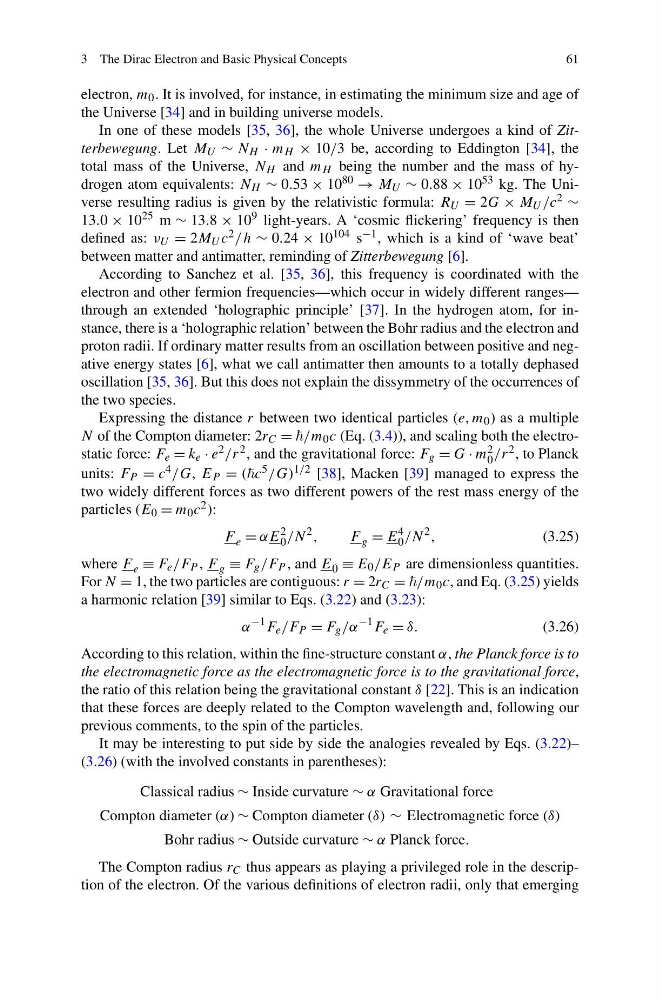
F e = αE
2
0 /N
2 ,
F g = E
4
0 /N
2 ,
(3.25)
where F e ≡ F e /F P , F g ≡ F g /F P , and E 0 ≡ E 0 /E P are dimensionless quantities.
For N = 1, the two particles are contiguous: r = 2r C = /m 0 c, and Eq. (3.25) yields
a harmonic relation [39] similar to Eqs. (3.22) and (3.23):
α
−1 F e /F P = F g /α
−1 F e = δ.
(3.26)
According to this relation, within the fine-structure constant α, the Planck force is to
the electromagnetic force as the electromagnetic force is to the gravitational force,
the ratio of this relation being the gravitational constant δ [22]. This is an indication
that these forces are deeply related to the Compton wavelength and, following our
previous comments, to the spin of the particles.
It may be interesting to put side by side the analogies revealed by Eqs. (3.22)–
(3.26) (with the involved constants in parentheses):
Classical radius ∼ Inside curvature ∼ α Gravitational force
Compton diameter (α) ∼ Compton diameter (δ) ∼ Electromagnetic force (δ)
Bohr radius ∼ Outside curvature ∼ α Planck force.
The Compton radius r C thus appears as playing a privileged role in the description of the electron. Of the various definitions of electron radii, only that emerging
61
electron, m 0 . It is involved, for instance, in estimating the minimum size and age of
the Universe [34] and in building universe models.
In one of these models [35, 36], the whole Universe undergoes a kind of Zitterbewegung. Let M U ∼ N H · m H × 10/3 be, according to Eddington [34], the
total mass of the Universe, N H and m H being the number and the mass of hydrogen atom equivalents: N H ∼ 0.53 × 10 80 → M U ∼ 0.88 × 10 53 kg. The Universe resulting radius is given by the relativistic formula: R U = 2G × M U /c 2 ∼
13.0 × 10 25 m ∼ 13.8 × 10 9 light-years. A ‘cosmic flickering’ frequency is then
defined as: ν U = 2M U c 2 /h ∼ 0.24 × 10 104 s −1 , which is a kind of ‘wave beat’
between matter and antimatter, reminding of Zitterbewegung [6].
According to Sanchez et al. [35, 36], this frequency is coordinated with the
electron and other fermion frequencies—which occur in widely different ranges—
through an extended ‘holographic principle’ [37]. In the hydrogen atom, for instance, there is a ‘holographic relation’ between the Bohr radius and the electron and
proton radii. If ordinary matter results from an oscillation between positive and negative energy states [6], what we call antimatter then amounts to a totally dephased
oscillation [35, 36]. But this does not explain the dissymmetry of the occurrences of
the two species.
Expressing the distance r between two identical particles (e, m 0 ) as a multiple
N of the Compton diameter: 2r C = /m 0 c (Eq. (3.4)), and scaling both the electrostatic force: F e = k e · e 2 /r 2 , and the gravitational force: F g = G · m 2
0 /r 2 , to Planck
units: F P = c 4 /G, E P = (c 5 /G) 1/2 [38], Macken [39] managed to express the
two widely different forces as two different powers of the rest mass energy of the
particles (E 0 = m 0 c 2 ):
F e = αE
2
0 /N
2 ,
F g = E
4
0 /N
2 ,
(3.25)
where F e ≡ F e /F P , F g ≡ F g /F P , and E 0 ≡ E 0 /E P are dimensionless quantities.
For N = 1, the two particles are contiguous: r = 2r C = /m 0 c, and Eq. (3.25) yields
a harmonic relation [39] similar to Eqs. (3.22) and (3.23):
α
−1 F e /F P = F g /α
−1 F e = δ.
(3.26)
According to this relation, within the fine-structure constant α, the Planck force is to
the electromagnetic force as the electromagnetic force is to the gravitational force,
the ratio of this relation being the gravitational constant δ [22]. This is an indication
that these forces are deeply related to the Compton wavelength and, following our
previous comments, to the spin of the particles.
It may be interesting to put side by side the analogies revealed by Eqs. (3.22)–
(3.26) (with the involved constants in parentheses):
Classical radius ∼ Inside curvature ∼ α Gravitational force
Compton diameter (α) ∼ Compton diameter (δ) ∼ Electromagnetic force (δ)
Bohr radius ∼ Outside curvature ∼ α Planck force.
The Compton radius r C thus appears as playing a privileged role in the description of the electron. Of the various definitions of electron radii, only that emerging