

58
J. Maruani
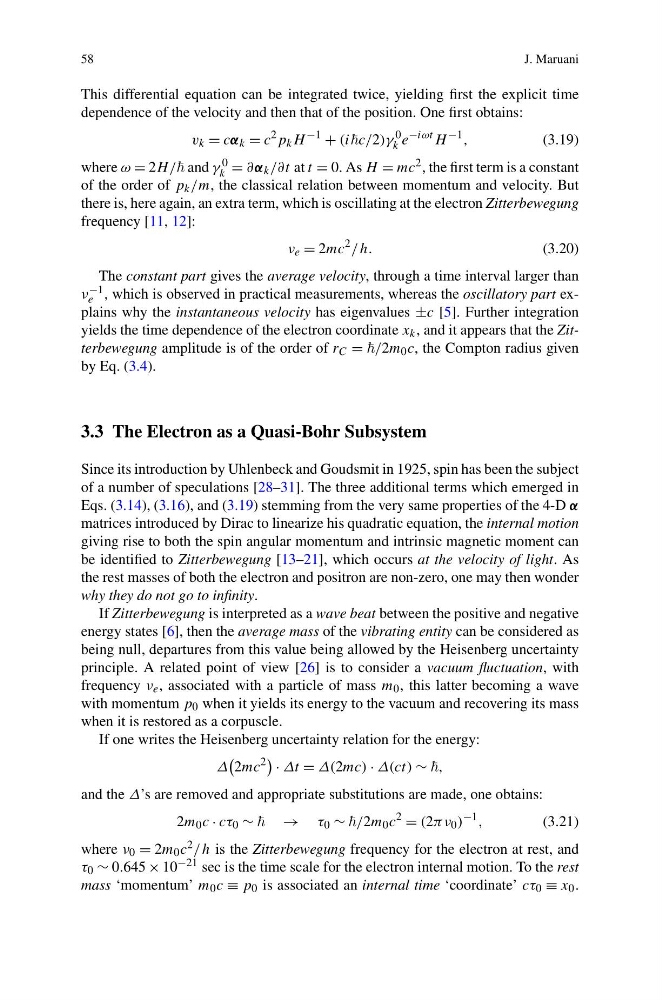
This differential equation can be integrated twice, yielding first the explicit time
dependence of the velocity and then that of the position. One first obtains:
v k = cα k = c
2 p k H
−1
+ (ic/2)γ
0
k e
−iωt H
−1 ,
(3.19)
where ω = 2H/ and γ 0
k = ∂α k /∂t at t = 0. As H = mc 2 , the first term is a constant
of the order of p k /m, the classical relation between momentum and velocity. But
there is, here again, an extra term, which is oscillating at the electron Zitterbewegung
frequency [11, 12]:
ν e = 2mc
2 /h.
(3.20)
The constant part gives the average velocity, through a time interval larger than
ν −1
e , which is observed in practical measurements, whereas the oscillatory part explains why the instantaneous velocity has eigenvalues ±c [5]. Further integration
yields the time dependence of the electron coordinate x k , and it appears that the Zitterbewegung amplitude is of the order of r C = /2m 0 c, the Compton radius given
by Eq. (3.4).
3.3 The Electron as a Quasi-Bohr Subsystem
Since its introduction by Uhlenbeck and Goudsmit in 1925, spin has been the subject
of a number of speculations [28–31]. The three additional terms which emerged in
Eqs. (3.14), (3.16), and (3.19) stemming from the very same properties of the 4-D α
matrices introduced by Dirac to linearize his quadratic equation, the internal motion
giving rise to both the spin angular momentum and intrinsic magnetic moment can
be identified to Zitterbewegung [13–21], which occurs at the velocity of light. As
the rest masses of both the electron and positron are non-zero, one may then wonder
why they do not go to infinity.
If Zitterbewegung is interpreted as a wave beat between the positive and negative
energy states [6], then the average mass of the vibrating entity can be considered as
being null, departures from this value being allowed by the Heisenberg uncertainty
principle. A related point of view [26] is to consider a vacuum fluctuation, with
frequency ν e , associated with a particle of mass m 0 , this latter becoming a wave
with momentum p 0 when it yields its energy to the vacuum and recovering its mass
when it is restored as a corpuscle.
If one writes the Heisenberg uncertainty relation for the energy:
Δ
2mc
2
· Δt = Δ(2mc) · Δ(ct) ∼ ,
and the Δ’s are removed and appropriate substitutions are made, one obtains:
2m 0 c · cτ 0 ∼ → τ 0 ∼ /2m 0 c
2
= (2πν 0 )
−1 ,
(3.21)
where ν 0 = 2m 0 c 2 /h is the Zitterbewegung frequency for the electron at rest, and
τ 0 ∼ 0.645 × 10 −21 sec is the time scale for the electron internal motion. To the rest
mass ‘momentum’ m 0 c ≡ p 0 is associated an internal time ‘coordinate’ cτ 0 ≡ x 0 .
J. Maruani
This differential equation can be integrated twice, yielding first the explicit time
dependence of the velocity and then that of the position. One first obtains:
v k = cα k = c
2 p k H
−1
+ (ic/2)γ
0
k e
−iωt H
−1 ,
(3.19)
where ω = 2H/ and γ 0
k = ∂α k /∂t at t = 0. As H = mc 2 , the first term is a constant
of the order of p k /m, the classical relation between momentum and velocity. But
there is, here again, an extra term, which is oscillating at the electron Zitterbewegung
frequency [11, 12]:
ν e = 2mc
2 /h.
(3.20)
The constant part gives the average velocity, through a time interval larger than
ν −1
e , which is observed in practical measurements, whereas the oscillatory part explains why the instantaneous velocity has eigenvalues ±c [5]. Further integration
yields the time dependence of the electron coordinate x k , and it appears that the Zitterbewegung amplitude is of the order of r C = /2m 0 c, the Compton radius given
by Eq. (3.4).
3.3 The Electron as a Quasi-Bohr Subsystem
Since its introduction by Uhlenbeck and Goudsmit in 1925, spin has been the subject
of a number of speculations [28–31]. The three additional terms which emerged in
Eqs. (3.14), (3.16), and (3.19) stemming from the very same properties of the 4-D α
matrices introduced by Dirac to linearize his quadratic equation, the internal motion
giving rise to both the spin angular momentum and intrinsic magnetic moment can
be identified to Zitterbewegung [13–21], which occurs at the velocity of light. As
the rest masses of both the electron and positron are non-zero, one may then wonder
why they do not go to infinity.
If Zitterbewegung is interpreted as a wave beat between the positive and negative
energy states [6], then the average mass of the vibrating entity can be considered as
being null, departures from this value being allowed by the Heisenberg uncertainty
principle. A related point of view [26] is to consider a vacuum fluctuation, with
frequency ν e , associated with a particle of mass m 0 , this latter becoming a wave
with momentum p 0 when it yields its energy to the vacuum and recovering its mass
when it is restored as a corpuscle.
If one writes the Heisenberg uncertainty relation for the energy:
Δ
2mc
2
· Δt = Δ(2mc) · Δ(ct) ∼ ,
and the Δ’s are removed and appropriate substitutions are made, one obtains:
2m 0 c · cτ 0 ∼ → τ 0 ∼ /2m 0 c
2
= (2πν 0 )
−1 ,
(3.21)
where ν 0 = 2m 0 c 2 /h is the Zitterbewegung frequency for the electron at rest, and
τ 0 ∼ 0.645 × 10 −21 sec is the time scale for the electron internal motion. To the rest
mass ‘momentum’ m 0 c ≡ p 0 is associated an internal time ‘coordinate’ cτ 0 ≡ x 0 .