

3 The Dirac Electron and Basic Physical Concepts
57
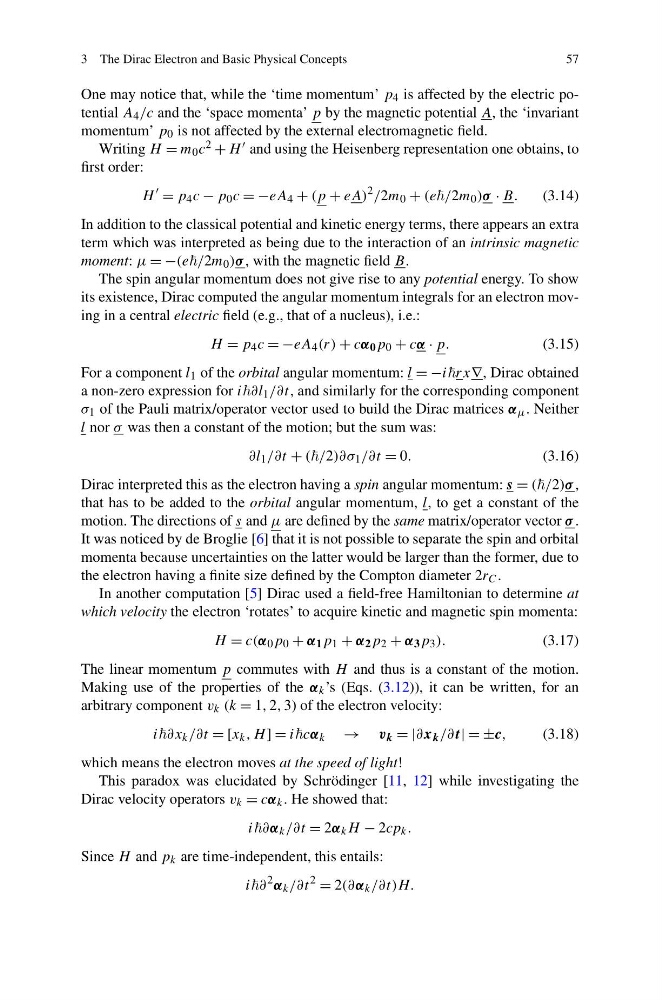
One may notice that, while the ‘time momentum’ p 4 is affected by the electric potential A 4 /c and the ‘space momenta’ p by the magnetic potential A, the ‘invariant
momentum’ p 0 is not affected by the external electromagnetic field.
Writing H = m 0 c 2 + H and using the Heisenberg representation one obtains, to
first order:
H
= p 4 c − p 0 c = −eA 4 + (p + eA)
2 /2m 0 + (e/2m 0 )σ · B.
(3.14)
In addition to the classical potential and kinetic energy terms, there appears an extra
term which was interpreted as being due to the interaction of an intrinsic magnetic
moment: μ = −(e/2m 0 )σ , with the magnetic field B.
The spin angular momentum does not give rise to any potential energy. To show
its existence, Dirac computed the angular momentum integrals for an electron moving in a central electric field (e.g., that of a nucleus), i.e.:
H = p 4 c = −eA 4 (r) + cα 0 p 0 + cα · p.
(3.15)
For a component l 1 of the orbital angular momentum: l = −irx∇, Dirac obtained
a non-zero expression for i∂l 1 /∂t, and similarly for the corresponding component
σ 1 of the Pauli matrix/operator vector used to build the Dirac matrices α μ . Neither
l nor σ was then a constant of the motion; but the sum was:
∂l 1 /∂t + (/2)∂σ 1 /∂t = 0.
(3.16)
Dirac interpreted this as the electron having a spin angular momentum: s = (/2)σ ,
that has to be added to the orbital angular momentum, l, to get a constant of the
motion. The directions of s and μ are defined by the same matrix/operator vector σ .
It was noticed by de Broglie [6] that it is not possible to separate the spin and orbital
momenta because uncertainties on the latter would be larger than the former, due to
the electron having a finite size defined by the Compton diameter 2r C .
In another computation [5] Dirac used a field-free Hamiltonian to determine at
which velocity the electron ‘rotates’ to acquire kinetic and magnetic spin momenta:
H = c(α 0 p 0 + α 1 p 1 + α 2 p 2 + α 3 p 3 ).
(3.17)
The linear momentum p commutes with H and thus is a constant of the motion.
Making use of the properties of the α k ’s (Eqs. (3.12)), it can be written, for an
arbitrary component v k (k = 1, 2, 3) of the electron velocity:
i∂x k /∂t = [x k , H ] = icα k → v k = |∂x k /∂t| = ±c,
(3.18)
which means the electron moves at the speed of light!
This paradox was elucidated by Schrödinger [11, 12] while investigating the
Dirac velocity operators v k = cα k . He showed that:
i∂α k /∂t = 2α k H − 2cp k .
Since H and p k are time-independent, this entails:
i∂
2 α k /∂t
2
= 2(∂α k /∂t)H.
57
One may notice that, while the ‘time momentum’ p 4 is affected by the electric potential A 4 /c and the ‘space momenta’ p by the magnetic potential A, the ‘invariant
momentum’ p 0 is not affected by the external electromagnetic field.
Writing H = m 0 c 2 + H and using the Heisenberg representation one obtains, to
first order:
H
= p 4 c − p 0 c = −eA 4 + (p + eA)
2 /2m 0 + (e/2m 0 )σ · B.
(3.14)
In addition to the classical potential and kinetic energy terms, there appears an extra
term which was interpreted as being due to the interaction of an intrinsic magnetic
moment: μ = −(e/2m 0 )σ , with the magnetic field B.
The spin angular momentum does not give rise to any potential energy. To show
its existence, Dirac computed the angular momentum integrals for an electron moving in a central electric field (e.g., that of a nucleus), i.e.:
H = p 4 c = −eA 4 (r) + cα 0 p 0 + cα · p.
(3.15)
For a component l 1 of the orbital angular momentum: l = −irx∇, Dirac obtained
a non-zero expression for i∂l 1 /∂t, and similarly for the corresponding component
σ 1 of the Pauli matrix/operator vector used to build the Dirac matrices α μ . Neither
l nor σ was then a constant of the motion; but the sum was:
∂l 1 /∂t + (/2)∂σ 1 /∂t = 0.
(3.16)
Dirac interpreted this as the electron having a spin angular momentum: s = (/2)σ ,
that has to be added to the orbital angular momentum, l, to get a constant of the
motion. The directions of s and μ are defined by the same matrix/operator vector σ .
It was noticed by de Broglie [6] that it is not possible to separate the spin and orbital
momenta because uncertainties on the latter would be larger than the former, due to
the electron having a finite size defined by the Compton diameter 2r C .
In another computation [5] Dirac used a field-free Hamiltonian to determine at
which velocity the electron ‘rotates’ to acquire kinetic and magnetic spin momenta:
H = c(α 0 p 0 + α 1 p 1 + α 2 p 2 + α 3 p 3 ).
(3.17)
The linear momentum p commutes with H and thus is a constant of the motion.
Making use of the properties of the α k ’s (Eqs. (3.12)), it can be written, for an
arbitrary component v k (k = 1, 2, 3) of the electron velocity:
i∂x k /∂t = [x k , H ] = icα k → v k = |∂x k /∂t| = ±c,
(3.18)
which means the electron moves at the speed of light!
This paradox was elucidated by Schrödinger [11, 12] while investigating the
Dirac velocity operators v k = cα k . He showed that:
i∂α k /∂t = 2α k H − 2cp k .
Since H and p k are time-independent, this entails:
i∂
2 α k /∂t
2
= 2(∂α k /∂t)H.