

320
T. Ishimoto and M. Tachikawa
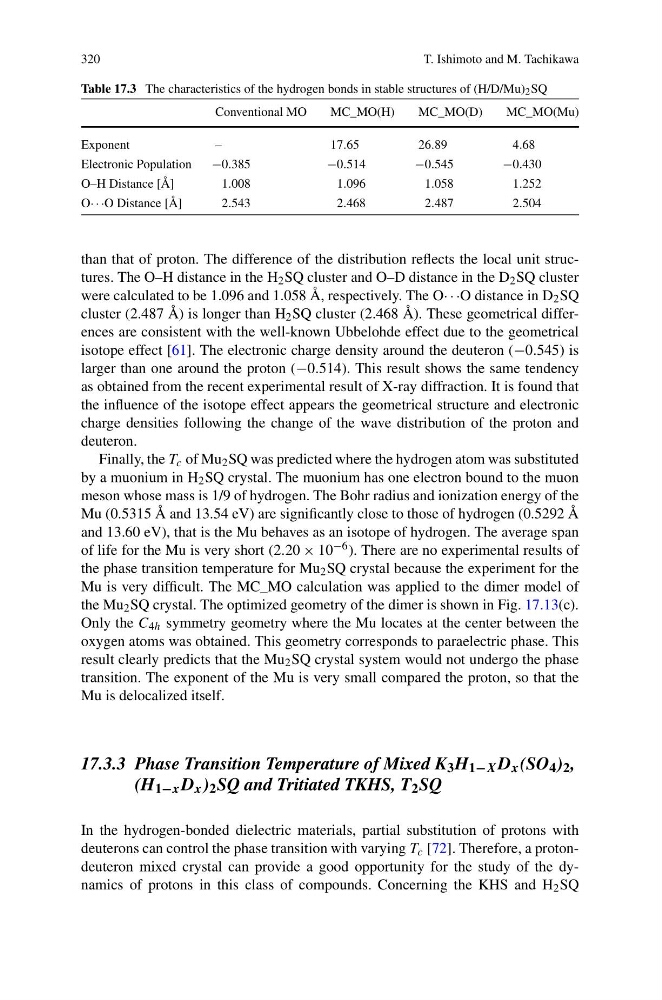
Table 17.3 The characteristics of the hydrogen bonds in stable structures of (H/D/Mu) 2 SQ
Conventional MO
MC_MO(H)
MC_MO(D)
MC_MO(Mu)
Exponent
–
17.65
26.89
4.68
Electronic Population
−0.385
−0.514
−0.545
−0.430
O–H Distance [Å]
1.008
1.096
1.058
1.252
O· · ·O Distance [Å]
2.543
2.468
2.487
2.504
than that of proton. The difference of the distribution reflects the local unit structures. The O–H distance in the H 2 SQ cluster and O–D distance in the D 2 SQ cluster
were calculated to be 1.096 and 1.058 Å, respectively. The O· · ·O distance in D 2 SQ
cluster (2.487 Å) is longer than H 2 SQ cluster (2.468 Å). These geometrical differences are consistent with the well-known Ubbelohde effect due to the geometrical
isotope effect [61]. The electronic charge density around the deuteron (−0.545) is
larger than one around the proton (−0.514). This result shows the same tendency
as obtained from the recent experimental result of X-ray diffraction. It is found that
the influence of the isotope effect appears the geometrical structure and electronic
charge densities following the change of the wave distribution of the proton and
deuteron.
Finally, the T c of Mu 2 SQ was predicted where the hydrogen atom was substituted
by a muonium in H 2 SQ crystal. The muonium has one electron bound to the muon
meson whose mass is 1/9 of hydrogen. The Bohr radius and ionization energy of the
Mu (0.5315 Å and 13.54 eV) are significantly close to those of hydrogen (0.5292 Å
and 13.60 eV), that is the Mu behaves as an isotope of hydrogen. The average span
of life for the Mu is very short (2.20 × 10 −6 ). There are no experimental results of
the phase transition temperature for Mu 2 SQ crystal because the experiment for the
Mu is very difficult. The MC_MO calculation was applied to the dimer model of
the Mu 2 SQ crystal. The optimized geometry of the dimer is shown in Fig. 17.13(c).
Only the C 4h symmetry geometry where the Mu locates at the center between the
oxygen atoms was obtained. This geometry corresponds to paraelectric phase. This
result clearly predicts that the Mu 2 SQ crystal system would not undergo the phase
transition. The exponent of the Mu is very small compared the proton, so that the
Mu is delocalized itself.
17.3.3 Phase Transition Temperature of Mixed K 3 H 1−X D x (SO 4 ) 2 ,
(H 1−x D x ) 2 SQ and Tritiated TKHS, T 2 SQ
In the hydrogen-bonded dielectric materials, partial substitution of protons with
deuterons can control the phase transition with varying T c [72]. Therefore, a protondeuteron mixed crystal can provide a good opportunity for the study of the dynamics of protons in this class of compounds. Concerning the KHS and H 2 SQ
T. Ishimoto and M. Tachikawa
Table 17.3 The characteristics of the hydrogen bonds in stable structures of (H/D/Mu) 2 SQ
Conventional MO
MC_MO(H)
MC_MO(D)
MC_MO(Mu)
Exponent
–
17.65
26.89
4.68
Electronic Population
−0.385
−0.514
−0.545
−0.430
O–H Distance [Å]
1.008
1.096
1.058
1.252
O· · ·O Distance [Å]
2.543
2.468
2.487
2.504
than that of proton. The difference of the distribution reflects the local unit structures. The O–H distance in the H 2 SQ cluster and O–D distance in the D 2 SQ cluster
were calculated to be 1.096 and 1.058 Å, respectively. The O· · ·O distance in D 2 SQ
cluster (2.487 Å) is longer than H 2 SQ cluster (2.468 Å). These geometrical differences are consistent with the well-known Ubbelohde effect due to the geometrical
isotope effect [61]. The electronic charge density around the deuteron (−0.545) is
larger than one around the proton (−0.514). This result shows the same tendency
as obtained from the recent experimental result of X-ray diffraction. It is found that
the influence of the isotope effect appears the geometrical structure and electronic
charge densities following the change of the wave distribution of the proton and
deuteron.
Finally, the T c of Mu 2 SQ was predicted where the hydrogen atom was substituted
by a muonium in H 2 SQ crystal. The muonium has one electron bound to the muon
meson whose mass is 1/9 of hydrogen. The Bohr radius and ionization energy of the
Mu (0.5315 Å and 13.54 eV) are significantly close to those of hydrogen (0.5292 Å
and 13.60 eV), that is the Mu behaves as an isotope of hydrogen. The average span
of life for the Mu is very short (2.20 × 10 −6 ). There are no experimental results of
the phase transition temperature for Mu 2 SQ crystal because the experiment for the
Mu is very difficult. The MC_MO calculation was applied to the dimer model of
the Mu 2 SQ crystal. The optimized geometry of the dimer is shown in Fig. 17.13(c).
Only the C 4h symmetry geometry where the Mu locates at the center between the
oxygen atoms was obtained. This geometry corresponds to paraelectric phase. This
result clearly predicts that the Mu 2 SQ crystal system would not undergo the phase
transition. The exponent of the Mu is very small compared the proton, so that the
Mu is delocalized itself.
17.3.3 Phase Transition Temperature of Mixed K 3 H 1−X D x (SO 4 ) 2 ,
(H 1−x D x ) 2 SQ and Tritiated TKHS, T 2 SQ
In the hydrogen-bonded dielectric materials, partial substitution of protons with
deuterons can control the phase transition with varying T c [72]. Therefore, a protondeuteron mixed crystal can provide a good opportunity for the study of the dynamics of protons in this class of compounds. Concerning the KHS and H 2 SQ