

112
S.O. Adamson et al.
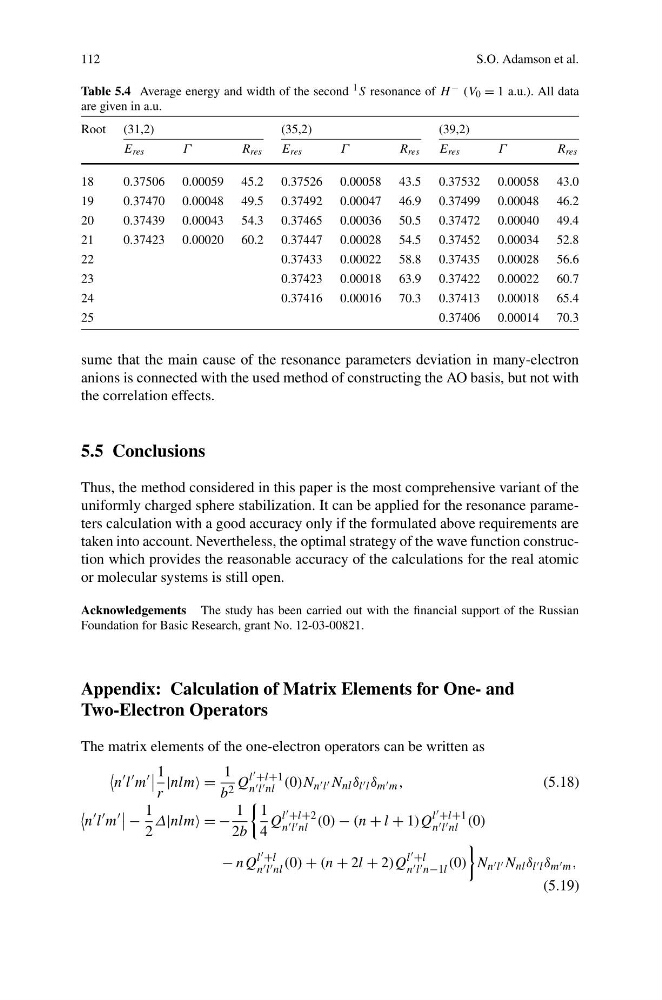
Table 5.4 Average energy and width of the second 1 S resonance of H − (V 0 = 1 a.u.). All data
are given in a.u.
Root (31,2)
(35,2)
(39,2)
E res
Γ
R res
E res
Γ
R res
E res
Γ
R res
18
0.37506 0.00059 45.2 0.37526 0.00058 43.5 0.37532 0.00058 43.0
19
0.37470 0.00048 49.5 0.37492 0.00047 46.9 0.37499 0.00048 46.2
20
0.37439 0.00043 54.3 0.37465 0.00036 50.5 0.37472 0.00040 49.4
21
0.37423 0.00020 60.2 0.37447 0.00028 54.5 0.37452 0.00034 52.8
22
0.37433 0.00022 58.8 0.37435 0.00028 56.6
23
0.37423 0.00018 63.9 0.37422 0.00022 60.7
24
0.37416 0.00016 70.3 0.37413 0.00018 65.4
25
0.37406 0.00014 70.3
sume that the main cause of the resonance parameters deviation in many-electron
anions is connected with the used method of constructing the AO basis, but not with
the correlation effects.
5.5 Conclusions
Thus, the method considered in this paper is the most comprehensive variant of the
uniformly charged sphere stabilization. It can be applied for the resonance parameters calculation with a good accuracy only if the formulated above requirements are
taken into account. Nevertheless, the optimal strategy of the wave function construction which provides the reasonable accuracy of the calculations for the real atomic
or molecular systems is still open.
Acknowledgements The study has been carried out with the financial support of the Russian
Foundation for Basic Research, grant No. 12-03-00821.
Appendix: Calculation of Matrix Elements for One- and
Two-Electron Operators
The matrix elements of the one-electron operators can be written as
n
l
m
1
r
|nlm =
1
b 2 Q
l +l+1
n l nl (0)N n l N nl δ l l δ m m ,
(5.18)
n
l
m
−
1
2
Δ|nlm = −
1
2b
1
4
Q
l +l+2
n l nl (0) − (n + l + 1)Q
l +l+1
n l nl (0)
− nQ
l +l
n l nl (0) + (n + 2l + 2)Q
l +l
n l n−1l (0)
N n l N nl δ l l δ m m ,
(5.19)
S.O. Adamson et al.
Table 5.4 Average energy and width of the second 1 S resonance of H − (V 0 = 1 a.u.). All data
are given in a.u.
Root (31,2)
(35,2)
(39,2)
E res
Γ
R res
E res
Γ
R res
E res
Γ
R res
18
0.37506 0.00059 45.2 0.37526 0.00058 43.5 0.37532 0.00058 43.0
19
0.37470 0.00048 49.5 0.37492 0.00047 46.9 0.37499 0.00048 46.2
20
0.37439 0.00043 54.3 0.37465 0.00036 50.5 0.37472 0.00040 49.4
21
0.37423 0.00020 60.2 0.37447 0.00028 54.5 0.37452 0.00034 52.8
22
0.37433 0.00022 58.8 0.37435 0.00028 56.6
23
0.37423 0.00018 63.9 0.37422 0.00022 60.7
24
0.37416 0.00016 70.3 0.37413 0.00018 65.4
25
0.37406 0.00014 70.3
sume that the main cause of the resonance parameters deviation in many-electron
anions is connected with the used method of constructing the AO basis, but not with
the correlation effects.
5.5 Conclusions
Thus, the method considered in this paper is the most comprehensive variant of the
uniformly charged sphere stabilization. It can be applied for the resonance parameters calculation with a good accuracy only if the formulated above requirements are
taken into account. Nevertheless, the optimal strategy of the wave function construction which provides the reasonable accuracy of the calculations for the real atomic
or molecular systems is still open.
Acknowledgements The study has been carried out with the financial support of the Russian
Foundation for Basic Research, grant No. 12-03-00821.
Appendix: Calculation of Matrix Elements for One- and
Two-Electron Operators
The matrix elements of the one-electron operators can be written as
n
l
m
1
r
|nlm =
1
b 2 Q
l +l+1
n l nl (0)N n l N nl δ l l δ m m ,
(5.18)
n
l
m
−
1
2
Δ|nlm = −
1
2b
1
4
Q
l +l+2
n l nl (0) − (n + l + 1)Q
l +l+1
n l nl (0)
− nQ
l +l
n l nl (0) + (n + 2l + 2)Q
l +l
n l n−1l (0)
N n l N nl δ l l δ m m ,
(5.19)