

11
rostrum. It is found all over the Mediterranean and on the East coast of the Atlantic
Ocean. This species grows up to a maximum of 22.5 cm. Young individuals are
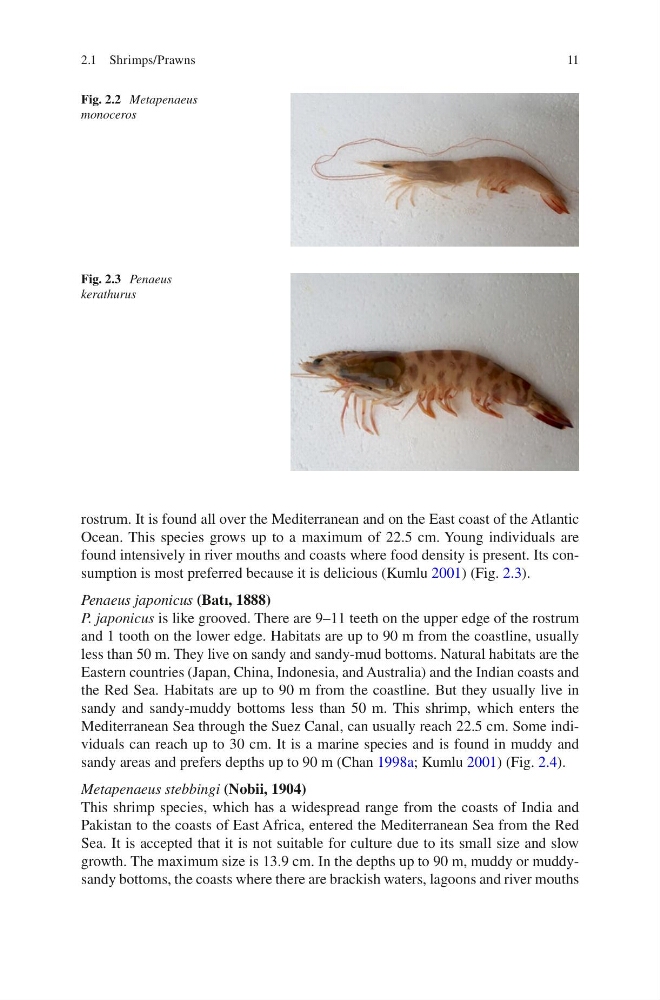
found intensively in river mouths and coasts where food density is present. Its consumption is most preferred because it is delicious (Kumlu 2001) (Fig. 2.3).
Penaeus japonicus (Batı, 1888)
P. japonicus is like grooved. There are 9–11 teeth on the upper edge of the rostrum
and 1 tooth on the lower edge. Habitats are up to 90 m from the coastline, usually
less than 50 m. They live on sandy and sandy-mud bottoms. Natural habitats are the
Eastern countries (Japan, China, Indonesia, and Australia) and the Indian coasts and
the Red Sea. Habitats are up to 90 m from the coastline. But they usually live in
sandy and sandy-muddy bottoms less than 50 m. This shrimp, which enters the
Mediterranean Sea through the Suez Canal, can usually reach 22.5 cm. Some individuals can reach up to 30 cm. It is a marine species and is found in muddy and
sandy areas and prefers depths up to 90 m (Chan 1998a; Kumlu 2001) (Fig. 2.4).
Metapenaeus stebbingi (Nobii, 1904)
This shrimp species, which has a widespread range from the coasts of India and
Pakistan to the coasts of East Africa, entered the Mediterranean Sea from the Red
Sea. It is accepted that it is not suitable for culture due to its small size and slow
growth. The maximum size is 13.9 cm. In the depths up to 90 m, muddy or muddysandy bottoms, the coasts where there are brackish waters, lagoons and river mouths
Fig. 2.2 Metapenaeus
monoceros
Fig. 2.3 Penaeus
kerathurus
2.1 Shrimps/Prawns
rostrum. It is found all over the Mediterranean and on the East coast of the Atlantic
Ocean. This species grows up to a maximum of 22.5 cm. Young individuals are
found intensively in river mouths and coasts where food density is present. Its consumption is most preferred because it is delicious (Kumlu 2001) (Fig. 2.3).
Penaeus japonicus (Batı, 1888)
P. japonicus is like grooved. There are 9–11 teeth on the upper edge of the rostrum
and 1 tooth on the lower edge. Habitats are up to 90 m from the coastline, usually
less than 50 m. They live on sandy and sandy-mud bottoms. Natural habitats are the
Eastern countries (Japan, China, Indonesia, and Australia) and the Indian coasts and
the Red Sea. Habitats are up to 90 m from the coastline. But they usually live in
sandy and sandy-muddy bottoms less than 50 m. This shrimp, which enters the
Mediterranean Sea through the Suez Canal, can usually reach 22.5 cm. Some individuals can reach up to 30 cm. It is a marine species and is found in muddy and
sandy areas and prefers depths up to 90 m (Chan 1998a; Kumlu 2001) (Fig. 2.4).
Metapenaeus stebbingi (Nobii, 1904)
This shrimp species, which has a widespread range from the coasts of India and
Pakistan to the coasts of East Africa, entered the Mediterranean Sea from the Red
Sea. It is accepted that it is not suitable for culture due to its small size and slow
growth. The maximum size is 13.9 cm. In the depths up to 90 m, muddy or muddysandy bottoms, the coasts where there are brackish waters, lagoons and river mouths
Fig. 2.2 Metapenaeus
monoceros
Fig. 2.3 Penaeus
kerathurus
2.1 Shrimps/Prawns