

10
Of the more than 2500 known shrimp species, 343 are of economic importance.
Of these, 110 species belong to the Penaeidae family and constitute 80% of the
shrimps captured from nature (Kumlu 2001). Member of this family are usually
marine origin. Some members, mainly those of the genera Parapenaeus penaeopsis
occur at deep water (more than 750 m). Penaeids are mostly benthic and mainly
found on soft bottom of sand and mud. Their size ranges from 2.5 to 35 cm body
length. Penaeus species are caught extensively by trawls, seines, set nets and traps.
Penaeus merguiensis and Penaeus monodon are the most important species. Penaeus
aquaculture, mostly Penaeus monodon, is very popular in many countries.
Metapenaeus is the secondary genus in aquaculture. The third commercially important species is Parapenaeopsis (Chan 1998a). In Caridae prawns, the first two of the
walking legs are clamps. In the Stenopodidae shrimp, the first three of the walking
legs are clamped, but III. double walking legs are much longer and longer than other
(Kumlu 2001).
Information about some important shrimp species is given below.
Penaeus semisulcatus (De Haan, 1844)
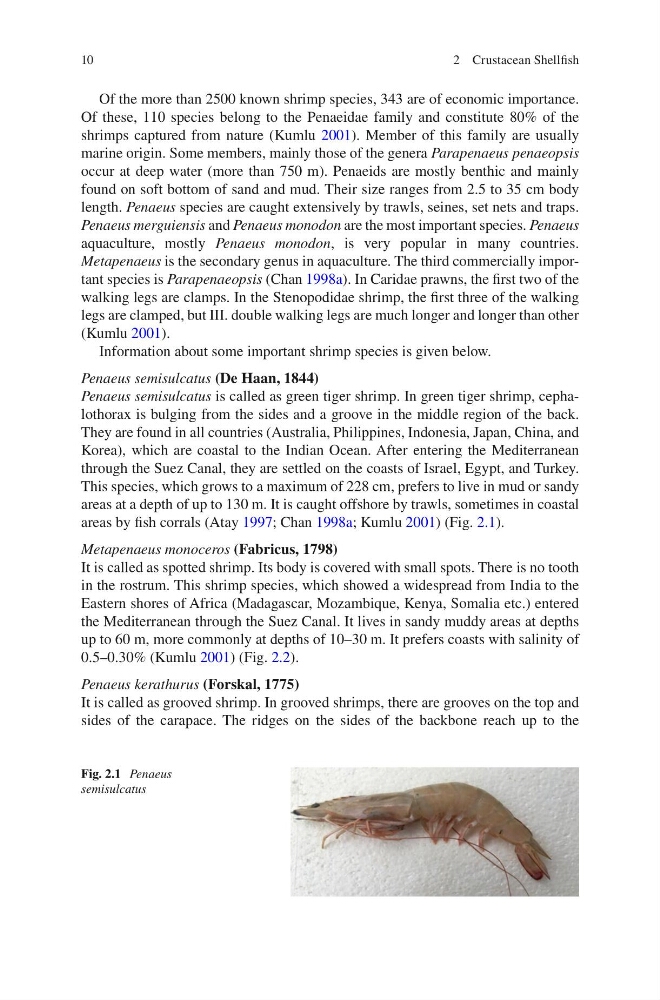
Penaeus semisulcatus is called as green tiger shrimp. In green tiger shrimp, cephalothorax is bulging from the sides and a groove in the middle region of the back.
They are found in all countries (Australia, Philippines, Indonesia, Japan, China, and
Korea), which are coastal to the Indian Ocean. After entering the Mediterranean
through the Suez Canal, they are settled on the coasts of Israel, Egypt, and Turkey.
This species, which grows to a maximum of 228 cm, prefers to live in mud or sandy
areas at a depth of up to 130 m. It is caught offshore by trawls, sometimes in coastal
areas by fish corrals (Atay 1997; Chan 1998a; Kumlu 2001) (Fig. 2.1).
Metapenaeus monoceros (Fabricus, 1798)
It is called as spotted shrimp. Its body is covered with small spots. There is no tooth
in the rostrum. This shrimp species, which showed a widespread from India to the
Eastern shores of Africa (Madagascar, Mozambique, Kenya, Somalia etc.) entered
the Mediterranean through the Suez Canal. It lives in sandy muddy areas at depths
up to 60 m, more commonly at depths of 10–30 m. It prefers coasts with salinity of
0.5–0.30% (Kumlu 2001) (Fig. 2.2).
Penaeus kerathurus (Forskal, 1775)
It is called as grooved shrimp. In grooved shrimps, there are grooves on the top and
sides of the carapace. The ridges on the sides of the backbone reach up to the
Fig. 2.1 Penaeus
semisulcatus
2 Crustacean Shellfish
Of the more than 2500 known shrimp species, 343 are of economic importance.
Of these, 110 species belong to the Penaeidae family and constitute 80% of the
shrimps captured from nature (Kumlu 2001). Member of this family are usually
marine origin. Some members, mainly those of the genera Parapenaeus penaeopsis
occur at deep water (more than 750 m). Penaeids are mostly benthic and mainly
found on soft bottom of sand and mud. Their size ranges from 2.5 to 35 cm body
length. Penaeus species are caught extensively by trawls, seines, set nets and traps.
Penaeus merguiensis and Penaeus monodon are the most important species. Penaeus
aquaculture, mostly Penaeus monodon, is very popular in many countries.
Metapenaeus is the secondary genus in aquaculture. The third commercially important species is Parapenaeopsis (Chan 1998a). In Caridae prawns, the first two of the
walking legs are clamps. In the Stenopodidae shrimp, the first three of the walking
legs are clamped, but III. double walking legs are much longer and longer than other
(Kumlu 2001).
Information about some important shrimp species is given below.
Penaeus semisulcatus (De Haan, 1844)
Penaeus semisulcatus is called as green tiger shrimp. In green tiger shrimp, cephalothorax is bulging from the sides and a groove in the middle region of the back.
They are found in all countries (Australia, Philippines, Indonesia, Japan, China, and
Korea), which are coastal to the Indian Ocean. After entering the Mediterranean
through the Suez Canal, they are settled on the coasts of Israel, Egypt, and Turkey.
This species, which grows to a maximum of 228 cm, prefers to live in mud or sandy
areas at a depth of up to 130 m. It is caught offshore by trawls, sometimes in coastal
areas by fish corrals (Atay 1997; Chan 1998a; Kumlu 2001) (Fig. 2.1).
Metapenaeus monoceros (Fabricus, 1798)
It is called as spotted shrimp. Its body is covered with small spots. There is no tooth
in the rostrum. This shrimp species, which showed a widespread from India to the
Eastern shores of Africa (Madagascar, Mozambique, Kenya, Somalia etc.) entered
the Mediterranean through the Suez Canal. It lives in sandy muddy areas at depths
up to 60 m, more commonly at depths of 10–30 m. It prefers coasts with salinity of
0.5–0.30% (Kumlu 2001) (Fig. 2.2).
Penaeus kerathurus (Forskal, 1775)
It is called as grooved shrimp. In grooved shrimps, there are grooves on the top and
sides of the carapace. The ridges on the sides of the backbone reach up to the
Fig. 2.1 Penaeus
semisulcatus
2 Crustacean Shellfish