

185
been fished in large numbers. Pecten maximus lives on sand and gravel bottoms but
it can be found in mud as well. The young molluscs live attached with their byssus
to a hard substrate, but when they become adult the shells are free-swimming. They
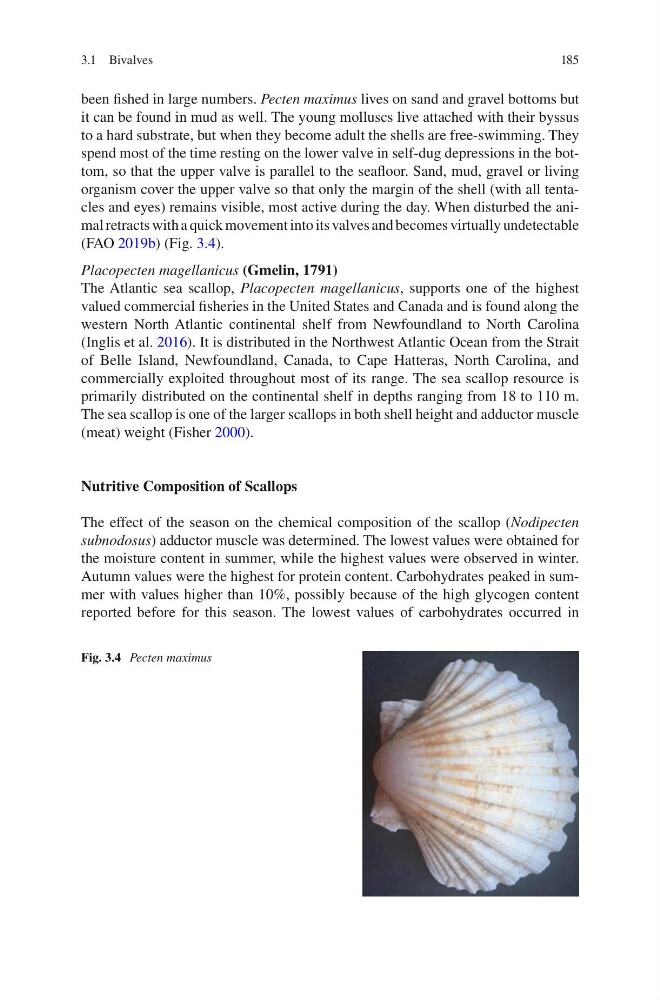
spend most of the time resting on the lower valve in self-dug depressions in the bottom, so that the upper valve is parallel to the seafloor. Sand, mud, gravel or living
organism cover the upper valve so that only the margin of the shell (with all tentacles and eyes) remains visible, most active during the day. When disturbed the animal retracts with a quick movement into its valves and becomes virtually undetectable
(FAO 2019b) (Fig. 3.4).
Placopecten magellanicus (Gmelin, 1791)
The Atlantic sea scallop, Placopecten magellanicus, supports one of the highest
valued commercial fisheries in the United States and Canada and is found along the
western North Atlantic continental shelf from Newfoundland to North Carolina
(Inglis et al. 2016). It is distributed in the Northwest Atlantic Ocean from the Strait
of Belle Island, Newfoundland, Canada, to Cape Hatteras, North Carolina, and
commercially exploited throughout most of its range. The sea scallop resource is
primarily distributed on the continental shelf in depths ranging from 18 to 110 m.
The sea scallop is one of the larger scallops in both shell height and adductor muscle
(meat) weight (Fisher 2000).
Nutritive Composition of Scallops
The effect of the season on the chemical composition of the scallop (Nodipecten
subnodosus) adductor muscle was determined. The lowest values were obtained for
the moisture content in summer, while the highest values were observed in winter.
Autumn values were the highest for protein content. Carbohydrates peaked in summer with values higher than 10%, possibly because of the high glycogen content
reported before for this season. The lowest values of carbohydrates occurred in
Fig. 3.4 Pecten maximus
3.1 Bivalves
been fished in large numbers. Pecten maximus lives on sand and gravel bottoms but
it can be found in mud as well. The young molluscs live attached with their byssus
to a hard substrate, but when they become adult the shells are free-swimming. They
spend most of the time resting on the lower valve in self-dug depressions in the bottom, so that the upper valve is parallel to the seafloor. Sand, mud, gravel or living
organism cover the upper valve so that only the margin of the shell (with all tentacles and eyes) remains visible, most active during the day. When disturbed the animal retracts with a quick movement into its valves and becomes virtually undetectable
(FAO 2019b) (Fig. 3.4).
Placopecten magellanicus (Gmelin, 1791)
The Atlantic sea scallop, Placopecten magellanicus, supports one of the highest
valued commercial fisheries in the United States and Canada and is found along the
western North Atlantic continental shelf from Newfoundland to North Carolina
(Inglis et al. 2016). It is distributed in the Northwest Atlantic Ocean from the Strait
of Belle Island, Newfoundland, Canada, to Cape Hatteras, North Carolina, and
commercially exploited throughout most of its range. The sea scallop resource is
primarily distributed on the continental shelf in depths ranging from 18 to 110 m.
The sea scallop is one of the larger scallops in both shell height and adductor muscle
(meat) weight (Fisher 2000).
Nutritive Composition of Scallops
The effect of the season on the chemical composition of the scallop (Nodipecten
subnodosus) adductor muscle was determined. The lowest values were obtained for
the moisture content in summer, while the highest values were observed in winter.
Autumn values were the highest for protein content. Carbohydrates peaked in summer with values higher than 10%, possibly because of the high glycogen content
reported before for this season. The lowest values of carbohydrates occurred in
Fig. 3.4 Pecten maximus
3.1 Bivalves