

Plasticity is a key regulatory feature of the kinases’ catalytic domain. However,
only few cysteines accessible in inactive conformations have been targeted to date.
In their seminal work analyzing cysteines available in DFG-out and αC-helix-out
conformations, Leproult et al. also designed imatinib-derived electrophilic inhibitors
to target the kinases KIT and PDGFRα (platelet-derived growth factor receptor α)
via cysteine moieties in the catalytic loop (Cys788 and Cys814, respectively)
[15]. Despite its relatively weak apparent potency, key compound 77 (Fig. 27)
labeled the predicted cysteines as shown by MS and hit only seven other targets
(PDGFRβ, JNK 1–3, DDR1, BRAFV600E, and CSF1R) in a panel of 440 kinases.
Notably, the panel contained 17 out of 20 kinases sharing an equivalently positioned
cysteine of which (besides KIT and PDGFRα) only PDGFRβ and CSF1R were
potently bound.
2.9 Development of Inhibitors Targeting Cysteines
in Allosteric Pockets
Besides ligands addressing the ATP pocket, covalent kinase inhibitors engaging
allosteric sites have also been identified. As an example, covalent allosteric inhibition of RSKs and MSKs has been suggested to contribute to the biological activity of
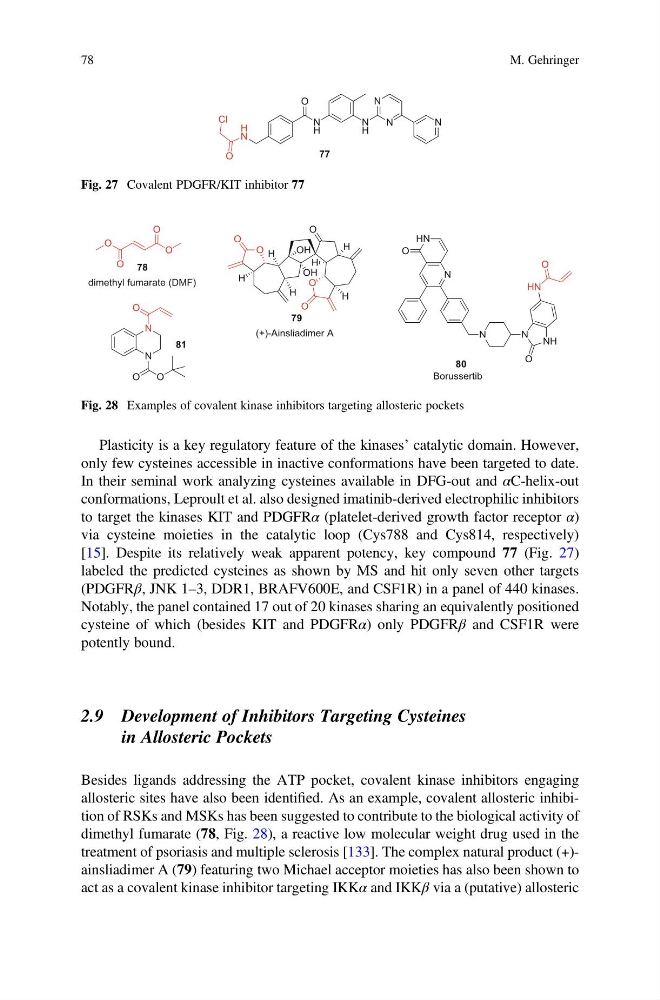
dimethyl fumarate (78, Fig. 28), a reactive low molecular weight drug used in the
treatment of psoriasis and multiple sclerosis [133]. The complex natural product (+)ainsliadimer A (79) featuring two Michael acceptor moieties has also been shown to
act as a covalent kinase inhibitor targeting IKKα and IKKβ via a (putative) allosteric
H
N
O
N
H
N
H
N
N
N
77
O
Cl
Fig. 27 Covalent PDGFR/KIT inhibitor 77
78
O
O
O
O
dimethyl fumarate (DMF)
O
O
H
OH
O
H
OH
O
O
H
H
H
H
(+)-Ainsliadimer A
79
N
HN
O
N
N
NH
O
HN
O
80
Borussertib
N
N
O
O
O
81
Fig. 28 Examples of covalent kinase inhibitors targeting allosteric pockets
78
M. Gehringer
only few cysteines accessible in inactive conformations have been targeted to date.
In their seminal work analyzing cysteines available in DFG-out and αC-helix-out
conformations, Leproult et al. also designed imatinib-derived electrophilic inhibitors
to target the kinases KIT and PDGFRα (platelet-derived growth factor receptor α)
via cysteine moieties in the catalytic loop (Cys788 and Cys814, respectively)
[15]. Despite its relatively weak apparent potency, key compound 77 (Fig. 27)
labeled the predicted cysteines as shown by MS and hit only seven other targets
(PDGFRβ, JNK 1–3, DDR1, BRAFV600E, and CSF1R) in a panel of 440 kinases.
Notably, the panel contained 17 out of 20 kinases sharing an equivalently positioned
cysteine of which (besides KIT and PDGFRα) only PDGFRβ and CSF1R were
potently bound.
2.9 Development of Inhibitors Targeting Cysteines
in Allosteric Pockets
Besides ligands addressing the ATP pocket, covalent kinase inhibitors engaging
allosteric sites have also been identified. As an example, covalent allosteric inhibition of RSKs and MSKs has been suggested to contribute to the biological activity of
dimethyl fumarate (78, Fig. 28), a reactive low molecular weight drug used in the
treatment of psoriasis and multiple sclerosis [133]. The complex natural product (+)ainsliadimer A (79) featuring two Michael acceptor moieties has also been shown to
act as a covalent kinase inhibitor targeting IKKα and IKKβ via a (putative) allosteric
H
N
O
N
H
N
H
N
N
N
77
O
Cl
Fig. 27 Covalent PDGFR/KIT inhibitor 77
78
O
O
O
O
dimethyl fumarate (DMF)
O
O
H
OH
O
H
OH
O
O
H
H
H
H
(+)-Ainsliadimer A
79
N
HN
O
N
N
NH
O
HN
O
80
Borussertib
N
N
O
O
O
81
Fig. 28 Examples of covalent kinase inhibitors targeting allosteric pockets
78
M. Gehringer