

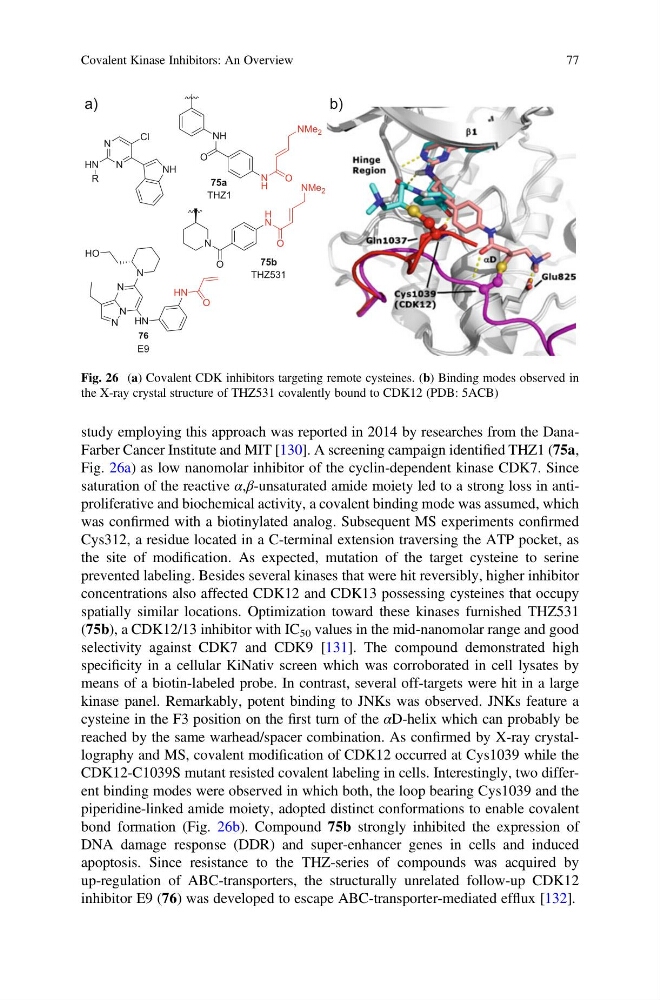
study employing this approach was reported in 2014 by researches from the DanaFarber Cancer Institute and MIT [130]. A screening campaign identified THZ1 (75a,
Fig. 26a) as low nanomolar inhibitor of the cyclin-dependent kinase CDK7. Since
saturation of the reactive α,β-unsaturated amide moiety led to a strong loss in antiproliferative and biochemical activity, a covalent binding mode was assumed, which
was confirmed with a biotinylated analog. Subsequent MS experiments confirmed
Cys312, a residue located in a C-terminal extension traversing the ATP pocket, as
the site of modification. As expected, mutation of the target cysteine to serine
prevented labeling. Besides several kinases that were hit reversibly, higher inhibitor
concentrations also affected CDK12 and CDK13 possessing cysteines that occupy
spatially similar locations. Optimization toward these kinases furnished THZ531
(75b), a CDK12/13 inhibitor with IC 50 values in the mid-nanomolar range and good
selectivity against CDK7 and CDK9 [131]. The compound demonstrated high
specificity in a cellular KiNativ screen which was corroborated in cell lysates by
means of a biotin-labeled probe. In contrast, several off-targets were hit in a large
kinase panel. Remarkably, potent binding to JNKs was observed. JNKs feature a
cysteine in the F3 position on the first turn of the αD-helix which can probably be
reached by the same warhead/spacer combination. As confirmed by X-ray crystallography and MS, covalent modification of CDK12 occurred at Cys1039 while the
CDK12-C1039S mutant resisted covalent labeling in cells. Interestingly, two different binding modes were observed in which both, the loop bearing Cys1039 and the
piperidine-linked amide moiety, adopted distinct conformations to enable covalent
bond formation (Fig. 26b). Compound 75b strongly inhibited the expression of
DNA damage response (DDR) and super-enhancer genes in cells and induced
apoptosis. Since resistance to the THZ-series of compounds was acquired by
up-regulation of ABC-transporters, the structurally unrelated follow-up CDK12
inhibitor E9 (76) was developed to escape ABC-transporter-mediated efflux [132].
N
N
HN
Cl
NH
R
N
O
H
N
O
NMe 2
75a
THZ1
75b
THZ531
a)
b)
NH
O
N
H
O
NMe 2
N
N
N
N
HN
HO
HN
O
E9
76
Fig. 26 (a) Covalent CDK inhibitors targeting remote cysteines. (b) Binding modes observed in
the X-ray crystal structure of THZ531 covalently bound to CDK12 (PDB: 5ACB)
Covalent Kinase Inhibitors: An Overview
77
Fig. 26a) as low nanomolar inhibitor of the cyclin-dependent kinase CDK7. Since
saturation of the reactive α,β-unsaturated amide moiety led to a strong loss in antiproliferative and biochemical activity, a covalent binding mode was assumed, which
was confirmed with a biotinylated analog. Subsequent MS experiments confirmed
Cys312, a residue located in a C-terminal extension traversing the ATP pocket, as
the site of modification. As expected, mutation of the target cysteine to serine
prevented labeling. Besides several kinases that were hit reversibly, higher inhibitor
concentrations also affected CDK12 and CDK13 possessing cysteines that occupy
spatially similar locations. Optimization toward these kinases furnished THZ531
(75b), a CDK12/13 inhibitor with IC 50 values in the mid-nanomolar range and good
selectivity against CDK7 and CDK9 [131]. The compound demonstrated high
specificity in a cellular KiNativ screen which was corroborated in cell lysates by
means of a biotin-labeled probe. In contrast, several off-targets were hit in a large
kinase panel. Remarkably, potent binding to JNKs was observed. JNKs feature a
cysteine in the F3 position on the first turn of the αD-helix which can probably be
reached by the same warhead/spacer combination. As confirmed by X-ray crystallography and MS, covalent modification of CDK12 occurred at Cys1039 while the
CDK12-C1039S mutant resisted covalent labeling in cells. Interestingly, two different binding modes were observed in which both, the loop bearing Cys1039 and the
piperidine-linked amide moiety, adopted distinct conformations to enable covalent
bond formation (Fig. 26b). Compound 75b strongly inhibited the expression of
DNA damage response (DDR) and super-enhancer genes in cells and induced
apoptosis. Since resistance to the THZ-series of compounds was acquired by
up-regulation of ABC-transporters, the structurally unrelated follow-up CDK12
inhibitor E9 (76) was developed to escape ABC-transporter-mediated efflux [132].
N
N
HN
Cl
NH
R
N
O
H
N
O
NMe 2
75a
THZ1
75b
THZ531
a)
b)
NH
O
N
H
O
NMe 2
N
N
N
N
HN
HO
HN
O
E9
76
Fig. 26 (a) Covalent CDK inhibitors targeting remote cysteines. (b) Binding modes observed in
the X-ray crystal structure of THZ531 covalently bound to CDK12 (PDB: 5ACB)
Covalent Kinase Inhibitors: An Overview
77