

inhibitor with a slow dissociation rate that recently entered phase III clinical trials for
the treatment of pemphigus (NCT03762265).
PF-303 (29, Fig. 12c), a covalent-reversible BTK inhibitor from Pfizer, addresses
the same cysteine residue via a cyanamide group [81]. Cyanamides, a warheads class
known from cysteine protease inhibitors [82, 83], react with cysteines at similar rates
as acrylamides [74]. This Pinner-type addition results in the reversible formation of
isothiourea products (Fig. 12d). PF-303, which can be regarded as an ibrutinib
bioisostere, is a very potent BTK inhibitor (IC 50 ¼ 0.64 nM, k inact /
K I ¼ 1.44 Â 10
5 M
À1 s
À1 ) with a moderate dissociation rate (t 1/2 ¼ 5 h). While
being highly selective against JAK3, ITK (both >10,000-fold), and several related
kinases, PF303 inhibits TEC and BMX at similar potency as BTK. The compound
efficiently blocked anti-IgM F(ab’)2-mediated proliferation of murine B-cells
(IC 50 ¼ 2 nM) and showed in vivo activity in mice upon oral dosing.
Interleukin-2 inducible T-cell kinase (ITK) is closely related to BTK and features
an equivalently positioned cysteine (Cys422) that was suggested to possess a lower
nucleophilicity due to a pK a increase promoted by the proximal Asp445 [84]. As a
mediator of T-cell receptor signaling, ITK plays an important role in T-cell development, differentiation, and function. It is considered a promising target in the
treatment of inflammatory and autoimmune disorders as well as T-cell malignancies.
Based on the fact that ibrutinib and similar BTK inhibitors show significant
off-target activity on ITK, researchers from Pfizer developed analogous compounds
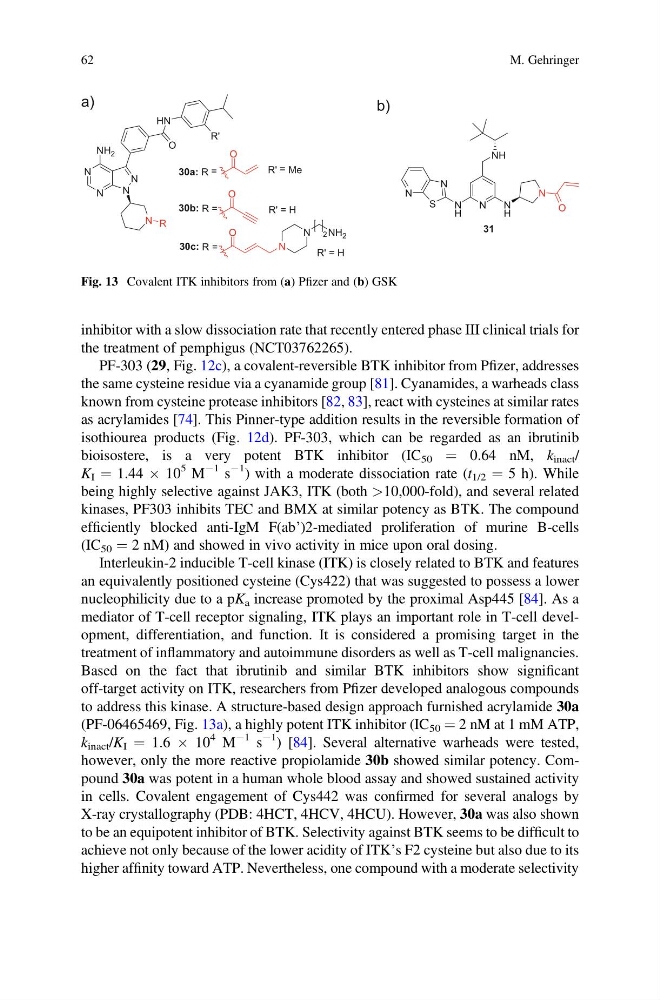
to address this kinase. A structure-based design approach furnished acrylamide 30a
(PF-06465469, Fig. 13a), a highly potent ITK inhibitor (IC 50 ¼ 2 nM at 1 mM ATP,
k inact /K I ¼ 1.6 Â 10
4 M
À1 s
À1 ) [84]. Several alternative warheads were tested,
however, only the more reactive propiolamide 30b showed similar potency. Compound 30a was potent in a human whole blood assay and showed sustained activity
in cells. Covalent engagement of Cys442 was confirmed for several analogs by
X-ray crystallography (PDB: 4HCT, 4HCV, 4HCU). However, 30a was also shown
to be an equipotent inhibitor of BTK. Selectivity against BTK seems to be difficult to
achieve not only because of the lower acidity of ITK’s F2 cysteine but also due to its
higher affinity toward ATP. Nevertheless, one compound with a moderate selectivity
NH 2
N
N
N R
N
N
30b: R =
30a: R =
O
O
HN
O
R'
R' = Me
R' = H
30c: R =
O
R' = H
N
N
NH 2
2
N
N
H
N
O
N
H
N
S
N
NH
a)
b)
31
Fig. 13 Covalent ITK inhibitors from (a) Pfizer and (b) GSK
62
M. Gehringer
the treatment of pemphigus (NCT03762265).
PF-303 (29, Fig. 12c), a covalent-reversible BTK inhibitor from Pfizer, addresses
the same cysteine residue via a cyanamide group [81]. Cyanamides, a warheads class
known from cysteine protease inhibitors [82, 83], react with cysteines at similar rates
as acrylamides [74]. This Pinner-type addition results in the reversible formation of
isothiourea products (Fig. 12d). PF-303, which can be regarded as an ibrutinib
bioisostere, is a very potent BTK inhibitor (IC 50 ¼ 0.64 nM, k inact /
K I ¼ 1.44 Â 10
5 M
À1 s
À1 ) with a moderate dissociation rate (t 1/2 ¼ 5 h). While
being highly selective against JAK3, ITK (both >10,000-fold), and several related
kinases, PF303 inhibits TEC and BMX at similar potency as BTK. The compound
efficiently blocked anti-IgM F(ab’)2-mediated proliferation of murine B-cells
(IC 50 ¼ 2 nM) and showed in vivo activity in mice upon oral dosing.
Interleukin-2 inducible T-cell kinase (ITK) is closely related to BTK and features
an equivalently positioned cysteine (Cys422) that was suggested to possess a lower
nucleophilicity due to a pK a increase promoted by the proximal Asp445 [84]. As a
mediator of T-cell receptor signaling, ITK plays an important role in T-cell development, differentiation, and function. It is considered a promising target in the
treatment of inflammatory and autoimmune disorders as well as T-cell malignancies.
Based on the fact that ibrutinib and similar BTK inhibitors show significant
off-target activity on ITK, researchers from Pfizer developed analogous compounds
to address this kinase. A structure-based design approach furnished acrylamide 30a
(PF-06465469, Fig. 13a), a highly potent ITK inhibitor (IC 50 ¼ 2 nM at 1 mM ATP,
k inact /K I ¼ 1.6 Â 10
4 M
À1 s
À1 ) [84]. Several alternative warheads were tested,
however, only the more reactive propiolamide 30b showed similar potency. Compound 30a was potent in a human whole blood assay and showed sustained activity
in cells. Covalent engagement of Cys442 was confirmed for several analogs by
X-ray crystallography (PDB: 4HCT, 4HCV, 4HCU). However, 30a was also shown
to be an equipotent inhibitor of BTK. Selectivity against BTK seems to be difficult to
achieve not only because of the lower acidity of ITK’s F2 cysteine but also due to its
higher affinity toward ATP. Nevertheless, one compound with a moderate selectivity
NH 2
N
N
N R
N
N
30b: R =
30a: R =
O
O
HN
O
R'
R' = Me
R' = H
30c: R =
O
R' = H
N
N
NH 2
2
N
N
H
N
O
N
H
N
S
N
NH
a)
b)
31
Fig. 13 Covalent ITK inhibitors from (a) Pfizer and (b) GSK
62
M. Gehringer