

residence time of approx. 1 week. In accordance with the applied design concept,
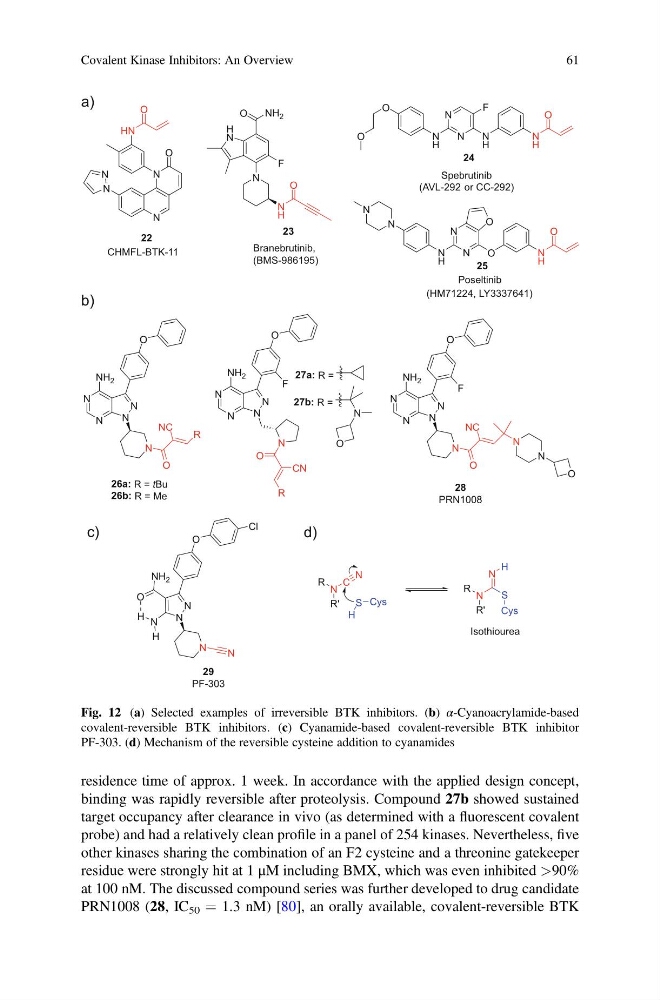
binding was rapidly reversible after proteolysis. Compound 27b showed sustained
target occupancy after clearance in vivo (as determined with a fluorescent covalent
probe) and had a relatively clean profile in a panel of 254 kinases. Nevertheless, five
other kinases sharing the combination of an F2 cysteine and a threonine gatekeeper
residue were strongly hit at 1 μM including BMX, which was even inhibited >90%
at 100 nM. The discussed compound series was further developed to drug candidate
PRN1008 (28, IC 50 ¼ 1.3 nM) [80], an orally available, covalent-reversible BTK
O
O
N
H
N
N
N
H
N
H
O
F
Spebrutinib
(AVL-292 or CC-292)
24
Poseltinib
(HM71224, LY3337641)
N
N
N
H
N
N
O
O
N
H
O
25
a)
b)
NH 2
O
N
N
N
O
N
N
NC
R
26a: R = tBu
26b: R = Me
NH 2
O
N
N
N
N
F
N
O
CN
R
N
27a: R =
27b: R =
NH 2
O
N
N
N
O
N
N
NC
F
N
N
O
28
PRN1008
O
N
N
N
O
NH 2
H
H
O
N
N
c)
Cl
29
PF-303
R'
N
C
N
H
S Cys
N
S
N
Cys
H
R
R
R'
Isothiourea
d)
N
N
O
N
N
HN
O
CHMFL-BTK-11
22
H
N
O
NH 2
N
N
H
O
F
23
Branebrutinib,
(BMS-986195)
Fig. 12 (a) Selected examples of irreversible BTK inhibitors. (b) α-Cyanoacrylamide-based
covalent-reversible BTK inhibitors. (c) Cyanamide-based covalent-reversible BTK inhibitor
PF-303. (d) Mechanism of the reversible cysteine addition to cyanamides
Covalent Kinase Inhibitors: An Overview
61
binding was rapidly reversible after proteolysis. Compound 27b showed sustained
target occupancy after clearance in vivo (as determined with a fluorescent covalent
probe) and had a relatively clean profile in a panel of 254 kinases. Nevertheless, five
other kinases sharing the combination of an F2 cysteine and a threonine gatekeeper
residue were strongly hit at 1 μM including BMX, which was even inhibited >90%
at 100 nM. The discussed compound series was further developed to drug candidate
PRN1008 (28, IC 50 ¼ 1.3 nM) [80], an orally available, covalent-reversible BTK
O
O
N
H
N
N
N
H
N
H
O
F
Spebrutinib
(AVL-292 or CC-292)
24
Poseltinib
(HM71224, LY3337641)
N
N
N
H
N
N
O
O
N
H
O
25
a)
b)
NH 2
O
N
N
N
O
N
N
NC
R
26a: R = tBu
26b: R = Me
NH 2
O
N
N
N
N
F
N
O
CN
R
N
27a: R =
27b: R =
NH 2
O
N
N
N
O
N
N
NC
F
N
N
O
28
PRN1008
O
N
N
N
O
NH 2
H
H
O
N
N
c)
Cl
29
PF-303
R'
N
C
N
H
S Cys
N
S
N
Cys
H
R
R
R'
Isothiourea
d)
N
N
O
N
N
HN
O
CHMFL-BTK-11
22
H
N
O
NH 2
N
N
H
O
F
23
Branebrutinib,
(BMS-986195)
Fig. 12 (a) Selected examples of irreversible BTK inhibitors. (b) α-Cyanoacrylamide-based
covalent-reversible BTK inhibitors. (c) Cyanamide-based covalent-reversible BTK inhibitor
PF-303. (d) Mechanism of the reversible cysteine addition to cyanamides
Covalent Kinase Inhibitors: An Overview
61