

BLK, HER4, and ITK, with IC 50 values of 22 nM, 44 nM, and 221 nM, respectively.
Based on the computed binding mode and the provided selectivity data, covalent
engagement of Cys909 can certainly be assumed although no X-ray or MS-data were
provided.
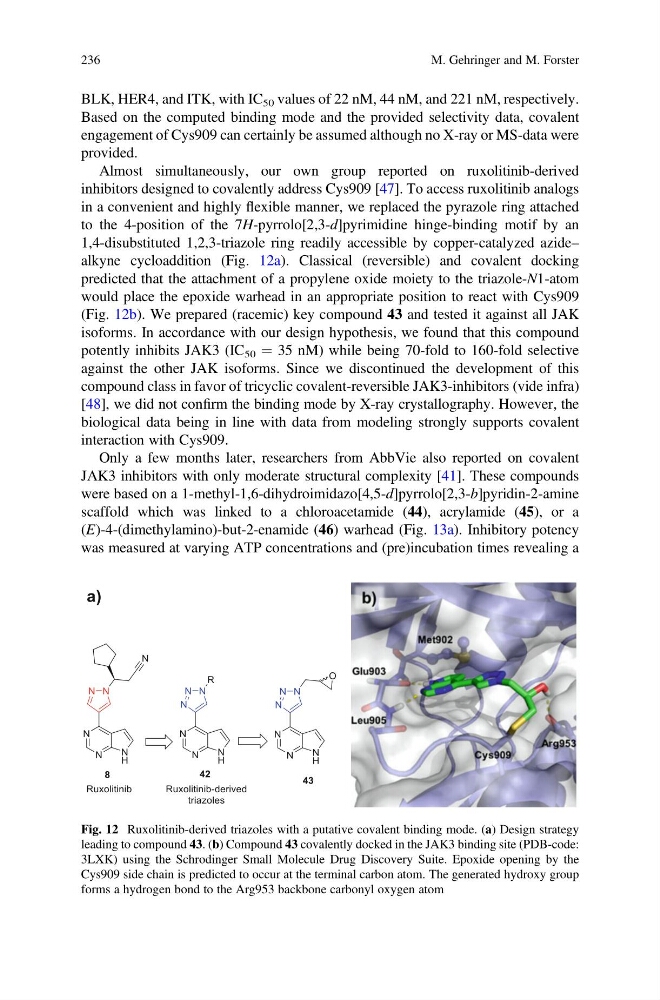
Almost simultaneously, our own group reported on ruxolitinib-derived
inhibitors designed to covalently address Cys909 [47]. To access ruxolitinib analogs
in a convenient and highly flexible manner, we replaced the pyrazole ring attached
to the 4-position of the 7H-pyrrolo[2,3-d]pyrimidine hinge-binding motif by an
1,4-disubstituted 1,2,3-triazole ring readily accessible by copper-catalyzed azide–
alkyne cycloaddition (Fig. 12a). Classical (reversible) and covalent docking
predicted that the attachment of a propylene oxide moiety to the triazole-N1-atom
would place the epoxide warhead in an appropriate position to react with Cys909
(Fig. 12b). We prepared (racemic) key compound 43 and tested it against all JAK
isoforms. In accordance with our design hypothesis, we found that this compound
potently inhibits JAK3 (IC 50 ¼ 35 nM) while being 70-fold to 160-fold selective
against the other JAK isoforms. Since we discontinued the development of this
compound class in favor of tricyclic covalent-reversible JAK3-inhibitors (vide infra)
[48], we did not confirm the binding mode by X-ray crystallography. However, the
biological data being in line with data from modeling strongly supports covalent
interaction with Cys909.
Only a few months later, researchers from AbbVie also reported on covalent
JAK3 inhibitors with only moderate structural complexity [41]. These compounds
were based on a 1-methyl-1,6-dihydroimidazo[4,5-d]pyrrolo[2,3-b]pyridin-2-amine
scaffold which was linked to a chloroacetamide (44), acrylamide (45), or a
(E)-4-(dimethylamino)-but-2-enamide (46) warhead (Fig. 13a). Inhibitory potency
was measured at varying ATP concentrations and (pre)incubation times revealing a
Fig. 12 Ruxolitinib-derived triazoles with a putative covalent binding mode. (a) Design strategy
leading to compound 43. (b) Compound 43 covalently docked in the JAK3 binding site (PDB-code:
3LXK) using the Schrodinger Small Molecule Drug Discovery Suite. Epoxide opening by the
Cys909 side chain is predicted to occur at the terminal carbon atom. The generated hydroxy group
forms a hydrogen bond to the Arg953 backbone carbonyl oxygen atom
236
M. Gehringer and M. Forster
Based on the computed binding mode and the provided selectivity data, covalent
engagement of Cys909 can certainly be assumed although no X-ray or MS-data were
provided.
Almost simultaneously, our own group reported on ruxolitinib-derived
inhibitors designed to covalently address Cys909 [47]. To access ruxolitinib analogs
in a convenient and highly flexible manner, we replaced the pyrazole ring attached
to the 4-position of the 7H-pyrrolo[2,3-d]pyrimidine hinge-binding motif by an
1,4-disubstituted 1,2,3-triazole ring readily accessible by copper-catalyzed azide–
alkyne cycloaddition (Fig. 12a). Classical (reversible) and covalent docking
predicted that the attachment of a propylene oxide moiety to the triazole-N1-atom
would place the epoxide warhead in an appropriate position to react with Cys909
(Fig. 12b). We prepared (racemic) key compound 43 and tested it against all JAK
isoforms. In accordance with our design hypothesis, we found that this compound
potently inhibits JAK3 (IC 50 ¼ 35 nM) while being 70-fold to 160-fold selective
against the other JAK isoforms. Since we discontinued the development of this
compound class in favor of tricyclic covalent-reversible JAK3-inhibitors (vide infra)
[48], we did not confirm the binding mode by X-ray crystallography. However, the
biological data being in line with data from modeling strongly supports covalent
interaction with Cys909.
Only a few months later, researchers from AbbVie also reported on covalent
JAK3 inhibitors with only moderate structural complexity [41]. These compounds
were based on a 1-methyl-1,6-dihydroimidazo[4,5-d]pyrrolo[2,3-b]pyridin-2-amine
scaffold which was linked to a chloroacetamide (44), acrylamide (45), or a
(E)-4-(dimethylamino)-but-2-enamide (46) warhead (Fig. 13a). Inhibitory potency
was measured at varying ATP concentrations and (pre)incubation times revealing a
Fig. 12 Ruxolitinib-derived triazoles with a putative covalent binding mode. (a) Design strategy
leading to compound 43. (b) Compound 43 covalently docked in the JAK3 binding site (PDB-code:
3LXK) using the Schrodinger Small Molecule Drug Discovery Suite. Epoxide opening by the
Cys909 side chain is predicted to occur at the terminal carbon atom. The generated hydroxy group
forms a hydrogen bond to the Arg953 backbone carbonyl oxygen atom
236
M. Gehringer and M. Forster