

α-cyanoacrylamide warheads (see Fig. 9 for selected examples 33–35) [42, 43]. Very
potent inhibitors with subnanomolar IC 50 values were reported in both series, however,
without providing further details on the binding modes.
Another patent from Merck Sharp & Dohme (MSD) published in 2013 included
a large series of 4-aryl-7H-pyrrolo[2,3-d]pyrimidines with acrylamides attached
to the meta-position of the 4-aryl-substituent. Many of these compounds featured
IC 50 values in the subnanomolar range and more than 10,000-fold selectivity over
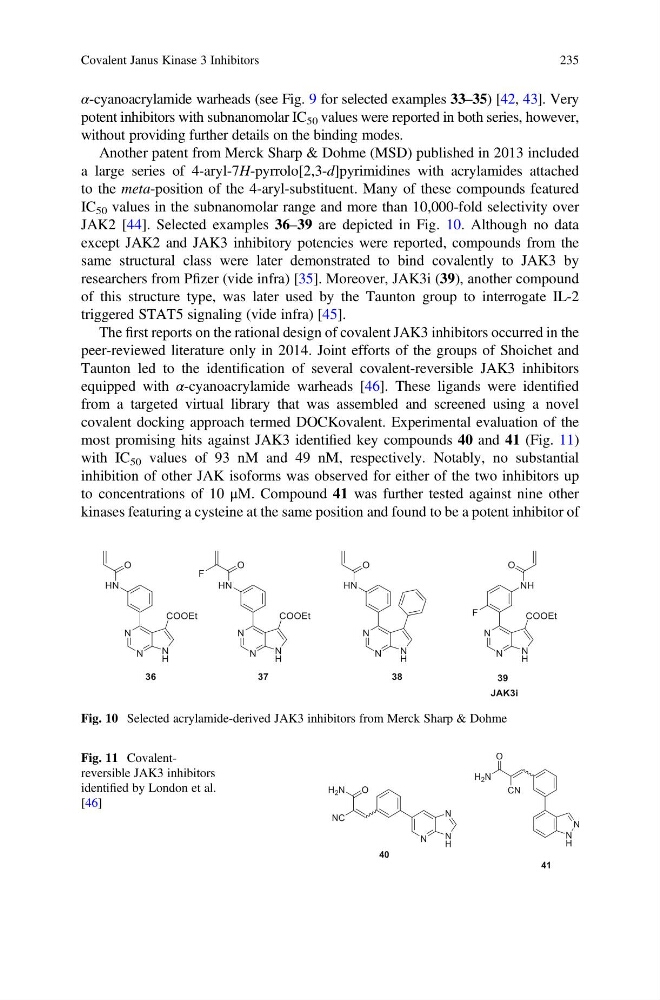
JAK2 [44]. Selected examples 36–39 are depicted in Fig. 10. Although no data
except JAK2 and JAK3 inhibitory potencies were reported, compounds from the
same structural class were later demonstrated to bind covalently to JAK3 by
researchers from Pfizer (vide infra) [35]. Moreover, JAK3i (39), another compound
of this structure type, was later used by the Taunton group to interrogate IL-2
triggered STAT5 signaling (vide infra) [45].
The first reports on the rational design of covalent JAK3 inhibitors occurred in the
peer-reviewed literature only in 2014. Joint efforts of the groups of Shoichet and
Taunton led to the identification of several covalent-reversible JAK3 inhibitors
equipped with α-cyanoacrylamide warheads [46]. These ligands were identified
from a targeted virtual library that was assembled and screened using a novel
covalent docking approach termed DOCKovalent. Experimental evaluation of the
most promising hits against JAK3 identified key compounds 40 and 41 (Fig. 11)
with IC 50 values of 93 nM and 49 nM, respectively. Notably, no substantial
inhibition of other JAK isoforms was observed for either of the two inhibitors up
to concentrations of 10 μM. Compound 41 was further tested against nine other
kinases featuring a cysteine at the same position and found to be a potent inhibitor of
Fig. 10 Selected acrylamide-derived JAK3 inhibitors from Merck Sharp & Dohme
Fig. 11 Covalentreversible JAK3 inhibitors
identified by London et al.
[46]
Covalent Janus Kinase 3 Inhibitors
235
potent inhibitors with subnanomolar IC 50 values were reported in both series, however,
without providing further details on the binding modes.
Another patent from Merck Sharp & Dohme (MSD) published in 2013 included
a large series of 4-aryl-7H-pyrrolo[2,3-d]pyrimidines with acrylamides attached
to the meta-position of the 4-aryl-substituent. Many of these compounds featured
IC 50 values in the subnanomolar range and more than 10,000-fold selectivity over
JAK2 [44]. Selected examples 36–39 are depicted in Fig. 10. Although no data
except JAK2 and JAK3 inhibitory potencies were reported, compounds from the
same structural class were later demonstrated to bind covalently to JAK3 by
researchers from Pfizer (vide infra) [35]. Moreover, JAK3i (39), another compound
of this structure type, was later used by the Taunton group to interrogate IL-2
triggered STAT5 signaling (vide infra) [45].
The first reports on the rational design of covalent JAK3 inhibitors occurred in the
peer-reviewed literature only in 2014. Joint efforts of the groups of Shoichet and
Taunton led to the identification of several covalent-reversible JAK3 inhibitors
equipped with α-cyanoacrylamide warheads [46]. These ligands were identified
from a targeted virtual library that was assembled and screened using a novel
covalent docking approach termed DOCKovalent. Experimental evaluation of the
most promising hits against JAK3 identified key compounds 40 and 41 (Fig. 11)
with IC 50 values of 93 nM and 49 nM, respectively. Notably, no substantial
inhibition of other JAK isoforms was observed for either of the two inhibitors up
to concentrations of 10 μM. Compound 41 was further tested against nine other
kinases featuring a cysteine at the same position and found to be a potent inhibitor of
Fig. 10 Selected acrylamide-derived JAK3 inhibitors from Merck Sharp & Dohme
Fig. 11 Covalentreversible JAK3 inhibitors
identified by London et al.
[46]
Covalent Janus Kinase 3 Inhibitors
235