

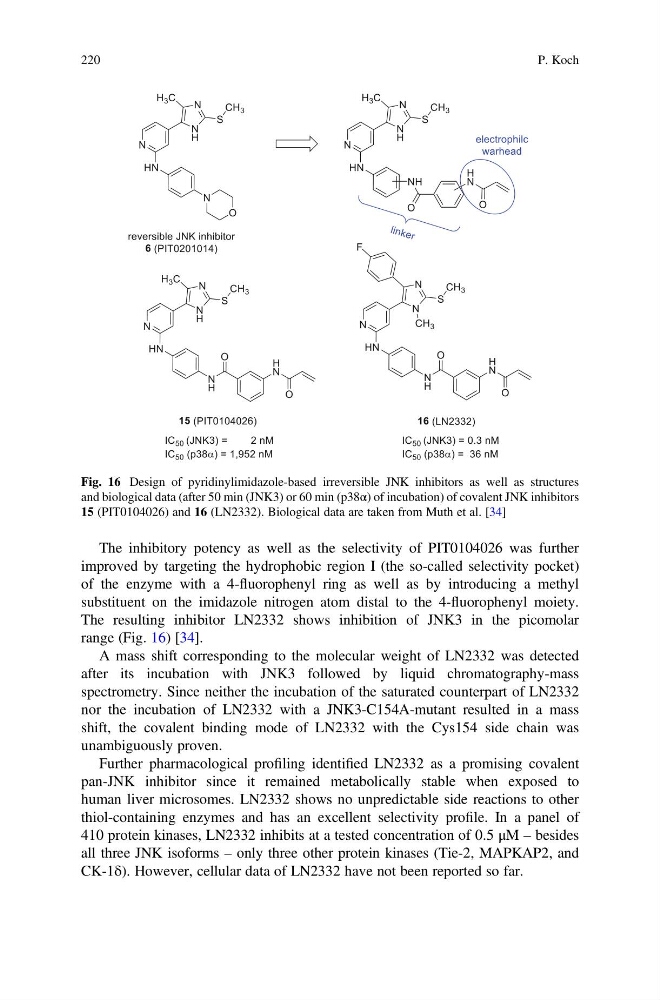
The inhibitory potency as well as the selectivity of PIT0104026 was further
improved by targeting the hydrophobic region I (the so-called selectivity pocket)
of the enzyme with a 4-fluorophenyl ring as well as by introducing a methyl
substituent on the imidazole nitrogen atom distal to the 4-fluorophenyl moiety.
The resulting inhibitor LN2332 shows inhibition of JNK3 in the picomolar
range (Fig. 16) [34].
A mass shift corresponding to the molecular weight of LN2332 was detected
after its incubation with JNK3 followed by liquid chromatography-mass
spectrometry. Since neither the incubation of the saturated counterpart of LN2332
nor the incubation of LN2332 with a JNK3-C154A-mutant resulted in a mass
shift, the covalent binding mode of LN2332 with the Cys154 side chain was
unambiguously proven.
Further pharmacological profiling identified LN2332 as a promising covalent
pan-JNK inhibitor since it remained metabolically stable when exposed to
human liver microsomes. LN2332 shows no unpredictable side reactions to other
thiol-containing enzymes and has an excellent selectivity profile. In a panel of
410 protein kinases, LN2332 inhibits at a tested concentration of 0.5 μM – besides
all three JNK isoforms – only three other protein kinases (Tie-2, MAPKAP2, and
CK-1δ). However, cellular data of LN2332 have not been reported so far.
Fig. 16 Design of pyridinylimidazole-based irreversible JNK inhibitors as well as structures
and biological data (after 50 min (JNK3) or 60 min (p38α) of incubation) of covalent JNK inhibitors
15 (PIT0104026) and 16 (LN2332). Biological data are taken from Muth et al. [34]
220
P. Koch
improved by targeting the hydrophobic region I (the so-called selectivity pocket)
of the enzyme with a 4-fluorophenyl ring as well as by introducing a methyl
substituent on the imidazole nitrogen atom distal to the 4-fluorophenyl moiety.
The resulting inhibitor LN2332 shows inhibition of JNK3 in the picomolar
range (Fig. 16) [34].
A mass shift corresponding to the molecular weight of LN2332 was detected
after its incubation with JNK3 followed by liquid chromatography-mass
spectrometry. Since neither the incubation of the saturated counterpart of LN2332
nor the incubation of LN2332 with a JNK3-C154A-mutant resulted in a mass
shift, the covalent binding mode of LN2332 with the Cys154 side chain was
unambiguously proven.
Further pharmacological profiling identified LN2332 as a promising covalent
pan-JNK inhibitor since it remained metabolically stable when exposed to
human liver microsomes. LN2332 shows no unpredictable side reactions to other
thiol-containing enzymes and has an excellent selectivity profile. In a panel of
410 protein kinases, LN2332 inhibits at a tested concentration of 0.5 μM – besides
all three JNK isoforms – only three other protein kinases (Tie-2, MAPKAP2, and
CK-1δ). However, cellular data of LN2332 have not been reported so far.
Fig. 16 Design of pyridinylimidazole-based irreversible JNK inhibitors as well as structures
and biological data (after 50 min (JNK3) or 60 min (p38α) of incubation) of covalent JNK inhibitors
15 (PIT0104026) and 16 (LN2332). Biological data are taken from Muth et al. [34]
220
P. Koch