

binding reversibly to the ATP-binding site, the retro-inverso peptide inhibitor
XG-102 occupies the docking site of the JIP scaffold protein. XG-102 consists of
30 D-configured amino acids and 1 glycine residue (Fig. 3). Clinical phase III trials
for treatment of hearing loss as well as for post-cataract surgery inflammation
and pain were recently completed for this peptide inhibitor.
2 Reversible Inhibitors
2.1 Prototypical JNK Inhibitor SP600125
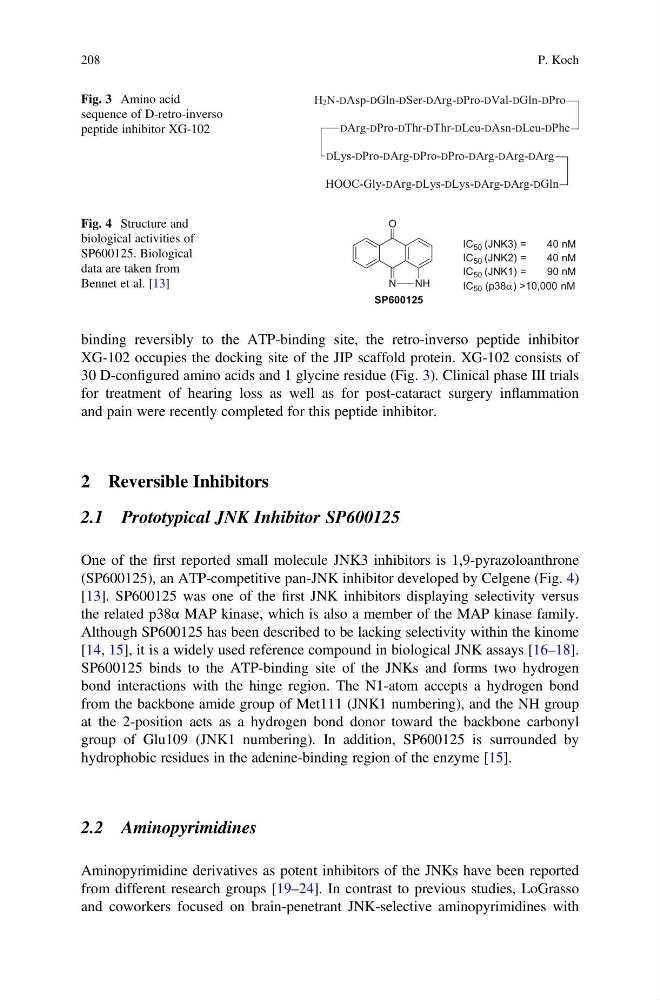
One of the first reported small molecule JNK3 inhibitors is 1,9-pyrazoloanthrone
(SP600125), an ATP-competitive pan-JNK inhibitor developed by Celgene (Fig. 4)
[13]. SP600125 was one of the first JNK inhibitors displaying selectivity versus
the related p38α MAP kinase, which is also a member of the MAP kinase family.
Although SP600125 has been described to be lacking selectivity within the kinome
[14, 15], it is a widely used reference compound in biological JNK assays [16–18].
SP600125 binds to the ATP-binding site of the JNKs and forms two hydrogen
bond interactions with the hinge region. The N1-atom accepts a hydrogen bond
from the backbone amide group of Met111 (JNK1 numbering), and the NH group
at the 2-position acts as a hydrogen bond donor toward the backbone carbonyl
group of Glu109 (JNK1 numbering). In addition, SP600125 is surrounded by
hydrophobic residues in the adenine-binding region of the enzyme [15].
2.2 Aminopyrimidines
Aminopyrimidine derivatives as potent inhibitors of the JNKs have been reported
from different research groups [19–24]. In contrast to previous studies, LoGrasso
and coworkers focused on brain-penetrant JNK-selective aminopyrimidines with
H2N-DAsp-DGln-DSer-DArg-DPro-DVal-DGln-DPro
DArg-DPro-DThr-DThr-DLeu-DAsn-DLeu-DPhe
DLys-DPro-DArg-DPro-DPro-DArg-DArg-DArg
HOOC-Gly-DArg-DLys-DLys-DArg-DArg-DGln
Fig. 3 Amino acid
sequence of D-retro-inverso
peptide inhibitor XG-102
O
N
NH
SP600125
IC 50 (JNK3) =
40 nM
IC 50 (JNK2) =
40 nM
IC 50 (JNK1) =
90 nM
IC 50 (p38α) >10,000 nM
Fig. 4 Structure and
biological activities of
SP600125. Biological
data are taken from
Bennet et al. [13]
208
P. Koch
XG-102 occupies the docking site of the JIP scaffold protein. XG-102 consists of
30 D-configured amino acids and 1 glycine residue (Fig. 3). Clinical phase III trials
for treatment of hearing loss as well as for post-cataract surgery inflammation
and pain were recently completed for this peptide inhibitor.
2 Reversible Inhibitors
2.1 Prototypical JNK Inhibitor SP600125
One of the first reported small molecule JNK3 inhibitors is 1,9-pyrazoloanthrone
(SP600125), an ATP-competitive pan-JNK inhibitor developed by Celgene (Fig. 4)
[13]. SP600125 was one of the first JNK inhibitors displaying selectivity versus
the related p38α MAP kinase, which is also a member of the MAP kinase family.
Although SP600125 has been described to be lacking selectivity within the kinome
[14, 15], it is a widely used reference compound in biological JNK assays [16–18].
SP600125 binds to the ATP-binding site of the JNKs and forms two hydrogen
bond interactions with the hinge region. The N1-atom accepts a hydrogen bond
from the backbone amide group of Met111 (JNK1 numbering), and the NH group
at the 2-position acts as a hydrogen bond donor toward the backbone carbonyl
group of Glu109 (JNK1 numbering). In addition, SP600125 is surrounded by
hydrophobic residues in the adenine-binding region of the enzyme [15].
2.2 Aminopyrimidines
Aminopyrimidine derivatives as potent inhibitors of the JNKs have been reported
from different research groups [19–24]. In contrast to previous studies, LoGrasso
and coworkers focused on brain-penetrant JNK-selective aminopyrimidines with
H2N-DAsp-DGln-DSer-DArg-DPro-DVal-DGln-DPro
DArg-DPro-DThr-DThr-DLeu-DAsn-DLeu-DPhe
DLys-DPro-DArg-DPro-DPro-DArg-DArg-DArg
HOOC-Gly-DArg-DLys-DLys-DArg-DArg-DGln
Fig. 3 Amino acid
sequence of D-retro-inverso
peptide inhibitor XG-102
O
N
NH
SP600125
IC 50 (JNK3) =
40 nM
IC 50 (JNK2) =
40 nM
IC 50 (JNK1) =
90 nM
IC 50 (p38α) >10,000 nM
Fig. 4 Structure and
biological activities of
SP600125. Biological
data are taken from
Bennet et al. [13]
208
P. Koch