

the aminopyrimidine moiety and the gatekeeper residue, and the binding site
becomes too narrow to accommodate the ligand due to introduction of the larger
isoleucine side chain [4, 145, 153]. This mutation is analogous to the T315I
substitution in BCR-ABL, classically associated with secondary resistance development in CML patients (Fig. 19) [4].
For that reason, nature and location of PDGFR oncogenic mutations will translate
in different prognoses, influencing tumor aggressiveness and the expected clinical
response to imatinib (60) treatment [146].
It is worthy of note that imatinib (60) represented an impressive breakthrough in
the therapy of PDGFR-addicted tumors. However, considering resistance development and refractory tumors, an urgent need for novel and alternative therapeutic
strategies has emerged [157].
4.3.2 Crenolanib: A Novel PDGFR Inhibitor Drug Candidate
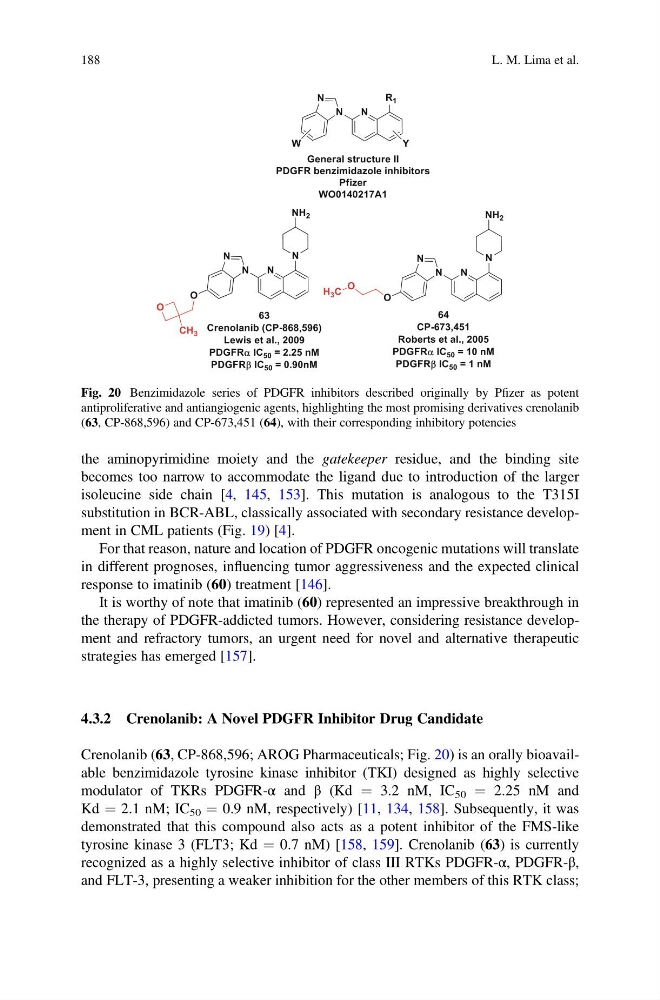
Crenolanib (63, CP-868,596; AROG Pharmaceuticals; Fig. 20) is an orally bioavailable benzimidazole tyrosine kinase inhibitor (TKI) designed as highly selective
modulator of TKRs PDGFR-α and β (Kd ¼ 3.2 nM, IC 50 ¼ 2.25 nM and
Kd ¼ 2.1 nM; IC 50 ¼ 0.9 nM, respectively) [11, 134, 158]. Subsequently, it was
demonstrated that this compound also acts as a potent inhibitor of the FMS-like
tyrosine kinase 3 (FLT3; Kd ¼ 0.7 nM) [158, 159]. Crenolanib (63) is currently
recognized as a highly selective inhibitor of class III RTKs PDGFR-α, PDGFR-β,
and FLT-3, presenting a weaker inhibition for the other members of this RTK class;
Fig. 20 Benzimidazole series of PDGFR inhibitors described originally by Pfizer as potent
antiproliferative and antiangiogenic agents, highlighting the most promising derivatives crenolanib
(63, CP-868,596) and CP-673,451 (64), with their corresponding inhibitory potencies
188
L. M. Lima et al.
becomes too narrow to accommodate the ligand due to introduction of the larger
isoleucine side chain [4, 145, 153]. This mutation is analogous to the T315I
substitution in BCR-ABL, classically associated with secondary resistance development in CML patients (Fig. 19) [4].
For that reason, nature and location of PDGFR oncogenic mutations will translate
in different prognoses, influencing tumor aggressiveness and the expected clinical
response to imatinib (60) treatment [146].
It is worthy of note that imatinib (60) represented an impressive breakthrough in
the therapy of PDGFR-addicted tumors. However, considering resistance development and refractory tumors, an urgent need for novel and alternative therapeutic
strategies has emerged [157].
4.3.2 Crenolanib: A Novel PDGFR Inhibitor Drug Candidate
Crenolanib (63, CP-868,596; AROG Pharmaceuticals; Fig. 20) is an orally bioavailable benzimidazole tyrosine kinase inhibitor (TKI) designed as highly selective
modulator of TKRs PDGFR-α and β (Kd ¼ 3.2 nM, IC 50 ¼ 2.25 nM and
Kd ¼ 2.1 nM; IC 50 ¼ 0.9 nM, respectively) [11, 134, 158]. Subsequently, it was
demonstrated that this compound also acts as a potent inhibitor of the FMS-like
tyrosine kinase 3 (FLT3; Kd ¼ 0.7 nM) [158, 159]. Crenolanib (63) is currently
recognized as a highly selective inhibitor of class III RTKs PDGFR-α, PDGFR-β,
and FLT-3, presenting a weaker inhibition for the other members of this RTK class;
Fig. 20 Benzimidazole series of PDGFR inhibitors described originally by Pfizer as potent
antiproliferative and antiangiogenic agents, highlighting the most promising derivatives crenolanib
(63, CP-868,596) and CP-673,451 (64), with their corresponding inhibitory potencies
188
L. M. Lima et al.