

imatinib (60), an innovative drug for clinical management of tumors with constitutively activated forms of the target TKs, i.e., c-ABL, c-KIT, or PDGFR-α/β [153].
No co-crystallized structure of imatinib (60) with PDGFR-α or β has been
reported. However, it is possible to predict the binding mode of drug 60 to these
targets based on previous NMR and crystallographic results for the inhibition of
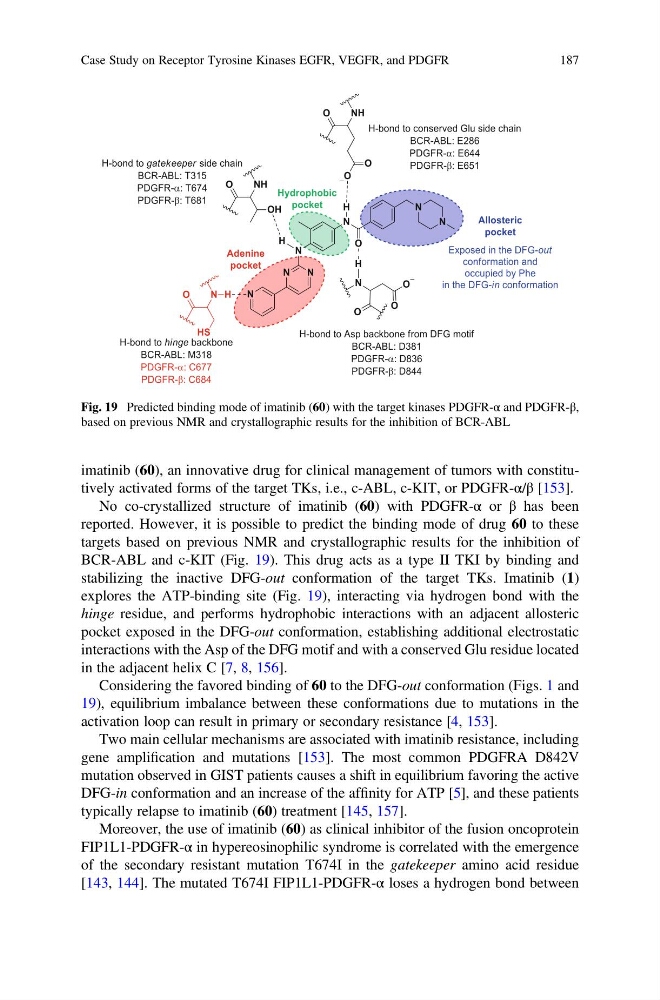
BCR-ABL and c-KIT (Fig. 19). This drug acts as a type II TKI by binding and
stabilizing the inactive DFG-out conformation of the target TKs. Imatinib (1)
explores the ATP-binding site (Fig. 19), interacting via hydrogen bond with the
hinge residue, and performs hydrophobic interactions with an adjacent allosteric
pocket exposed in the DFG-out conformation, establishing additional electrostatic
interactions with the Asp of the DFG motif and with a conserved Glu residue located
in the adjacent helix C [7, 8, 156].
Considering the favored binding of 60 to the DFG-out conformation (Figs. 1 and
19), equilibrium imbalance between these conformations due to mutations in the
activation loop can result in primary or secondary resistance [4, 153].
Two main cellular mechanisms are associated with imatinib resistance, including
gene amplification and mutations [153]. The most common PDGFRA D842V
mutation observed in GIST patients causes a shift in equilibrium favoring the active
DFG-in conformation and an increase of the affinity for ATP [5], and these patients
typically relapse to imatinib (60) treatment [145, 157].
Moreover, the use of imatinib (60) as clinical inhibitor of the fusion oncoprotein
FIP1L1-PDGFR-α in hypereosinophilic syndrome is correlated with the emergence
of the secondary resistant mutation T674I in the gatekeeper amino acid residue
[143, 144]. The mutated T674I FIP1L1-PDGFR-α loses a hydrogen bond between
Fig. 19 Predicted binding mode of imatinib (60) with the target kinases PDGFR-α and PDGFR-β,
based on previous NMR and crystallographic results for the inhibition of BCR-ABL
Case Study on Receptor Tyrosine Kinases EGFR, VEGFR, and PDGFR
187
No co-crystallized structure of imatinib (60) with PDGFR-α or β has been
reported. However, it is possible to predict the binding mode of drug 60 to these
targets based on previous NMR and crystallographic results for the inhibition of
BCR-ABL and c-KIT (Fig. 19). This drug acts as a type II TKI by binding and
stabilizing the inactive DFG-out conformation of the target TKs. Imatinib (1)
explores the ATP-binding site (Fig. 19), interacting via hydrogen bond with the
hinge residue, and performs hydrophobic interactions with an adjacent allosteric
pocket exposed in the DFG-out conformation, establishing additional electrostatic
interactions with the Asp of the DFG motif and with a conserved Glu residue located
in the adjacent helix C [7, 8, 156].
Considering the favored binding of 60 to the DFG-out conformation (Figs. 1 and
19), equilibrium imbalance between these conformations due to mutations in the
activation loop can result in primary or secondary resistance [4, 153].
Two main cellular mechanisms are associated with imatinib resistance, including
gene amplification and mutations [153]. The most common PDGFRA D842V
mutation observed in GIST patients causes a shift in equilibrium favoring the active
DFG-in conformation and an increase of the affinity for ATP [5], and these patients
typically relapse to imatinib (60) treatment [145, 157].
Moreover, the use of imatinib (60) as clinical inhibitor of the fusion oncoprotein
FIP1L1-PDGFR-α in hypereosinophilic syndrome is correlated with the emergence
of the secondary resistant mutation T674I in the gatekeeper amino acid residue
[143, 144]. The mutated T674I FIP1L1-PDGFR-α loses a hydrogen bond between
Fig. 19 Predicted binding mode of imatinib (60) with the target kinases PDGFR-α and PDGFR-β,
based on previous NMR and crystallographic results for the inhibition of BCR-ABL
Case Study on Receptor Tyrosine Kinases EGFR, VEGFR, and PDGFR
187