

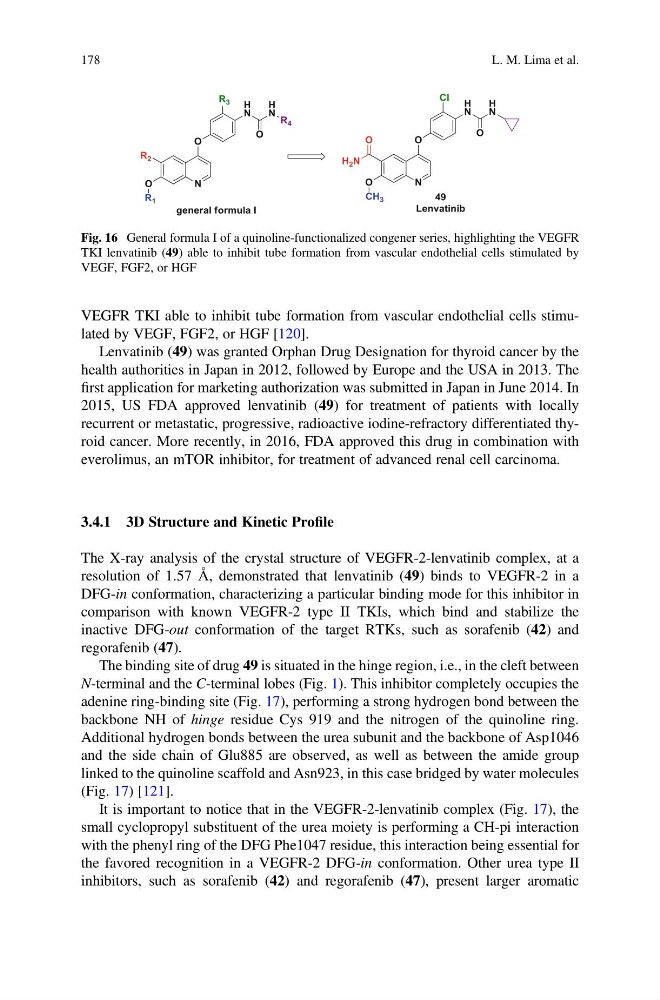
VEGFR TKI able to inhibit tube formation from vascular endothelial cells stimulated by VEGF, FGF2, or HGF [120].
Lenvatinib (49) was granted Orphan Drug Designation for thyroid cancer by the
health authorities in Japan in 2012, followed by Europe and the USA in 2013. The
first application for marketing authorization was submitted in Japan in June 2014. In
2015, US FDA approved lenvatinib (49) for treatment of patients with locally
recurrent or metastatic, progressive, radioactive iodine-refractory differentiated thyroid cancer. More recently, in 2016, FDA approved this drug in combination with
everolimus, an mTOR inhibitor, for treatment of advanced renal cell carcinoma.
3.4.1 3D Structure and Kinetic Profile
The X-ray analysis of the crystal structure of VEGFR-2-lenvatinib complex, at a
resolution of 1.57 Å, demonstrated that lenvatinib (49) binds to VEGFR-2 in a
DFG-in conformation, characterizing a particular binding mode for this inhibitor in
comparison with known VEGFR-2 type II TKIs, which bind and stabilize the
inactive DFG-out conformation of the target RTKs, such as sorafenib (42) and
regorafenib (47).
The binding site of drug 49 is situated in the hinge region, i.e., in the cleft between
N-terminal and the C-terminal lobes (Fig. 1). This inhibitor completely occupies the
adenine ring-binding site (Fig. 17), performing a strong hydrogen bond between the
backbone NH of hinge residue Cys 919 and the nitrogen of the quinoline ring.
Additional hydrogen bonds between the urea subunit and the backbone of Asp1046
and the side chain of Glu885 are observed, as well as between the amide group
linked to the quinoline scaffold and Asn923, in this case bridged by water molecules
(Fig. 17) [121].
It is important to notice that in the VEGFR-2-lenvatinib complex (Fig. 17), the
small cyclopropyl substituent of the urea moiety is performing a CH-pi interaction
with the phenyl ring of the DFG Phe1047 residue, this interaction being essential for
the favored recognition in a VEGFR-2 DFG-in conformation. Other urea type II
inhibitors, such as sorafenib (42) and regorafenib (47), present larger aromatic
Fig. 16 General formula I of a quinoline-functionalized congener series, highlighting the VEGFR
TKI lenvatinib (49) able to inhibit tube formation from vascular endothelial cells stimulated by
VEGF, FGF2, or HGF
178
L. M. Lima et al.
Lenvatinib (49) was granted Orphan Drug Designation for thyroid cancer by the
health authorities in Japan in 2012, followed by Europe and the USA in 2013. The
first application for marketing authorization was submitted in Japan in June 2014. In
2015, US FDA approved lenvatinib (49) for treatment of patients with locally
recurrent or metastatic, progressive, radioactive iodine-refractory differentiated thyroid cancer. More recently, in 2016, FDA approved this drug in combination with
everolimus, an mTOR inhibitor, for treatment of advanced renal cell carcinoma.
3.4.1 3D Structure and Kinetic Profile
The X-ray analysis of the crystal structure of VEGFR-2-lenvatinib complex, at a
resolution of 1.57 Å, demonstrated that lenvatinib (49) binds to VEGFR-2 in a
DFG-in conformation, characterizing a particular binding mode for this inhibitor in
comparison with known VEGFR-2 type II TKIs, which bind and stabilize the
inactive DFG-out conformation of the target RTKs, such as sorafenib (42) and
regorafenib (47).
The binding site of drug 49 is situated in the hinge region, i.e., in the cleft between
N-terminal and the C-terminal lobes (Fig. 1). This inhibitor completely occupies the
adenine ring-binding site (Fig. 17), performing a strong hydrogen bond between the
backbone NH of hinge residue Cys 919 and the nitrogen of the quinoline ring.
Additional hydrogen bonds between the urea subunit and the backbone of Asp1046
and the side chain of Glu885 are observed, as well as between the amide group
linked to the quinoline scaffold and Asn923, in this case bridged by water molecules
(Fig. 17) [121].
It is important to notice that in the VEGFR-2-lenvatinib complex (Fig. 17), the
small cyclopropyl substituent of the urea moiety is performing a CH-pi interaction
with the phenyl ring of the DFG Phe1047 residue, this interaction being essential for
the favored recognition in a VEGFR-2 DFG-in conformation. Other urea type II
inhibitors, such as sorafenib (42) and regorafenib (47), present larger aromatic
Fig. 16 General formula I of a quinoline-functionalized congener series, highlighting the VEGFR
TKI lenvatinib (49) able to inhibit tube formation from vascular endothelial cells stimulated by
VEGF, FGF2, or HGF
178
L. M. Lima et al.