

8 Next Clinical Developments
The human genome encodes for over 500 kinases which gives ample scope for novel
target finding and drug development in cancer therapy [141]. In addition to the
48 FDA-approved kinase inhibitors, a huge range of potential inhibitors are currently
in clinical or preclinical trials. For example, clinical phase-I trials of compounds
targeting nerve growth factor receptors [142], polo-like kinase 1 [143],
phosphatidylinositol 4,5-bisphosphate 3-kinase delta and gamma [144], protein
kinase B [145], focal adhesion kinase [146], casein kinase II [147], and Aurora
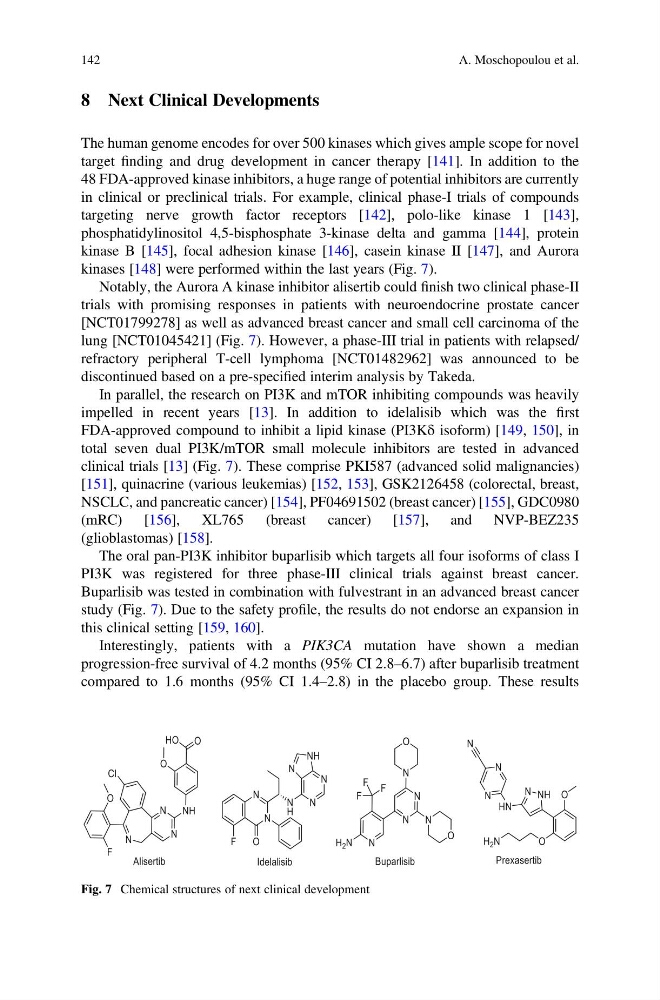
kinases [148] were performed within the last years (Fig. 7).
Notably, the Aurora A kinase inhibitor alisertib could finish two clinical phase-II
trials with promising responses in patients with neuroendocrine prostate cancer
[NCT01799278] as well as advanced breast cancer and small cell carcinoma of the
lung [NCT01045421] (Fig. 7). However, a phase-III trial in patients with relapsed/
refractory peripheral T-cell lymphoma [NCT01482962] was announced to be
discontinued based on a pre-specified interim analysis by Takeda.
In parallel, the research on PI3K and mTOR inhibiting compounds was heavily
impelled in recent years [13]. In addition to idelalisib which was the first
FDA-approved compound to inhibit a lipid kinase (PI3Kδ isoform) [149, 150], in
total seven dual PI3K/mTOR small molecule inhibitors are tested in advanced
clinical trials [13] (Fig. 7). These comprise PKI587 (advanced solid malignancies)
[151], quinacrine (various leukemias) [152, 153], GSK2126458 (colorectal, breast,
NSCLC, and pancreatic cancer) [154], PF04691502 (breast cancer) [155], GDC0980
(mRC) [156], XL765 (breast cancer) [157], and NVP-BEZ235
(glioblastomas) [158].
The oral pan-PI3K inhibitor buparlisib which targets all four isoforms of class I
PI3K was registered for three phase-III clinical trials against breast cancer.
Buparlisib was tested in combination with fulvestrant in an advanced breast cancer
study (Fig. 7). Due to the safety profile, the results do not endorse an expansion in
this clinical setting [159, 160].
Interestingly, patients with a PIK3CA mutation have shown a median
progression-free survival of 4.2 months (95% CI 2.8–6.7) after buparlisib treatment
compared to 1.6 months (95% CI 1.4–2.8) in the placebo group. These results
Fig. 7 Chemical structures of next clinical development
142
A. Moschopoulou et al.
The human genome encodes for over 500 kinases which gives ample scope for novel
target finding and drug development in cancer therapy [141]. In addition to the
48 FDA-approved kinase inhibitors, a huge range of potential inhibitors are currently
in clinical or preclinical trials. For example, clinical phase-I trials of compounds
targeting nerve growth factor receptors [142], polo-like kinase 1 [143],
phosphatidylinositol 4,5-bisphosphate 3-kinase delta and gamma [144], protein
kinase B [145], focal adhesion kinase [146], casein kinase II [147], and Aurora
kinases [148] were performed within the last years (Fig. 7).
Notably, the Aurora A kinase inhibitor alisertib could finish two clinical phase-II
trials with promising responses in patients with neuroendocrine prostate cancer
[NCT01799278] as well as advanced breast cancer and small cell carcinoma of the
lung [NCT01045421] (Fig. 7). However, a phase-III trial in patients with relapsed/
refractory peripheral T-cell lymphoma [NCT01482962] was announced to be
discontinued based on a pre-specified interim analysis by Takeda.
In parallel, the research on PI3K and mTOR inhibiting compounds was heavily
impelled in recent years [13]. In addition to idelalisib which was the first
FDA-approved compound to inhibit a lipid kinase (PI3Kδ isoform) [149, 150], in
total seven dual PI3K/mTOR small molecule inhibitors are tested in advanced
clinical trials [13] (Fig. 7). These comprise PKI587 (advanced solid malignancies)
[151], quinacrine (various leukemias) [152, 153], GSK2126458 (colorectal, breast,
NSCLC, and pancreatic cancer) [154], PF04691502 (breast cancer) [155], GDC0980
(mRC) [156], XL765 (breast cancer) [157], and NVP-BEZ235
(glioblastomas) [158].
The oral pan-PI3K inhibitor buparlisib which targets all four isoforms of class I
PI3K was registered for three phase-III clinical trials against breast cancer.
Buparlisib was tested in combination with fulvestrant in an advanced breast cancer
study (Fig. 7). Due to the safety profile, the results do not endorse an expansion in
this clinical setting [159, 160].
Interestingly, patients with a PIK3CA mutation have shown a median
progression-free survival of 4.2 months (95% CI 2.8–6.7) after buparlisib treatment
compared to 1.6 months (95% CI 1.4–2.8) in the placebo group. These results
Fig. 7 Chemical structures of next clinical development
142
A. Moschopoulou et al.