

7 MEK Inhibitors
The observation of therapy resistance and paradoxical ERK activation upon RAF
inhibition resulted in increased effort to develop inhibitors targeting MEK. Several
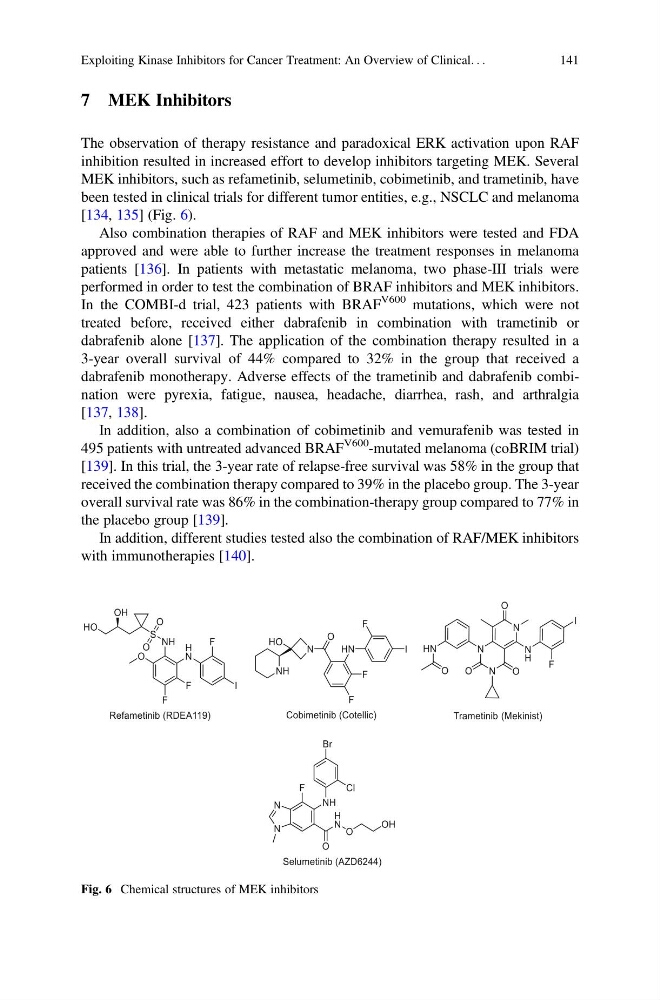
MEK inhibitors, such as refametinib, selumetinib, cobimetinib, and trametinib, have
been tested in clinical trials for different tumor entities, e.g., NSCLC and melanoma
[134, 135] (Fig. 6).
Also combination therapies of RAF and MEK inhibitors were tested and FDA
approved and were able to further increase the treatment responses in melanoma
patients [136]. In patients with metastatic melanoma, two phase-III trials were
performed in order to test the combination of BRAF inhibitors and MEK inhibitors.
In the COMBI-d trial, 423 patients with BRAF
V600 mutations, which were not
treated before, received either dabrafenib in combination with trametinib or
dabrafenib alone [137]. The application of the combination therapy resulted in a
3-year overall survival of 44% compared to 32% in the group that received a
dabrafenib monotherapy. Adverse effects of the trametinib and dabrafenib combination were pyrexia, fatigue, nausea, headache, diarrhea, rash, and arthralgia
[137, 138].
In addition, also a combination of cobimetinib and vemurafenib was tested in
495 patients with untreated advanced BRAF
V600
-mutated melanoma (coBRIM trial)
[139]. In this trial, the 3-year rate of relapse-free survival was 58% in the group that
received the combination therapy compared to 39% in the placebo group. The 3-year
overall survival rate was 86% in the combination-therapy group compared to 77% in
the placebo group [139].
In addition, different studies tested also the combination of RAF/MEK inhibitors
with immunotherapies [140].
Fig. 6 Chemical structures of MEK inhibitors
Exploiting Kinase Inhibitors for Cancer Treatment: An Overview of Clinical. . .
141
The observation of therapy resistance and paradoxical ERK activation upon RAF
inhibition resulted in increased effort to develop inhibitors targeting MEK. Several
MEK inhibitors, such as refametinib, selumetinib, cobimetinib, and trametinib, have
been tested in clinical trials for different tumor entities, e.g., NSCLC and melanoma
[134, 135] (Fig. 6).
Also combination therapies of RAF and MEK inhibitors were tested and FDA
approved and were able to further increase the treatment responses in melanoma
patients [136]. In patients with metastatic melanoma, two phase-III trials were
performed in order to test the combination of BRAF inhibitors and MEK inhibitors.
In the COMBI-d trial, 423 patients with BRAF
V600 mutations, which were not
treated before, received either dabrafenib in combination with trametinib or
dabrafenib alone [137]. The application of the combination therapy resulted in a
3-year overall survival of 44% compared to 32% in the group that received a
dabrafenib monotherapy. Adverse effects of the trametinib and dabrafenib combination were pyrexia, fatigue, nausea, headache, diarrhea, rash, and arthralgia
[137, 138].
In addition, also a combination of cobimetinib and vemurafenib was tested in
495 patients with untreated advanced BRAF
V600
-mutated melanoma (coBRIM trial)
[139]. In this trial, the 3-year rate of relapse-free survival was 58% in the group that
received the combination therapy compared to 39% in the placebo group. The 3-year
overall survival rate was 86% in the combination-therapy group compared to 77% in
the placebo group [139].
In addition, different studies tested also the combination of RAF/MEK inhibitors
with immunotherapies [140].
Fig. 6 Chemical structures of MEK inhibitors
Exploiting Kinase Inhibitors for Cancer Treatment: An Overview of Clinical. . .
141