

RAS represents an important proto-oncogene and a major oncogenic driver. It
was found mutated in around 30% of all human cancer entities [100]. Due to the fact
that RAS proteins do not harbor any cavities for small molecule interaction,
approaches to directly inhibit the function of RAS have not been successful so far.
Therefore, the inhibition of RAS downstream factors such as RAF, MEK, and ERK
has gained interest for the treatment of cancer [100].
RAF monomers are usually inactive, since the N-terminal domain of BRAF
triggers autoinhibition [101, 102]. Upon activation, RAF forms homo- and
heterodimers which induces downstream signaling to MEK. While physiological
RAS activation induces MEK activation mainly via the formation of BRAF dimers
[103], oncogenic RAS often triggers the formation of BRAF-RAF1 heterodimers
[101, 104, 105].
BRAF mutations are present in 8% of all human tumors [106]. They were found
in more than 50% of melanoma patients and were also identified in CRC (5–10%),
hairy cell leukemia ($100%), thyroid carcinomas (25–45%), and, as a rare event,
ovarian and lung cancer [106, 107]. Ninety percent of all BRAF mutations account
for a substitution of valine with glutamic acid at position 600 (V600E) [100]. This
mutation results in a constitutive kinase activity of BRAF monomers and protects
BRAF from ERK-mediated negative feedback signaling [102].
The identification of BRAF mutations as oncogenic drivers led to intensified
efforts in order to develop more selective and potent BRAF inhibitors. This work
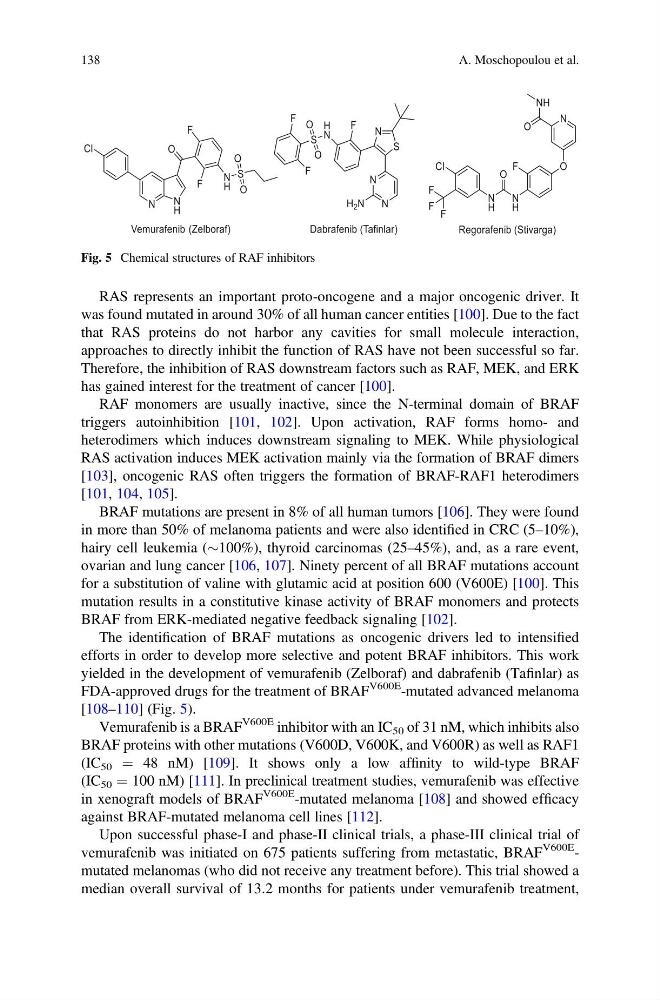
yielded in the development of vemurafenib (Zelboraf) and dabrafenib (Tafinlar) as
FDA-approved drugs for the treatment of BRAF
V600E -mutated advanced melanoma
[108–110] (Fig. 5).
Vemurafenib is a BRAF
V600E inhibitor with an IC 50 of 31 nM, which inhibits also
BRAF proteins with other mutations (V600D, V600K, and V600R) as well as RAF1
(IC 50 ¼ 48 nM) [109]. It shows only a low affinity to wild-type BRAF
(IC 50 ¼ 100 nM) [111]. In preclinical treatment studies, vemurafenib was effective
in xenograft models of BRAF
V600E -mutated melanoma [108] and showed efficacy
against BRAF-mutated melanoma cell lines [112].
Upon successful phase-I and phase-II clinical trials, a phase-III clinical trial of
vemurafenib was initiated on 675 patients suffering from metastatic, BRAF
V600E -
mutated melanomas (who did not receive any treatment before). This trial showed a
median overall survival of 13.2 months for patients under vemurafenib treatment,
Fig. 5 Chemical structures of RAF inhibitors
138
A. Moschopoulou et al.
was found mutated in around 30% of all human cancer entities [100]. Due to the fact
that RAS proteins do not harbor any cavities for small molecule interaction,
approaches to directly inhibit the function of RAS have not been successful so far.
Therefore, the inhibition of RAS downstream factors such as RAF, MEK, and ERK
has gained interest for the treatment of cancer [100].
RAF monomers are usually inactive, since the N-terminal domain of BRAF
triggers autoinhibition [101, 102]. Upon activation, RAF forms homo- and
heterodimers which induces downstream signaling to MEK. While physiological
RAS activation induces MEK activation mainly via the formation of BRAF dimers
[103], oncogenic RAS often triggers the formation of BRAF-RAF1 heterodimers
[101, 104, 105].
BRAF mutations are present in 8% of all human tumors [106]. They were found
in more than 50% of melanoma patients and were also identified in CRC (5–10%),
hairy cell leukemia ($100%), thyroid carcinomas (25–45%), and, as a rare event,
ovarian and lung cancer [106, 107]. Ninety percent of all BRAF mutations account
for a substitution of valine with glutamic acid at position 600 (V600E) [100]. This
mutation results in a constitutive kinase activity of BRAF monomers and protects
BRAF from ERK-mediated negative feedback signaling [102].
The identification of BRAF mutations as oncogenic drivers led to intensified
efforts in order to develop more selective and potent BRAF inhibitors. This work
yielded in the development of vemurafenib (Zelboraf) and dabrafenib (Tafinlar) as
FDA-approved drugs for the treatment of BRAF
V600E -mutated advanced melanoma
[108–110] (Fig. 5).
Vemurafenib is a BRAF
V600E inhibitor with an IC 50 of 31 nM, which inhibits also
BRAF proteins with other mutations (V600D, V600K, and V600R) as well as RAF1
(IC 50 ¼ 48 nM) [109]. It shows only a low affinity to wild-type BRAF
(IC 50 ¼ 100 nM) [111]. In preclinical treatment studies, vemurafenib was effective
in xenograft models of BRAF
V600E -mutated melanoma [108] and showed efficacy
against BRAF-mutated melanoma cell lines [112].
Upon successful phase-I and phase-II clinical trials, a phase-III clinical trial of
vemurafenib was initiated on 675 patients suffering from metastatic, BRAF
V600E -
mutated melanomas (who did not receive any treatment before). This trial showed a
median overall survival of 13.2 months for patients under vemurafenib treatment,
Fig. 5 Chemical structures of RAF inhibitors
138
A. Moschopoulou et al.