

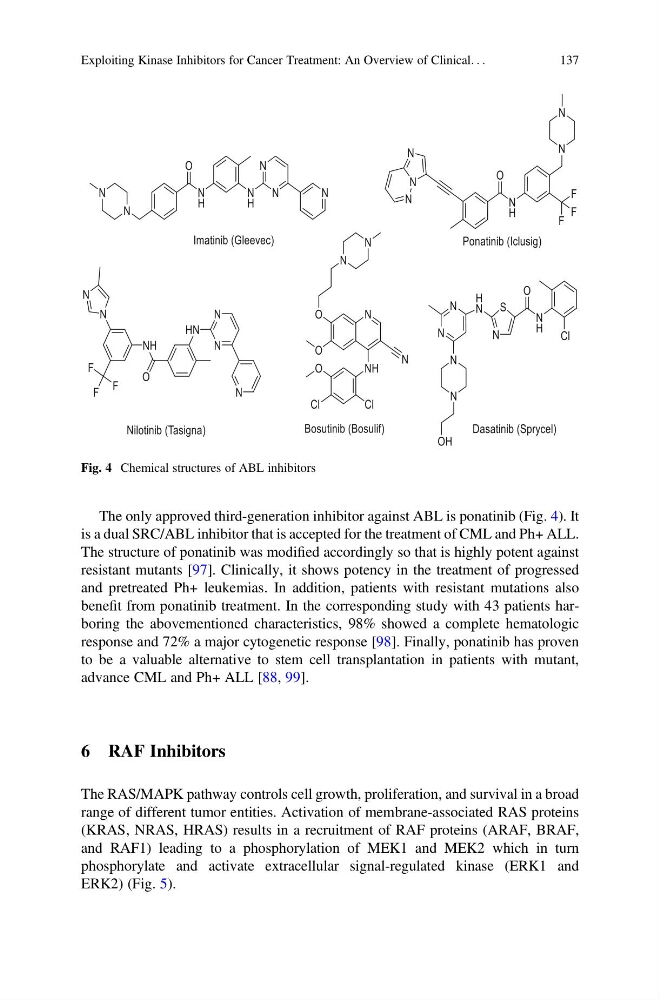
The only approved third-generation inhibitor against ABL is ponatinib (Fig. 4). It
is a dual SRC/ABL inhibitor that is accepted for the treatment of CML and Ph+ ALL.
The structure of ponatinib was modified accordingly so that is highly potent against
resistant mutants [97]. Clinically, it shows potency in the treatment of progressed
and pretreated Ph+ leukemias. In addition, patients with resistant mutations also
benefit from ponatinib treatment. In the corresponding study with 43 patients harboring the abovementioned characteristics, 98% showed a complete hematologic
response and 72% a major cytogenetic response [98]. Finally, ponatinib has proven
to be a valuable alternative to stem cell transplantation in patients with mutant,
advance CML and Ph+ ALL [88, 99].
6 RAF Inhibitors
The RAS/MAPK pathway controls cell growth, proliferation, and survival in a broad
range of different tumor entities. Activation of membrane-associated RAS proteins
(KRAS, NRAS, HRAS) results in a recruitment of RAF proteins (ARAF, BRAF,
and RAF1) leading to a phosphorylation of MEK1 and MEK2 which in turn
phosphorylate and activate extracellular signal-regulated kinase (ERK1 and
ERK2) (Fig. 5).
Fig. 4 Chemical structures of ABL inhibitors
Exploiting Kinase Inhibitors for Cancer Treatment: An Overview of Clinical. . .
137
is a dual SRC/ABL inhibitor that is accepted for the treatment of CML and Ph+ ALL.
The structure of ponatinib was modified accordingly so that is highly potent against
resistant mutants [97]. Clinically, it shows potency in the treatment of progressed
and pretreated Ph+ leukemias. In addition, patients with resistant mutations also
benefit from ponatinib treatment. In the corresponding study with 43 patients harboring the abovementioned characteristics, 98% showed a complete hematologic
response and 72% a major cytogenetic response [98]. Finally, ponatinib has proven
to be a valuable alternative to stem cell transplantation in patients with mutant,
advance CML and Ph+ ALL [88, 99].
6 RAF Inhibitors
The RAS/MAPK pathway controls cell growth, proliferation, and survival in a broad
range of different tumor entities. Activation of membrane-associated RAS proteins
(KRAS, NRAS, HRAS) results in a recruitment of RAF proteins (ARAF, BRAF,
and RAF1) leading to a phosphorylation of MEK1 and MEK2 which in turn
phosphorylate and activate extracellular signal-regulated kinase (ERK1 and
ERK2) (Fig. 5).
Fig. 4 Chemical structures of ABL inhibitors
Exploiting Kinase Inhibitors for Cancer Treatment: An Overview of Clinical. . .
137