

3. All the selectivity pocket residues in interaction with the propeller-shaped ligand
are extremely conserved across the PI3K isoforms.
To tentatively rationalize at least the unintuitive observed selectivity profile of
(S)-27 vs (R)-27, we further explored the two 3D co-structures collected with (S)-27
in PI3Kβ and PI3Kδ and embarked in molecular dynamics simulations, solvent
clustering, and statistical thermodynamic analysis using the WaterMap methodology
[81] in order to investigate the network of water molecules at the vicinity of the
ligand (<7 Å) and assess their respective entropy, enthalpy, and free energies
[82]. With this algorithm, regions of high water density are identified as “hydration
sites,” and their corresponding enthalpies and entropies are computed relative to
bulk solvent using inhomogeneous solvation theory.
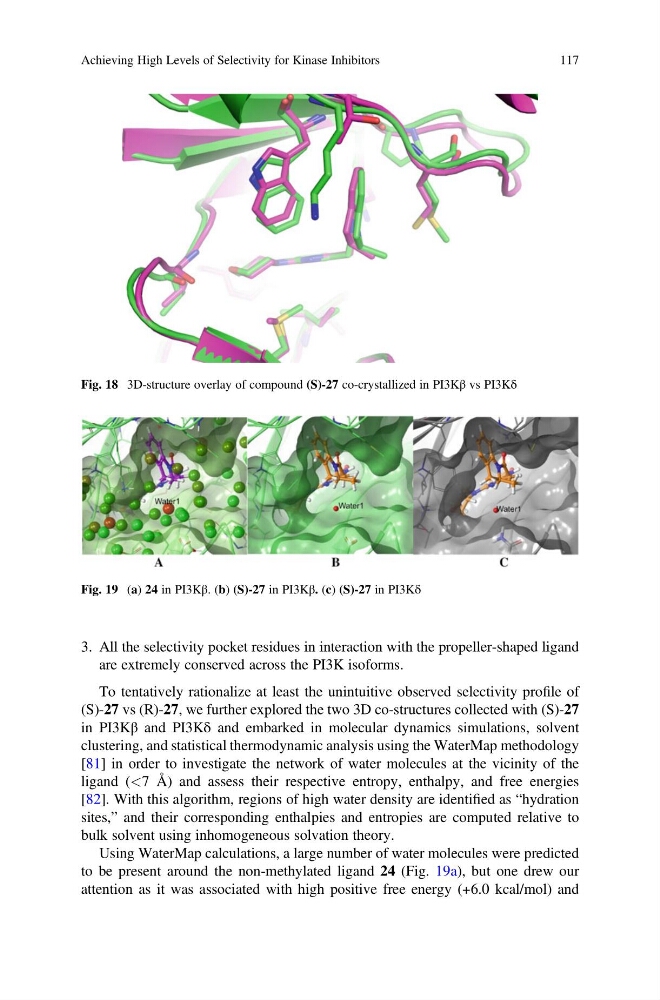
Using WaterMap calculations, a large number of water molecules were predicted
to be present around the non-methylated ligand 24 (Fig. 19a), but one drew our
attention as it was associated with high positive free energy (+6.0 kcal/mol) and
Fig. 18 3D-structure overlay of compound (S)-27 co-crystallized in PI3Kβ vs PI3Kδ
Fig. 19 (a) 24 in PI3Kβ. (b) (S)-27 in PI3Kβ. (c) (S)-27 in PI3Kδ
Achieving High Levels of Selectivity for Kinase Inhibitors
117
are extremely conserved across the PI3K isoforms.
To tentatively rationalize at least the unintuitive observed selectivity profile of
(S)-27 vs (R)-27, we further explored the two 3D co-structures collected with (S)-27
in PI3Kβ and PI3Kδ and embarked in molecular dynamics simulations, solvent
clustering, and statistical thermodynamic analysis using the WaterMap methodology
[81] in order to investigate the network of water molecules at the vicinity of the
ligand (<7 Å) and assess their respective entropy, enthalpy, and free energies
[82]. With this algorithm, regions of high water density are identified as “hydration
sites,” and their corresponding enthalpies and entropies are computed relative to
bulk solvent using inhomogeneous solvation theory.
Using WaterMap calculations, a large number of water molecules were predicted
to be present around the non-methylated ligand 24 (Fig. 19a), but one drew our
attention as it was associated with high positive free energy (+6.0 kcal/mol) and
Fig. 18 3D-structure overlay of compound (S)-27 co-crystallized in PI3Kβ vs PI3Kδ
Fig. 19 (a) 24 in PI3Kβ. (b) (S)-27 in PI3Kβ. (c) (S)-27 in PI3Kδ
Achieving High Levels of Selectivity for Kinase Inhibitors
117