

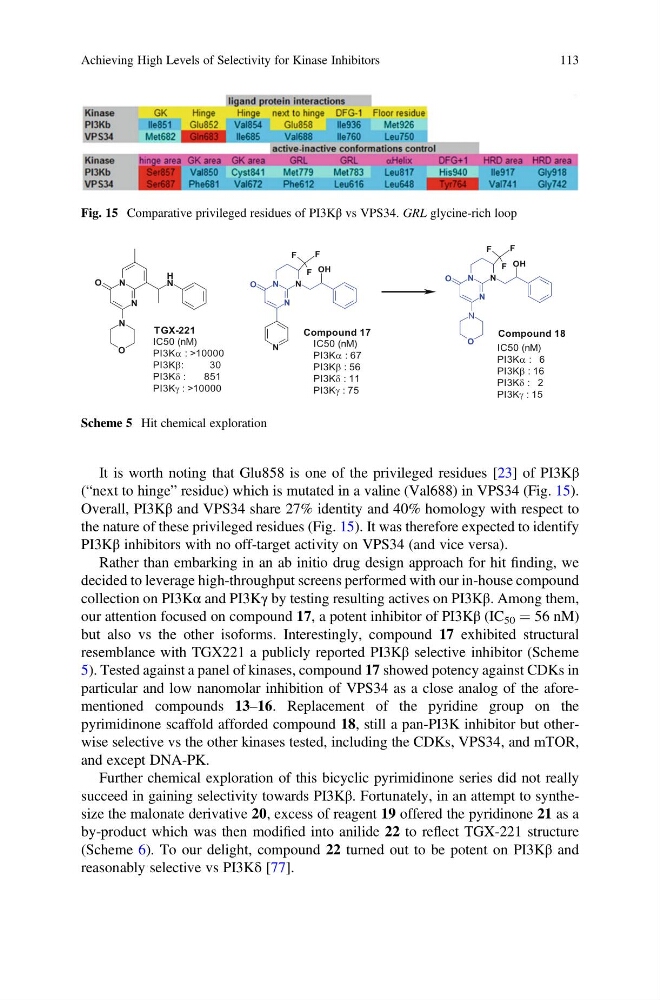
It is worth noting that Glu858 is one of the privileged residues [23] of PI3Kβ
(“next to hinge” residue) which is mutated in a valine (Val688) in VPS34 (Fig. 15).
Overall, PI3Kβ and VPS34 share 27% identity and 40% homology with respect to
the nature of these privileged residues (Fig. 15). It was therefore expected to identify
PI3Kβ inhibitors with no off-target activity on VPS34 (and vice versa).
Rather than embarking in an ab initio drug design approach for hit finding, we
decided to leverage high-throughput screens performed with our in-house compound
collection on PI3Kα and PI3Kγ by testing resulting actives on PI3Kβ. Among them,
our attention focused on compound 17, a potent inhibitor of PI3Kβ (IC 50 ¼ 56 nM)
but also vs the other isoforms. Interestingly, compound 17 exhibited structural
resemblance with TGX221 a publicly reported PI3Kβ selective inhibitor (Scheme
5). Tested against a panel of kinases, compound 17 showed potency against CDKs in
particular and low nanomolar inhibition of VPS34 as a close analog of the aforementioned compounds 13–16. Replacement of the pyridine group on the
pyrimidinone scaffold afforded compound 18, still a pan-PI3K inhibitor but otherwise selective vs the other kinases tested, including the CDKs, VPS34, and mTOR,
and except DNA-PK.
Further chemical exploration of this bicyclic pyrimidinone series did not really
succeed in gaining selectivity towards PI3Kβ. Fortunately, in an attempt to synthesize the malonate derivative 20, excess of reagent 19 offered the pyridinone 21 as a
by-product which was then modified into anilide 22 to reflect TGX-221 structure
(Scheme 6). To our delight, compound 22 turned out to be potent on PI3Kβ and
reasonably selective vs PI3Kδ [77].
Fig. 15 Comparative privileged residues of PI3Kβ vs VPS34. GRL glycine-rich loop
TGX-221
Compound 17
IC50 (nM)
PI3Kα : >10000
PI3Kβ:
30
PI3Kδ :
851
PI3Kγ : >10000
Compound 18
IC50 (nM)
PI3Kα : 6
PI3Kβ : 16
PI3Kδ : 2
PI3Kγ : 15
IC50 (nM)
PI3Kα : 67
PI3Kβ : 56
PI3Kδ : 11
PI3Kγ : 75
OH
N
N
O
N
O
N
F
F
F
O
N
N
H
O
N
N
OH
N
N
O
N
N
F
F
F
Scheme 5 Hit chemical exploration
Achieving High Levels of Selectivity for Kinase Inhibitors
113
(“next to hinge” residue) which is mutated in a valine (Val688) in VPS34 (Fig. 15).
Overall, PI3Kβ and VPS34 share 27% identity and 40% homology with respect to
the nature of these privileged residues (Fig. 15). It was therefore expected to identify
PI3Kβ inhibitors with no off-target activity on VPS34 (and vice versa).
Rather than embarking in an ab initio drug design approach for hit finding, we
decided to leverage high-throughput screens performed with our in-house compound
collection on PI3Kα and PI3Kγ by testing resulting actives on PI3Kβ. Among them,
our attention focused on compound 17, a potent inhibitor of PI3Kβ (IC 50 ¼ 56 nM)
but also vs the other isoforms. Interestingly, compound 17 exhibited structural
resemblance with TGX221 a publicly reported PI3Kβ selective inhibitor (Scheme
5). Tested against a panel of kinases, compound 17 showed potency against CDKs in
particular and low nanomolar inhibition of VPS34 as a close analog of the aforementioned compounds 13–16. Replacement of the pyridine group on the
pyrimidinone scaffold afforded compound 18, still a pan-PI3K inhibitor but otherwise selective vs the other kinases tested, including the CDKs, VPS34, and mTOR,
and except DNA-PK.
Further chemical exploration of this bicyclic pyrimidinone series did not really
succeed in gaining selectivity towards PI3Kβ. Fortunately, in an attempt to synthesize the malonate derivative 20, excess of reagent 19 offered the pyridinone 21 as a
by-product which was then modified into anilide 22 to reflect TGX-221 structure
(Scheme 6). To our delight, compound 22 turned out to be potent on PI3Kβ and
reasonably selective vs PI3Kδ [77].
Fig. 15 Comparative privileged residues of PI3Kβ vs VPS34. GRL glycine-rich loop
TGX-221
Compound 17
IC50 (nM)
PI3Kα : >10000
PI3Kβ:
30
PI3Kδ :
851
PI3Kγ : >10000
Compound 18
IC50 (nM)
PI3Kα : 6
PI3Kβ : 16
PI3Kδ : 2
PI3Kγ : 15
IC50 (nM)
PI3Kα : 67
PI3Kβ : 56
PI3Kδ : 11
PI3Kγ : 75
OH
N
N
O
N
O
N
F
F
F
O
N
N
H
O
N
N
OH
N
N
O
N
N
F
F
F
Scheme 5 Hit chemical exploration
Achieving High Levels of Selectivity for Kinase Inhibitors
113