

tumor suppressor PTEN gene. Both PIK3CA somatic mutation and PTEN deletions
are in general mutually exclusive [70]. PTEN-deficient cell lines have been demonstrated to depend on PI3Kβ activity as downregulation of the PIK3CB gene by
shRNA led to cell growth and tumor growth inhibitions correlated with pAKT
inhibition. In those cells, PIK3CA gene inhibition induced no effect regarding
phosphorylation of AKT 473-residue [71].
As PTEN is deficient in many cancers including the most prevalent ones and
those associated with the lowest survival rates (e.g., 23% occurrence in lung, 35% in
colon, and 47% in gastric cancers) [72], it was relevant to engage a discovery
program to identify selective PI3Kβ inhibitors, expecting a superior safety profile
for such agents compared to the generation of pan-PI3K inhibitors which exhibited
limiting adverse effects in clinical settings [73].
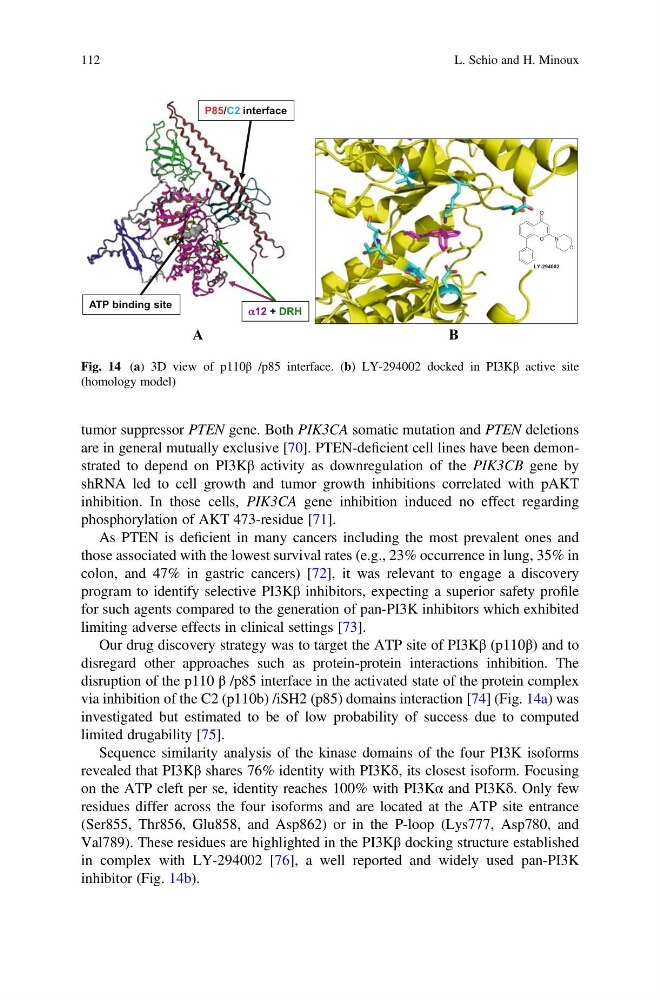
Our drug discovery strategy was to target the ATP site of PI3Kβ (p110β) and to
disregard other approaches such as protein-protein interactions inhibition. The
disruption of the p110 β /p85 interface in the activated state of the protein complex
via inhibition of the C2 (p110b) /iSH2 (p85) domains interaction [74] (Fig. 14a) was
investigated but estimated to be of low probability of success due to computed
limited drugability [75].
Sequence similarity analysis of the kinase domains of the four PI3K isoforms
revealed that PI3Kβ shares 76% identity with PI3Kδ, its closest isoform. Focusing
on the ATP cleft per se, identity reaches 100% with PI3Kα and PI3Kδ. Only few
residues differ across the four isoforms and are located at the ATP site entrance
(Ser855, Thr856, Glu858, and Asp862) or in the P-loop (Lys777, Asp780, and
Val789). These residues are highlighted in the PI3Kβ docking structure established
in complex with LY-294002 [76], a well reported and widely used pan-PI3K
inhibitor (Fig. 14b).
ATP binding site
P85/C2 interface
α12 + DRH
O
O
N
O
LY-294002
A
B
Fig. 14 (a) 3D view of p110β /p85 interface. (b) LY-294002 docked in PI3Kβ active site
(homology model)
112
L. Schio and H. Minoux
are in general mutually exclusive [70]. PTEN-deficient cell lines have been demonstrated to depend on PI3Kβ activity as downregulation of the PIK3CB gene by
shRNA led to cell growth and tumor growth inhibitions correlated with pAKT
inhibition. In those cells, PIK3CA gene inhibition induced no effect regarding
phosphorylation of AKT 473-residue [71].
As PTEN is deficient in many cancers including the most prevalent ones and
those associated with the lowest survival rates (e.g., 23% occurrence in lung, 35% in
colon, and 47% in gastric cancers) [72], it was relevant to engage a discovery
program to identify selective PI3Kβ inhibitors, expecting a superior safety profile
for such agents compared to the generation of pan-PI3K inhibitors which exhibited
limiting adverse effects in clinical settings [73].
Our drug discovery strategy was to target the ATP site of PI3Kβ (p110β) and to
disregard other approaches such as protein-protein interactions inhibition. The
disruption of the p110 β /p85 interface in the activated state of the protein complex
via inhibition of the C2 (p110b) /iSH2 (p85) domains interaction [74] (Fig. 14a) was
investigated but estimated to be of low probability of success due to computed
limited drugability [75].
Sequence similarity analysis of the kinase domains of the four PI3K isoforms
revealed that PI3Kβ shares 76% identity with PI3Kδ, its closest isoform. Focusing
on the ATP cleft per se, identity reaches 100% with PI3Kα and PI3Kδ. Only few
residues differ across the four isoforms and are located at the ATP site entrance
(Ser855, Thr856, Glu858, and Asp862) or in the P-loop (Lys777, Asp780, and
Val789). These residues are highlighted in the PI3Kβ docking structure established
in complex with LY-294002 [76], a well reported and widely used pan-PI3K
inhibitor (Fig. 14b).
ATP binding site
P85/C2 interface
α12 + DRH
O
O
N
O
LY-294002
A
B
Fig. 14 (a) 3D view of p110β /p85 interface. (b) LY-294002 docked in PI3Kβ active site
(homology model)
112
L. Schio and H. Minoux