

4 Design of Specific VPS34 Inhibitors for Autophagy
Blockade in Tumors
VPS34 (also known as PIK3C3) is a lipid kinase of the class III PI3K
(phosphoinositide 3-kinases) isoform which specifically catalyzes the phosphorylation of phosphatidylinositol (PtdIns) generating (PtdIns)3P [57]. VPS34 is the
catalytic subunit of different complexes which associates the regulatory subunit
Vps15 (also known as p150) for activity and several accessory subunits. Vps15 is
myristoylated allowing the VPS34 protein complex to be anchored to intracellular
membranes. Membrane-bound PtdIns3P binds to proteins which are involved in the
formation of autophagosomes and participate also in endosomal trafficking from
early to late endosomes [58, 59].
VPS34 plays an active role in the autophagy process by which cells adapt to
protect themselves from metabolic stresses and hypoxic conditions. Autophagy is
thought to be a process by which cancer cells develop resistance against chemotherapy and radiotherapy treatments. VPS34 has hence emerged as a new promising
approach for cancer treatment as a single agent or in combination and recently as a
target for insulin resistance in type 2 diabetes [60].
At the time we embarked in a drug discovery project in this field, no selective
VPS34 inhibitors were known in the literature [61], and research studies were
reported with pan PI3K inhibitors reflecting the high similarity in sequences between
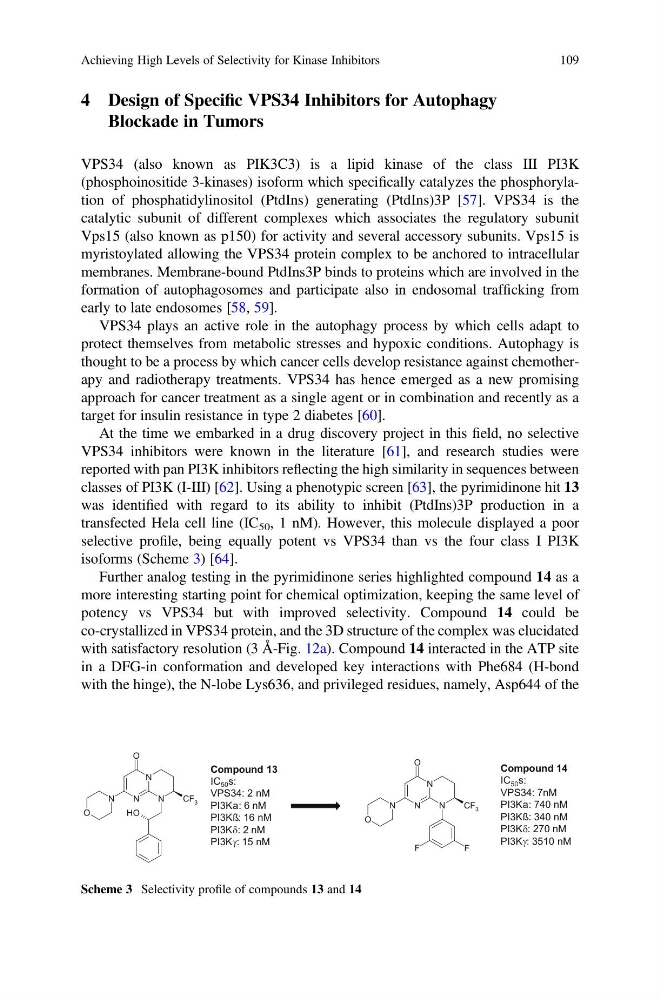
classes of PI3K (I-III) [62]. Using a phenotypic screen [63], the pyrimidinone hit 13
was identified with regard to its ability to inhibit (PtdIns)3P production in a
transfected Hela cell line (IC 50 , 1 nM). However, this molecule displayed a poor
selective profile, being equally potent vs VPS34 than vs the four class I PI3K
isoforms (Scheme 3) [64].
Further analog testing in the pyrimidinone series highlighted compound 14 as a
more interesting starting point for chemical optimization, keeping the same level of
potency vs VPS34 but with improved selectivity. Compound 14 could be
co-crystallized in VPS34 protein, and the 3D structure of the complex was elucidated
with satisfactory resolution (3 Å-Fig. 12a). Compound 14 interacted in the ATP site
in a DFG-in conformation and developed key interactions with Phe684 (H-bond
with the hinge), the N-lobe Lys636, and privileged residues, namely, Asp644 of the
N
N
N
O
N
O
CF 3
O
H
N
N
N
O
N
O
CF 3
F
F
Compound 13
IC 50 s:
VPS34: 2 nM
PI3Ka: 6 nM
PI3Kß: 16 nM
PI3Kδ: 2 nM
PI3Kγ: 15 nM
Compound 14
IC 50 s:
VPS34: 7nM
PI3Ka: 740 nM
PI3Kß: 340 nM
PI3Kδ: 270 nM
PI3Kγ: 3510 nM
Scheme 3 Selectivity profile of compounds 13 and 14
Achieving High Levels of Selectivity for Kinase Inhibitors
109
Blockade in Tumors
VPS34 (also known as PIK3C3) is a lipid kinase of the class III PI3K
(phosphoinositide 3-kinases) isoform which specifically catalyzes the phosphorylation of phosphatidylinositol (PtdIns) generating (PtdIns)3P [57]. VPS34 is the
catalytic subunit of different complexes which associates the regulatory subunit
Vps15 (also known as p150) for activity and several accessory subunits. Vps15 is
myristoylated allowing the VPS34 protein complex to be anchored to intracellular
membranes. Membrane-bound PtdIns3P binds to proteins which are involved in the
formation of autophagosomes and participate also in endosomal trafficking from
early to late endosomes [58, 59].
VPS34 plays an active role in the autophagy process by which cells adapt to
protect themselves from metabolic stresses and hypoxic conditions. Autophagy is
thought to be a process by which cancer cells develop resistance against chemotherapy and radiotherapy treatments. VPS34 has hence emerged as a new promising
approach for cancer treatment as a single agent or in combination and recently as a
target for insulin resistance in type 2 diabetes [60].
At the time we embarked in a drug discovery project in this field, no selective
VPS34 inhibitors were known in the literature [61], and research studies were
reported with pan PI3K inhibitors reflecting the high similarity in sequences between
classes of PI3K (I-III) [62]. Using a phenotypic screen [63], the pyrimidinone hit 13
was identified with regard to its ability to inhibit (PtdIns)3P production in a
transfected Hela cell line (IC 50 , 1 nM). However, this molecule displayed a poor
selective profile, being equally potent vs VPS34 than vs the four class I PI3K
isoforms (Scheme 3) [64].
Further analog testing in the pyrimidinone series highlighted compound 14 as a
more interesting starting point for chemical optimization, keeping the same level of
potency vs VPS34 but with improved selectivity. Compound 14 could be
co-crystallized in VPS34 protein, and the 3D structure of the complex was elucidated
with satisfactory resolution (3 Å-Fig. 12a). Compound 14 interacted in the ATP site
in a DFG-in conformation and developed key interactions with Phe684 (H-bond
with the hinge), the N-lobe Lys636, and privileged residues, namely, Asp644 of the
N
N
N
O
N
O
CF 3
O
H
N
N
N
O
N
O
CF 3
F
F
Compound 13
IC 50 s:
VPS34: 2 nM
PI3Ka: 6 nM
PI3Kß: 16 nM
PI3Kδ: 2 nM
PI3Kγ: 15 nM
Compound 14
IC 50 s:
VPS34: 7nM
PI3Ka: 740 nM
PI3Kß: 340 nM
PI3Kδ: 270 nM
PI3Kγ: 3510 nM
Scheme 3 Selectivity profile of compounds 13 and 14
Achieving High Levels of Selectivity for Kinase Inhibitors
109