

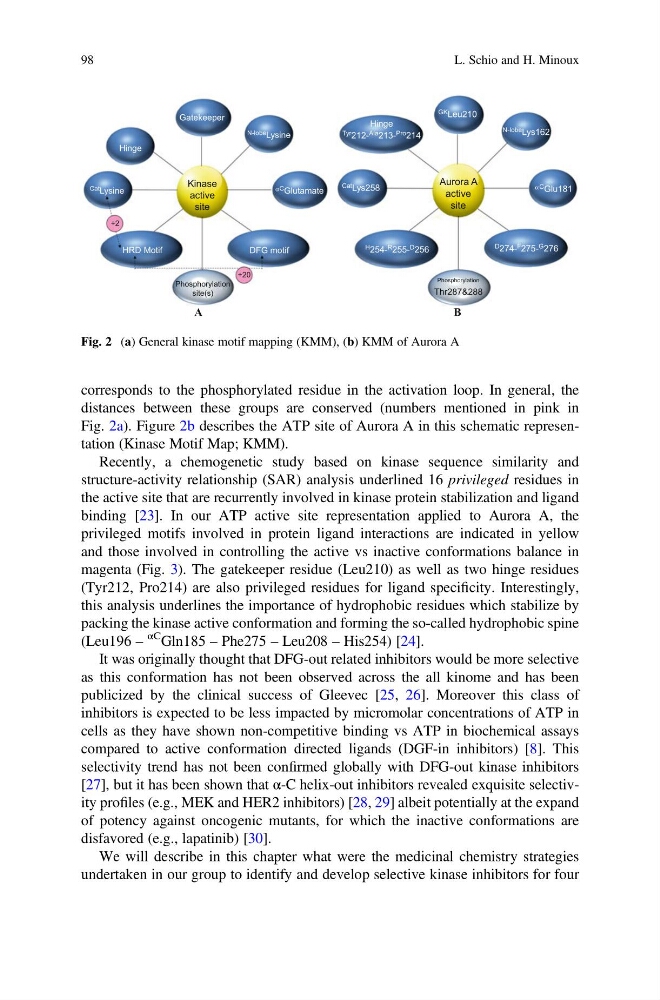
corresponds to the phosphorylated residue in the activation loop. In general, the
distances between these groups are conserved (numbers mentioned in pink in
Fig. 2a). Figure 2b describes the ATP site of Aurora A in this schematic representation (Kinase Motif Map; KMM).
Recently, a chemogenetic study based on kinase sequence similarity and
structure-activity relationship (SAR) analysis underlined 16 privileged residues in
the active site that are recurrently involved in kinase protein stabilization and ligand
binding [23]. In our ATP active site representation applied to Aurora A, the
privileged motifs involved in protein ligand interactions are indicated in yellow
and those involved in controlling the active vs inactive conformations balance in
magenta (Fig. 3). The gatekeeper residue (Leu210) as well as two hinge residues
(Tyr212, Pro214) are also privileged residues for ligand specificity. Interestingly,
this analysis underlines the importance of hydrophobic residues which stabilize by
packing the kinase active conformation and forming the so-called hydrophobic spine
(Leu196 –
αC Gln185 – Phe275 – Leu208 – His254) [24].
It was originally thought that DFG-out related inhibitors would be more selective
as this conformation has not been observed across the all kinome and has been
publicized by the clinical success of Gleevec [25, 26]. Moreover this class of
inhibitors is expected to be less impacted by micromolar concentrations of ATP in
cells as they have shown non-competitive binding vs ATP in biochemical assays
compared to active conformation directed ligands (DGF-in inhibitors) [8]. This
selectivity trend has not been confirmed globally with DFG-out kinase inhibitors
[27], but it has been shown that α-C helix-out inhibitors revealed exquisite selectivity profiles (e.g., MEK and HER2 inhibitors) [28, 29] albeit potentially at the expand
of potency against oncogenic mutants, for which the inactive conformations are
disfavored (e.g., lapatinib) [30].
We will describe in this chapter what were the medicinal chemistry strategies
undertaken in our group to identify and develop selective kinase inhibitors for four
A
B
DFG motif
C Glutamate
N-lobe Lysine
Gatekeeper
HRD Motif
Cat Lysine
Phosphorylation
site(s)
Kinase
active
site
Hinge
+2
+20
D 274- F 275- G 276
C Glu181
N-lobe Lys162
GK Leu210
H 254- R 255- D 256
Cat Lys258
Tyr 212- Ala 213- Pro 214
Hinge
Phosphorylation
Thr287&288
Aurora A
active
site
Fig. 2 (a) General kinase motif mapping (KMM), (b) KMM of Aurora A
98
L. Schio and H. Minoux
distances between these groups are conserved (numbers mentioned in pink in
Fig. 2a). Figure 2b describes the ATP site of Aurora A in this schematic representation (Kinase Motif Map; KMM).
Recently, a chemogenetic study based on kinase sequence similarity and
structure-activity relationship (SAR) analysis underlined 16 privileged residues in
the active site that are recurrently involved in kinase protein stabilization and ligand
binding [23]. In our ATP active site representation applied to Aurora A, the
privileged motifs involved in protein ligand interactions are indicated in yellow
and those involved in controlling the active vs inactive conformations balance in
magenta (Fig. 3). The gatekeeper residue (Leu210) as well as two hinge residues
(Tyr212, Pro214) are also privileged residues for ligand specificity. Interestingly,
this analysis underlines the importance of hydrophobic residues which stabilize by
packing the kinase active conformation and forming the so-called hydrophobic spine
(Leu196 –
αC Gln185 – Phe275 – Leu208 – His254) [24].
It was originally thought that DFG-out related inhibitors would be more selective
as this conformation has not been observed across the all kinome and has been
publicized by the clinical success of Gleevec [25, 26]. Moreover this class of
inhibitors is expected to be less impacted by micromolar concentrations of ATP in
cells as they have shown non-competitive binding vs ATP in biochemical assays
compared to active conformation directed ligands (DGF-in inhibitors) [8]. This
selectivity trend has not been confirmed globally with DFG-out kinase inhibitors
[27], but it has been shown that α-C helix-out inhibitors revealed exquisite selectivity profiles (e.g., MEK and HER2 inhibitors) [28, 29] albeit potentially at the expand
of potency against oncogenic mutants, for which the inactive conformations are
disfavored (e.g., lapatinib) [30].
We will describe in this chapter what were the medicinal chemistry strategies
undertaken in our group to identify and develop selective kinase inhibitors for four
A
B
DFG motif
C Glutamate
N-lobe Lysine
Gatekeeper
HRD Motif
Cat Lysine
Phosphorylation
site(s)
Kinase
active
site
Hinge
+2
+20
D 274- F 275- G 276
C Glu181
N-lobe Lys162
GK Leu210
H 254- R 255- D 256
Cat Lys258
Tyr 212- Ala 213- Pro 214
Hinge
Phosphorylation
Thr287&288
Aurora A
active
site
Fig. 2 (a) General kinase motif mapping (KMM), (b) KMM of Aurora A
98
L. Schio and H. Minoux