

8.5 Chemisorption of Hydrogen and Metallic Nanomaterials
89
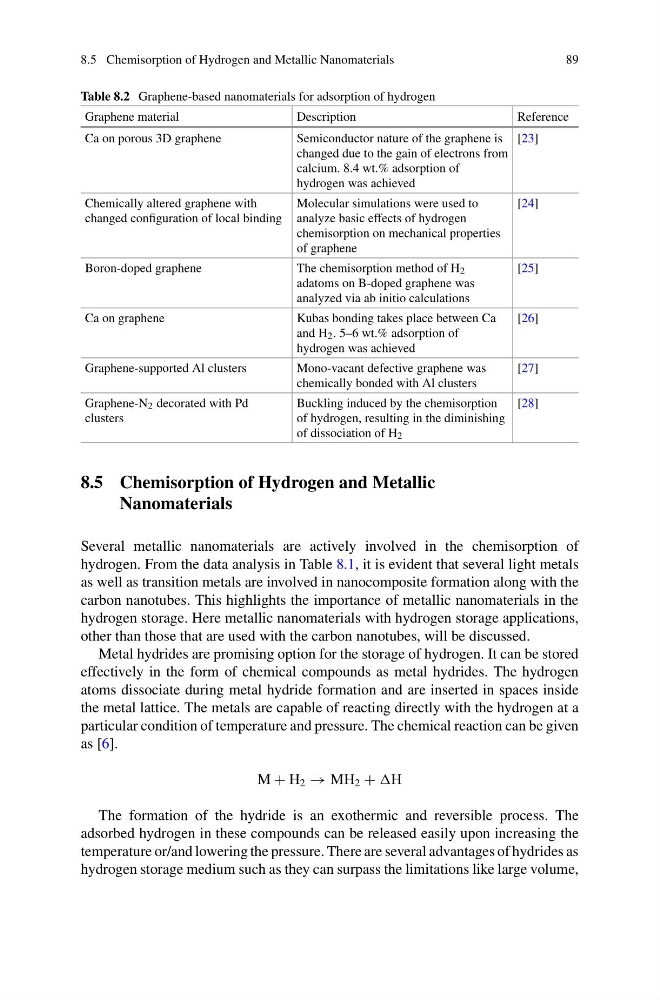
Table 8.2 Graphene-based nanomaterials for adsorption of hydrogen
Graphene material
Description
Reference
Ca on porous 3D graphene
Semiconductor nature of the graphene is
changed due to the gain of electrons from
calcium. 8.4 wt.% adsorption of
hydrogen was achieved
[23]
Chemically altered graphene with
changed configuration of local binding
Molecular simulations were used to
analyze basic effects of hydrogen
chemisorption on mechanical properties
of graphene
[24]
Boron-doped graphene
The chemisorption method of H 2
adatoms on B-doped graphene was
analyzed via ab initio calculations
[25]
Ca on graphene
Kubas bonding takes place between Ca
and H 2 . 5–6 wt.% adsorption of
hydrogen was achieved
[26]
Graphene-supported Al clusters
Mono-vacant defective graphene was
chemically bonded with Al clusters
[27]
Graphene-N 2 decorated with Pd
clusters
Buckling induced by the chemisorption
of hydrogen, resulting in the diminishing
of dissociation of H 2
[28]
8.5 Chemisorption of Hydrogen and Metallic
Nanomaterials
Several metallic nanomaterials are actively involved in the chemisorption of
hydrogen. From the data analysis in Table 8.1, it is evident that several light metals
as well as transition metals are involved in nanocomposite formation along with the
carbon nanotubes. This highlights the importance of metallic nanomaterials in the
hydrogen storage. Here metallic nanomaterials with hydrogen storage applications,
other than those that are used with the carbon nanotubes, will be discussed.
Metal hydrides are promising option for the storage of hydrogen. It can be stored
effectively in the form of chemical compounds as metal hydrides. The hydrogen
atoms dissociate during metal hydride formation and are inserted in spaces inside
the metal lattice. The metals are capable of reacting directly with the hydrogen at a
particular condition of temperature and pressure. The chemical reaction can be given
as [6].
M + H 2 → MH 2 + H
The formation of the hydride is an exothermic and reversible process. The
adsorbed hydrogen in these compounds can be released easily upon increasing the
temperature or/and lowering the pressure. There are several advantages of hydrides as
hydrogen storage medium such as they can surpass the limitations like large volume,
89
Table 8.2 Graphene-based nanomaterials for adsorption of hydrogen
Graphene material
Description
Reference
Ca on porous 3D graphene
Semiconductor nature of the graphene is
changed due to the gain of electrons from
calcium. 8.4 wt.% adsorption of
hydrogen was achieved
[23]
Chemically altered graphene with
changed configuration of local binding
Molecular simulations were used to
analyze basic effects of hydrogen
chemisorption on mechanical properties
of graphene
[24]
Boron-doped graphene
The chemisorption method of H 2
adatoms on B-doped graphene was
analyzed via ab initio calculations
[25]
Ca on graphene
Kubas bonding takes place between Ca
and H 2 . 5–6 wt.% adsorption of
hydrogen was achieved
[26]
Graphene-supported Al clusters
Mono-vacant defective graphene was
chemically bonded with Al clusters
[27]
Graphene-N 2 decorated with Pd
clusters
Buckling induced by the chemisorption
of hydrogen, resulting in the diminishing
of dissociation of H 2
[28]
8.5 Chemisorption of Hydrogen and Metallic
Nanomaterials
Several metallic nanomaterials are actively involved in the chemisorption of
hydrogen. From the data analysis in Table 8.1, it is evident that several light metals
as well as transition metals are involved in nanocomposite formation along with the
carbon nanotubes. This highlights the importance of metallic nanomaterials in the
hydrogen storage. Here metallic nanomaterials with hydrogen storage applications,
other than those that are used with the carbon nanotubes, will be discussed.
Metal hydrides are promising option for the storage of hydrogen. It can be stored
effectively in the form of chemical compounds as metal hydrides. The hydrogen
atoms dissociate during metal hydride formation and are inserted in spaces inside
the metal lattice. The metals are capable of reacting directly with the hydrogen at a
particular condition of temperature and pressure. The chemical reaction can be given
as [6].
M + H 2 → MH 2 + H
The formation of the hydride is an exothermic and reversible process. The
adsorbed hydrogen in these compounds can be released easily upon increasing the
temperature or/and lowering the pressure. There are several advantages of hydrides as
hydrogen storage medium such as they can surpass the limitations like large volume,