

88
8 Chemisorption
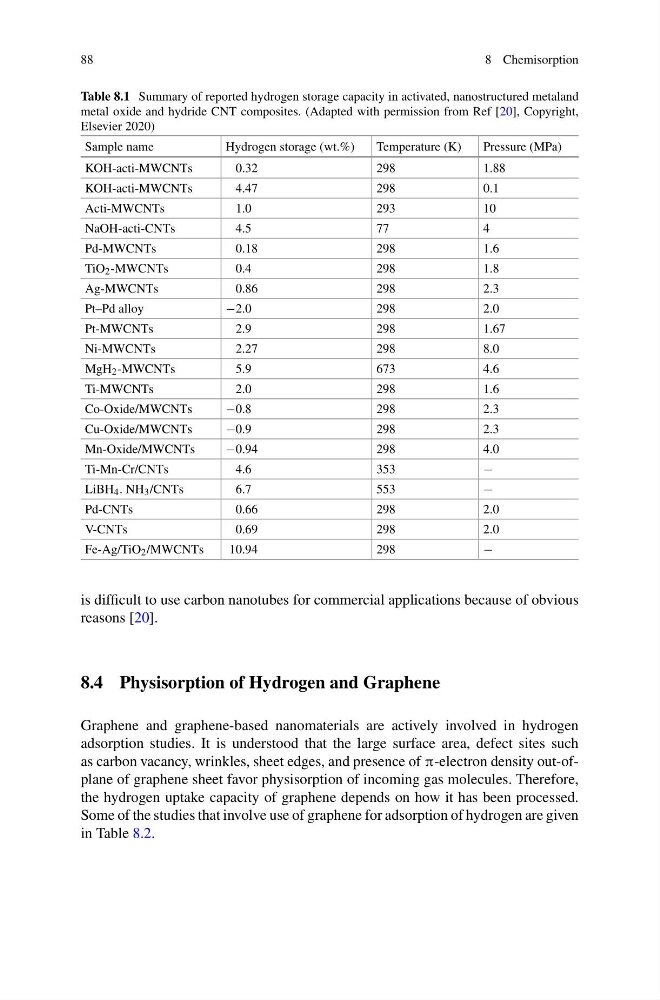
Table 8.1 Summary of reported hydrogen storage capacity in activated, nanostructured metaland
metal oxide and hydride CNT composites. (Adapted with permission from Ref [20], Copyright,
Elsevier 2020)
Sample name
Hydrogen storage (wt.%)
Temperature (K)
Pressure (MPa)
KOH-acti-MWCNTs
0.32
298
1.88
KOH-acti-MWCNTs
4.47
298
0.1
Acti-MWCNTs
1.0
293
10
NaOH-acti-CNTs
4.5
77
4
Pd-MWCNTs
0.18
298
1.6
TiO 2 -MWCNTs
0.4
298
1.8
Ag-MWCNTs
0.86
298
2.3
Pt–Pd alloy
−2.0
298
2.0
Pt-MWCNTs
2.9
298
1.67
Ni-MWCNTs
2.27
298
8.0
MgH 2 -MWCNTs
5.9
673
4.6
Ti-MWCNTs
2.0
298
1.6
Co-Oxide/MWCNTs
−0.8
298
2.3
Cu-Oxide/MWCNTs
−0.9
298
2.3
Mn-Oxide/MWCNTs
−0.94
298
4.0
Ti-Mn-Cr/CNTs
4.6
353
−
LiBH 4 . NH 3 /CNTs
6.7
553
−
Pd-CNTs
0.66
298
2.0
V-CNTs
0.69
298
2.0
Fe-Ag/TiO 2 /MWCNTs
10.94
298
−
is difficult to use carbon nanotubes for commercial applications because of obvious
reasons [20].
8.4 Physisorption of Hydrogen and Graphene
Graphene and graphene-based nanomaterials are actively involved in hydrogen
adsorption studies. It is understood that the large surface area, defect sites such
as carbon vacancy, wrinkles, sheet edges, and presence of π-electron density out-ofplane of graphene sheet favor physisorption of incoming gas molecules. Therefore,
the hydrogen uptake capacity of graphene depends on how it has been processed.
Some of the studies that involve use of graphene for adsorption of hydrogen are given
in Table 8.2.
8 Chemisorption
Table 8.1 Summary of reported hydrogen storage capacity in activated, nanostructured metaland
metal oxide and hydride CNT composites. (Adapted with permission from Ref [20], Copyright,
Elsevier 2020)
Sample name
Hydrogen storage (wt.%)
Temperature (K)
Pressure (MPa)
KOH-acti-MWCNTs
0.32
298
1.88
KOH-acti-MWCNTs
4.47
298
0.1
Acti-MWCNTs
1.0
293
10
NaOH-acti-CNTs
4.5
77
4
Pd-MWCNTs
0.18
298
1.6
TiO 2 -MWCNTs
0.4
298
1.8
Ag-MWCNTs
0.86
298
2.3
Pt–Pd alloy
−2.0
298
2.0
Pt-MWCNTs
2.9
298
1.67
Ni-MWCNTs
2.27
298
8.0
MgH 2 -MWCNTs
5.9
673
4.6
Ti-MWCNTs
2.0
298
1.6
Co-Oxide/MWCNTs
−0.8
298
2.3
Cu-Oxide/MWCNTs
−0.9
298
2.3
Mn-Oxide/MWCNTs
−0.94
298
4.0
Ti-Mn-Cr/CNTs
4.6
353
−
LiBH 4 . NH 3 /CNTs
6.7
553
−
Pd-CNTs
0.66
298
2.0
V-CNTs
0.69
298
2.0
Fe-Ag/TiO 2 /MWCNTs
10.94
298
−
is difficult to use carbon nanotubes for commercial applications because of obvious
reasons [20].
8.4 Physisorption of Hydrogen and Graphene
Graphene and graphene-based nanomaterials are actively involved in hydrogen
adsorption studies. It is understood that the large surface area, defect sites such
as carbon vacancy, wrinkles, sheet edges, and presence of π-electron density out-ofplane of graphene sheet favor physisorption of incoming gas molecules. Therefore,
the hydrogen uptake capacity of graphene depends on how it has been processed.
Some of the studies that involve use of graphene for adsorption of hydrogen are given
in Table 8.2.